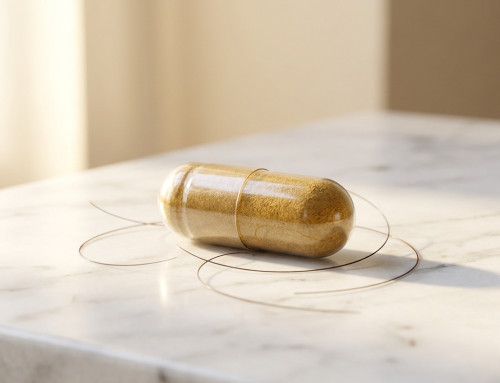

Hair Loss Pill Ingredient Breakdown: Doses, Mechanisms & Clinical Evidence
Most men researching hair loss pills run into the same wall. They find endless ingredient lists with no context: no doses, no mechanisms, and no honest assessment of which ingredients actually work. A label reads like a promise, but a promise without a validated dose is just marketing. In a field where results depend on precision, that gap matters enormously.
This article closes that gap. It is a forensic-level audit of every ingredient in a modern 4-in-1 hair loss capsule: oral minoxidil 2.5 mg, dutasteride 0.5 mg, biotin 1 mg, and vitamin D3 600 IU. Each ingredient is examined on four fronts: what it is, the exact clinical dose, how it works, and what the evidence actually shows.
Due diligence is no longer optional. The 2025 FDA warning on compounded topical finasteride and the 2025 European Medicines Agency ruling on suicidality have made ingredient scrutiny a requirement, not a luxury. Men deserve straight answers before starting any prescription treatment.
To keep the analysis honest, this article uses a simple evidence-tier framework:
- Tier 1: FDA-approved actives with decades of clinical data
- Tier 2: Off-label prescriptions backed by strong randomized controlled trials (RCTs)
- Tier 3: Nutraceuticals with moderate clinical evidence
- Tier 4: Ingredients supported only by in vitro or animal data
One theme runs through everything that follows: the dose is the drug. The right ingredient at the wrong dose is a placebo. Prescription actives and over-the-counter nutraceuticals are covered separately, with honest assessments of what each can and cannot do.
Why the Dose Is the Drug: Understanding How Hair Loss Pills Actually Work
Androgenetic alopecia (AGA), or male pattern baldness, affects roughly 50% of men by their fifth decade. Its primary driver is dihydrotestosterone (DHT), a hormone that gradually shrinks hair follicles until they stop producing visible hair. The psychological toll is well documented, and the biology is relentless.
Any effective hair loss pill must address two mechanisms at once:
- Suppress DHT production at the follicle level to halt miniaturization
- Stimulate follicular blood flow and growth signaling to encourage regrowth
Here is where dose becomes decisive. Every clinically validated ingredient has a threshold below which it simply does not work. An underdosed active does not produce weaker results; it often produces no results at all. This is the single most overlooked truth in hair loss marketing.
There is also a critical regulatory distinction. Prescription actives require licensed provider approval and have proven themselves in Phase III randomized controlled trials. Over-the-counter nutraceuticals are regulated by the FDA as foods, not drugs, which means they are not required to prove efficacy or safety before going to market.
The strongest results come from combination therapy. Pairing a DHT blocker with a follicle stimulator produces synergistic outcomes, with improvement rates reaching up to 94% compared with 59 to 80% for single-agent treatments. With that foundation established, the following sections provide an ingredient-by-ingredient breakdown.
Ingredient #1: Oral Minoxidil 2.5 mg — The Follicle Stimulator
Regulatory status: Topical minoxidil has been FDA-approved since 1988. Oral minoxidil for hair loss remains an off-label prescription use in the United States.
Mechanism: Minoxidil widens blood vessels and opens potassium channels, delivering more oxygen, blood, and nutrients to the hair follicle. It also promotes follicular recovery through VEGF and Wnt/β-catenin signaling pathways, which support the growth phase of the hair cycle.
Why 2.5 mg and not 5 mg? Recent evidence reshapes the standard here. A September 2025 RCT confirmed that 2.5 mg matched 5 mg in efficacy while producing significantly fewer side effects. The international Delphi consensus recommends 2.5 mg per day for men (with a range of 1.25 to 5 mg) as the evidence-backed standard. In other words, 2.5 mg is the sweet spot: full efficacy, better tolerability.
Side-effect profile at low doses: The most common effect is hypertrichosis (unwanted body and facial hair), occurring in roughly 15% of patients. Cardiovascular effects are uncommon at 2.5 mg: lightheadedness (1.7%), fluid retention (1.3%), and tachycardia (0.9%). A 2025 narrative review in the Journal of Clinical Medicine documented this favorable adverse event profile for low-dose oral minoxidil.
The stopping penalty: Gains from oral minoxidil typically reverse over 6 to 12 months after discontinuation. Maintaining results requires indefinite use.
Evidence tier: Tier 2. Off-label prescription with strong RCT support and international consensus backing.
Ingredient #2: Dutasteride 0.5 mg — The Dual-Enzyme DHT Blocker
The core differentiator: Dutasteride inhibits both Type I and Type II 5-alpha reductase isoenzymes. Finasteride inhibits only Type II. That single distinction drives everything.
The clinical impact: Dutasteride suppresses serum DHT by up to 98%, compared with finasteride’s 71%. That 27-percentage-point gap translates directly into superior follicle preservation.
The evidence: A 2025 Bayesian network meta-analysis of 33 RCTs ranked dutasteride 0.5 mg per day as the most effective monotherapy for male AGA, earning a SUCRA score of 96.3% for total hair density improvement at 24 weeks. No other single-agent AGA treatment has stronger data as of 2026.
Regulatory status: Off-label in the United States; formally approved for AGA in South Korea and Japan.
Why 0.5 mg? A 2025 Phase III trial validated a lower 0.2 mg dose with a favorable safety profile, giving providers a gentler option for sensitive patients. However, 0.5 mg remains the standard for maximum efficacy and the strongest evidence base.
Side-effect profile: Sexual side effects, including reduced libido and erectile dysfunction, are the primary concern. In Thryve Hair Lab’s data, fewer than 0.3% of users report mild, temporary effects.
The stopping penalty: As with finasteride, gains reverse upon discontinuation. DHT levels rebound and follicle miniaturization resumes.
Evidence tier: Tier 2. Off-label prescription with the strongest RCT evidence base of any single AGA monotherapy.
Dutasteride vs. Finasteride: Why the Mechanism Difference Matters
The 5-alpha reductase enzyme system comes in two forms. Type I is concentrated in the skin and liver. Type II is concentrated in the scalp and prostate.
Finasteride blocks only Type II, leaving Type I-driven DHT production fully intact. That accounts for the remaining 29% of DHT that finasteride cannot touch. Dutasteride blocks both isoenzymes, closing the Type I pathway and achieving near-complete DHT suppression of up to 98%.
The mechanism difference is not academic. It is the reason dutasteride consistently outperforms finasteride in head-to-head density measurements. For a deeper look at how these two drugs compare, see our dutasteride vs. finasteride breakdown.
The 2025 safety context matters here. In 2025, the European Medicines Agency formally acknowledged suicidal ideation as a confirmed side effect of finasteride, a significant regulatory milestone. A September 2025 review in The Journal of Clinical Psychiatry compiled data from eight major studies (2017 to 2023) consistently linking finasteride to higher rates of mood disorders and suicidality across multiple countries and health databases. The proposed mechanism involves disruption of neurosteroids such as allopregnanolone, which are involved in mood regulation, not simply DHT suppression. In April 2025, the FDA issued a warning specifically targeting compounded topical finasteride sprays and solutions, citing serious adverse events including persistent sexual dysfunction and mood changes.
Importantly, dutasteride’s psychiatric risk profile has not been studied to the same extent. This is precisely why the prescribing decision must be individualized and why an informed conversation with a licensed provider is essential. For men who are candidates for a 5-alpha reductase inhibitor, the efficacy evidence increasingly favors dutasteride, but the decision remains a medical one.
Ingredient #3: Biotin 1 mg — The Structural Supporter
Biotin (vitamin B7) supports keratin production and hair structure. It is a foundational building block for healthy hair, not a DHT blocker or a follicle stimulator.
The most important caveat deserves to be stated plainly: standalone biotin supplements are unlikely to treat hair loss unless the patient has a confirmed biotin deficiency. Any content that lists biotin as a headline “hair growth” ingredient without this qualifier is misleading. For a full examination of this topic, see does biotin alone stop hair loss.
So why include it at 1 mg? Because it plays a legitimate complementary role. As the prescription actives drive regrowth, biotin supports the structural integrity of that new hair. It is supportive, not primary, and it is included honestly on that basis.
Regulatory status: OTC nutraceutical regulated by the FDA as a food. No pre-market efficacy proof required.
Evidence tier: Tier 3. A well-understood biological role in hair structure, but limited standalone clinical evidence for treating AGA. At 1 mg, it is safe, well-tolerated, and a sensible addition that supports overall hair health without overpromising.
Ingredient #4: Vitamin D3 600 IU — The Follicle Nourisher
Vitamin D3 has a genuine biological rationale in hair health. Vitamin D receptors are present in hair follicles, and vitamin D plays a role in the follicle cycle, particularly the anagen (growth) phase. Deficiency is associated with hair loss conditions including alopecia areata and telogen effluvium.
The evidence deserves an honest framing. A 2026 systematic review and meta-analysis in the Journal of Cosmetic Dermatology categorizes vitamin D3 supplementation for hair loss as lower-quality evidence compared with prescription actives. It is biologically plausible and associated with follicle health, but the clinical case for supplementation in non-deficient men is not yet definitive.
Why 600 IU? It is a reasonable, conservative dose that addresses potential subclinical deficiency (common among men who spend limited time outdoors) without any risk of toxicity.
Regulatory status: OTC nutraceutical regulated as a food supplement.
Evidence tier: Tier 3. A sensible supporting ingredient that contributes meaningfully to follicular health, but not a headline active.
How the 4-in-1 Formula Works as a System
The logic of the formula is synergy. The prescription actives address the two primary drivers of AGA directly. Dutasteride shuts down DHT-driven follicle miniaturization, while oral minoxidil corrects insufficient follicular blood flow and stimulates growth. The nutraceuticals, biotin and vitamin D3, support the structural and biological environment in which that regrowth takes place.
A 2025 PMC retrospective study on combined oral minoxidil plus finasteride demonstrated improved convenience, adherence, and possibly superior efficacy compared with monotherapy. The same principle applies to any well-designed combination regimen: attacking AGA from multiple angles beats treating one mechanism in isolation.
The compliance advantage is significant. A single daily capsule eliminates the complexity of managing separate topical and oral regimens. Since consistency is the single most important predictor of results, simplifying the routine is itself a clinical benefit. This is central to Thryve Hair Lab’s design: one capsule, once daily, replacing multiple products. Men who have struggled with multi-product routines will find more context in our guide on why to stop taking multiple hair loss products.
Timeline: Results typically begin at 3 to 6 months, with peak improvement at 9 to 12 months. This aligns with the published literature on both dutasteride and oral minoxidil.
Stopping penalty: Every prescription active in the formula requires indefinite use. Discontinuation reverses gains over time. The formula is custom-compounded and requires licensed provider review and approval, which distinguishes it from an OTC supplement stack.
Natural DHT Blockers vs. Prescription Actives: What the Evidence Actually Shows
Many men research natural alternatives before committing to prescription treatment, and some natural ingredients genuinely earn their place in the conversation.
Saw palmetto is the most-studied natural DHT blocker. Five RCTs and two prospective cohort studies show positive effects at 320 mg per day of standardized liposterolic extract (85 to 95% fatty acids). At that standardization, it can reduce scalp DHT by 32 to 45%. The critical caveat: a 2012 study found only 38% of men saw hair growth with saw palmetto versus 68% with finasteride. Real, but weaker.
Pumpkin seed oil (PSO) has surprisingly strong evidence. A landmark 2014 randomized, double-blind, placebo-controlled trial (n=76) found the PSO group taking 400 mg per day had 40% more hair than placebo after 24 weeks. The 2026 Journal of Cosmetic Dermatology meta-analysis confirmed it as one of the best-evidenced natural supplements.
Zinc helps only in cases of confirmed zinc deficiency. Blood testing is essential before supplementing; it is not a general hair growth aid.
The decisive issue is the efficacy gap. Natural DHT blockers typically reduce DHT by only 10 to 30%, versus finasteride’s 60 to 70% and dutasteride’s 98%. For men with moderate-to-severe loss, that gap is the difference between preserving follicles and watching them disappear. Our full comparison of how to stop hair loss naturally vs. medically covers this in greater depth.
There is also a quality-control gap. Because the FDA regulates supplements as foods, companies are not required to prove efficacy or safety before sale, creating major variability in dosing and standardization.
Evidence tiers: Saw palmetto (320 mg standardized) and pumpkin seed oil (400 mg) both land at Tier 3. Zinc is Tier 3 conditional, useful only in deficiency. The conclusion is straightforward: natural supplements can support a regimen, but they cannot replicate the DHT suppression or follicular stimulation of prescription actives.
Safety Profile: What Every Man Should Know Before Starting
Men are right to ask hard questions before starting any prescription hair loss treatment. Here is the honest picture.
Oral minoxidil at 2.5 mg: Hypertrichosis in roughly 15%, lightheadedness (1.7%), fluid retention (1.3%), and tachycardia (0.9%). Cardiovascular effects are uncommon at this dose. Any cardiovascular history should be disclosed during the medical questionnaire.
Dutasteride at 0.5 mg: Sexual side effects are the primary concern, reported in fewer than 0.3% of users in Thryve Hair Lab’s data. The 2025 Phase III trial on the lower 0.2 mg dose showed a favorable safety profile for men who need a gentler option. Men who want a thorough review of the evidence can read more about whether dutasteride is safe for hair loss.
The finasteride psychiatric context: The 2025 EMA ruling and the September 2025 Journal of Clinical Psychiatry review are specifically about finasteride, not dutasteride. The proposed mechanism involves disruption of allopregnanolone, a neurosteroid tied to mood regulation. It matters that Thryve Hair Lab’s formula uses dutasteride rather than finasteride, a distinction that is directly relevant in the context of the 2025 FDA and EMA warnings. Even so, men with any history of mood disorders should raise this with their provider.
The licensed provider review is not a formality. The online medical questionnaire and provider approval process exist specifically to screen for contraindications. This is a doctor-supervised medication, not a self-prescribed supplement. For healthy men without contraindications, the risk-benefit profile of a supervised 4-in-1 formula at these doses is well-supported by the 2025 to 2026 clinical literature.
The 2026 Pipeline: What Is Coming Next in Hair Loss Treatment
The treatment landscape is evolving quickly, and two pipeline compounds are worth watching.
Clascoterone 5%, a topical androgen receptor antagonist, completed its Phase 3 SCALP 1 and SCALP 2 trials in December 2025, showing up to 539% relative improvement in target area hair count versus placebo. It blocks DHT at the receptor level without systemic absorption and could become the first new FDA-approved mechanism for AGA in over 30 years.
VDPHL01, an extended-release oral minoxidil formulation from Veradermics, hit its Phase 3 primary endpoint in April 2026, with 79 to 86% of participants reporting improvement versus 36% on placebo. It is designed to lower cardiovascular side effects through reduced peak plasma concentrations.
Here is why this matters for men deciding today: neither compound is approved or commercially available yet. Men who start proven treatment now are not missing out on a better option that already exists. They are preserving follicles that cannot be recovered once lost. Follicles that miniaturize completely cannot be restored by any current or near-term treatment. Starting early maximizes the benefit of whatever regimen a man chooses.
Ingredient Evidence Summary: A Quick-Reference Tier Framework
| Tier | Ingredients | Evidence Basis |
|---|---|---|
| Tier 1: FDA-Approved Actives | Topical minoxidil (1988), oral finasteride 1 mg (1997) | Decades of data; regulatory gold standard, though not the only evidence-backed options |
| Tier 2: Off-Label, Strong RCT Support | Oral minoxidil 2.5 mg, dutasteride 0.5 mg | Delphi consensus + September 2025 RCT; 2025 Bayesian meta-analysis (SUCRA 96.3%) |
| Tier 3: Nutraceuticals, Moderate Evidence | Saw palmetto 320 mg, pumpkin seed oil 400 mg, biotin 1 mg, vitamin D3 600 IU | 5 RCTs + 2 cohort studies (saw palmetto); 2014 RCT + 2026 meta-analysis (PSO); supportive roles (biotin, D3) |
| Tier 4: In Vitro / Animal Data Only | Not present in the Thryve Hair Lab formula | Many OTC supplements rely heavily on Tier 4 ingredients without disclosing it |
A final note on the quality-control gap: OTC supplements are not required to prove efficacy before sale, so standardization and sourcing matter enormously for Tier 3 ingredients. A saw palmetto product that is not standardized to 85 to 95% fatty acids is not the saw palmetto the studies used.
Conclusion: What a Forensic Ingredient Audit Actually Tells You
The core finding is simple: not all hair loss pill ingredients are equal. The difference between a formula that works and one that does not comes down to which ingredients are included, at what doses, and whether those doses are clinically validated.
The key takeaways hold up under scrutiny. Oral minoxidil at 2.5 mg is the evidence-backed sweet spot, matching 5 mg in efficacy with fewer side effects. Dutasteride at 0.5 mg achieves up to 98% DHT suppression versus finasteride’s 71% and ranks as the top monotherapy in the 2025 network meta-analysis. Biotin and vitamin D3 play legitimate supporting roles but are not primary actives, and honest formulas treat them accordingly.
The 2025 FDA and EMA actions on finasteride are significant, and they underscore why the choice of DHT blocker matters, not just the drug class. A formula built on dutasteride sits in a meaningfully different safety conversation than one built on finasteride.
The early-action message is not a sales tactic; it is biology. Follicles lost to complete miniaturization cannot be recovered. The men who see the best results are those who act before the damage is irreversible. Combining a dual-enzyme DHT blocker with a follicle stimulator and structural supporters in a single daily capsule, reviewed by a licensed provider, is the logical conclusion of the evidence. It attacks AGA from multiple angles at once.
The evidence is clear, the doses are validated, and the path forward is straightforward for men who are ready to act.
Ready to See What a Clinically Backed 4-in-1 Formula Can Do for Your Hair?
Now that the formula makes sense, including why each dose was chosen and what the clinical evidence shows, the next step is determining whether it is the right fit.
The process is built for convenience and privacy: a 2 to 3 minute online medical questionnaire, a licensed provider review (typically within one business day), and 2-day FedEx delivery. No office visits. No complexity.
Thryve Hair Lab backs the plan with a 1-Year Satisfaction Guarantee: if visible results do not appear after consistent use, users receive a full refund or account credit. The 20-week subscription runs $67 per month with free shipping, a substantial savings compared with buying the ingredients separately at roughly $135 per month.
Start your free consultation and get your personalized treatment plan today.
Every month without treatment is another month of follicle miniaturization that cannot be reversed. The best time to act is now.