
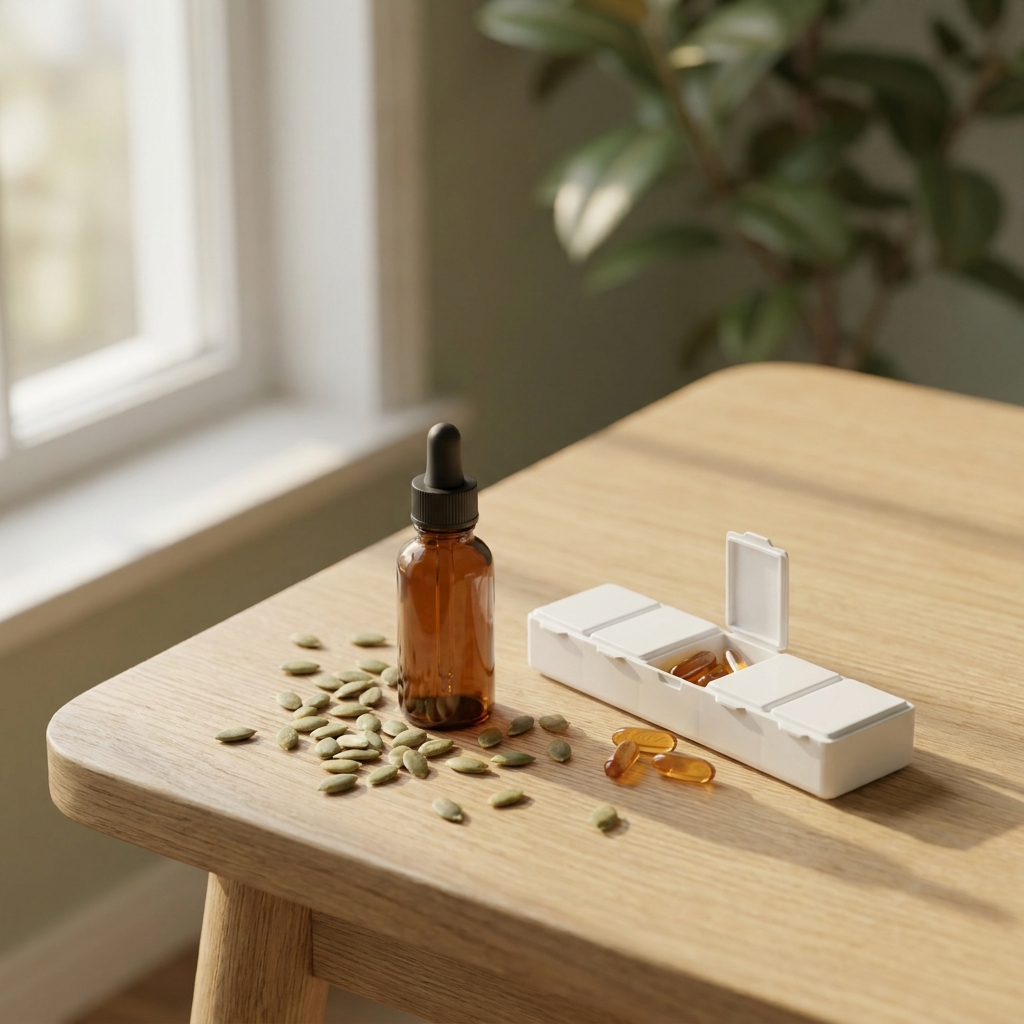
Pumpkin Seed Oil Hair Regrowth: Beyond the 40% Headline (2026)
Introduction: The Statistic Everyone Quotes, But Nobody Questions
Search for pumpkin seed oil and hair regrowth, and one number appears almost everywhere: pumpkin seed oil increases hair count by 40%. It shows up in supplement ads, wellness blogs, and social media routines, usually as the opening line.
The statistic is real. It comes from a legitimate randomized clinical trial. The problem is that it is routinely stripped of its context: what was actually tested, how hair was measured, and what else the same study found. Without that context, men weighing their options can end up with expectations the data cannot support.
This article looks past the headline. It examines the original 2014 trial data, incorporates newer research, including a recent network meta-analysis in Frontiers in Nutrition, and closes with a practical framework for where pumpkin seed oil realistically fits for men who want meaningful regrowth. The aim is neither to debunk nor to promote the ingredient, but to interrogate the evidence honestly.
The Study Behind the Statistic: What the 2014 Trial Actually Tested
The 40% figure traces back to a randomized, double-blind, placebo-controlled trial by Cho and colleagues, published in 2014. Researchers enrolled 76 men with mild to moderate androgenetic alopecia (AGA), the hereditary, hormone-driven form of male pattern baldness, and followed them for 24 weeks.
The topline numbers were:
- Week 12: Hair count rose 30% in the treatment group versus 5% in the placebo group.
- Week 24: Hair count rose 40% in the treatment group versus 10% in the placebo group (P < 0.001).
- Absolute change: 6.2 hairs versus 1.8 hairs within the magnified counting field.
That last figure is the one most articles leave out, and it changes how the headline should be read. The “40%” was a mean percentage change in hair count within a single measured scalp area, not 40% more coverage across the entire head. A relative increase in a small, magnified field is meaningful scientifically, but it does not mean a man will see 40% more hair in the mirror.
The Product Was Not Pure Pumpkin Seed Oil
There is a second detail that rarely makes it into popular coverage. The men in the treatment group did not take a standalone pumpkin seed oil supplement. They took a branded, proprietary capsule called Octa Sabal Plus, dosed as two 100 mg capsules before breakfast and two before dinner, totaling 400 mg of pumpkin seed oil per day.
Pumpkin seed oil was the main ingredient, but it was one component of a formulated product. That matters: when the study’s results are attributed entirely to “pumpkin seed oil,” that is an extrapolation the trial design cannot fully support. Only a handful of more skeptical analyses, such as Perfect Hair Health, have flagged this point. Most sites skip it entirely.
The Part of the Study Most Sites Don’t Mention
Beyond hair counts, the trial included a more conservative secondary measure: global ratings by a blinded, independent assessor at week 24. This is closer to what most men actually care about, which is whether the improvement is visible.
The breakdown among the 37 treated men:
- 17 were rated slightly or moderately improved
- 19 were rated unchanged
- 1 was rated worse
In other words, roughly half of the treated group showed no visible improvement to a trained evaluator, even as the hair-count instrument recorded a 40% average relative increase.
Both findings are true. A sensitive counting tool can detect small changes in a magnified field that a human observer cannot see on a full scalp. But the two numbers tell different stories about how noticeable the benefit is likely to be for the individual man looking in the mirror.
The Placebo Group Anomaly Nobody Explains
The placebo arm contains another oddity. According to an analysis by Perfect Hair Health, the published data show a dramatic increase in hair thickness in the placebo group, reported at roughly 350%. An inert placebo should not produce shifts of that magnitude, and the study does not explain it.
This does not invalidate the trial, but it raises legitimate questions about measurement noise, the small sample size (n=76), and the overall precision of the instruments used. When a placebo produces large, unexplained movement in a measured parameter, every other number in the study deserves a measure of caution.
A published commentary on the trial adds another limitation: study duration should ideally be at least one year, because seasonal variation in male hormone levels affects the hair growth cycle. A 24-week window may capture seasonal effects alongside, or instead of, treatment effects.
Closing the Freshness Gap: What the Newest Research Shows
Critique alone does not tell the whole story. A fair evaluation must also look at what has been published since 2014. Newer and larger-scale research has independently pointed toward a modest but real effect, which is a more useful conclusion than either the hype or the dismissal.
The 2021 Topical Trial in Women: A Different Kind of Evidence
Ibrahim and colleagues (2021, Journal of Cosmetic Dermatology) randomized women with female pattern hair loss (FPHL) to either topical pumpkin seed oil (1 mL per day applied to the scalp) or 5% minoxidil foam for three months.
The findings were nuanced. The pumpkin seed oil group showed a significant decrease in hair shaft diversity and vellus hair count. Vellus hairs are fine, non-pigmented hairs associated with follicular miniaturization, so a reduction suggests follicles may be recovering. On that specific measure, pumpkin seed oil outperformed minoxidil. Minoxidil, however, won on other measures. The authors concluded that pumpkin seed oil shows a promising role in treating female pattern hair loss.
For male readers, the caveat is critical: this trial was in women, used topical application, and measured different outcomes. It should not be conflated with the oral evidence from the 2014 trial, though many articles blend the two.
The 2023 JAMA Dermatology Systematic Review
A 2023 systematic review in JAMA Dermatology evaluated 30 studies on nutritional supplements for hair loss. It concluded that the highest-quality evidence suggested potential effectiveness for several supplements, including pumpkin seed oil, zinc, and tocotrienol.
The review’s framing was measured: nutritional interventions “may benefit select patients,” with the important caveat that federal oversight of these supplements is lacking. On safety, the findings were reassuring. Adverse effects were rare and mild across all therapies evaluated, including pumpkin seed oil.
The 2025 Frontiers in Nutrition Network Meta-Analysis: The Missing Update
The most significant recent update is a network meta-analysis published in Frontiers in Nutrition in late 2025, which most existing content has not yet incorporated. It pooled 19 randomized controlled trials involving 1,658 AGA patients across 16 dietary supplements.
Compared with placebo, the following significantly improved hair density:
- Standardized plant extracts (Nutrafol)
- Apple extract
- Tocotrienols
- Pumpkin seed oil
- A Cistanche/Laminaria compound
Pumpkin seed oil and saw palmetto extract ranked among the best-performing supplements in the analysis, effectively a modern, independent confirmation of the signal first seen in 2014.
The authors were careful, however. They described the evidence as low-certainty and heterogeneous, and even the top-ranked supplements remain well below finasteride, dutasteride, and minoxidil in overall efficacy.
Oral vs. Topical Pumpkin Seed Oil: Two Different Evidence Bases
Much of the content online treats oral capsules and scalp oils as interchangeable. They are not. Each rests on a separate, and unequal, body of evidence.
| Factor | Oral PSO | Topical PSO | Animal Evidence |
|---|---|---|---|
| Key study | Cho et al. (2014) | Ibrahim et al. (2021) | 2022 mouse study |
| Population | Men with AGA | Women with FPHL | Mice |
| Dose | 400 mg/day | 1 mL/day on scalp | Topical and oral |
| Duration | 24 weeks | 3 months | 7 days topical, 14 days oral |
| Comparison | Placebo | 5% minoxidil foam | Controls |
| Main measure | Hair count | Vellus hairs, shaft diversity | Follicle number and growth |
Topical pumpkin seed oil, as used in many social media routines, is largely unstudied for true regrowth in men. In practice, it may function more as a scalp conditioner or moisturizer than an active regrowth agent.
The practical takeaway: for men choosing between the two, the oral route has the more rigorous human data behind it.
The Proposed Mechanism: Promising Theory, Not Proven Biology
The commonly cited explanation runs as follows. Pumpkin seeds contain phytosterols and linoleic acid (an omega-6 fatty acid), both of which research suggests may inhibit 5-alpha reductase, the enzyme that converts testosterone into DHT. DHT is the hormone that shrinks genetically susceptible follicles in androgenetic alopecia. Less enzyme activity could mean less DHT and less pressure on those follicles.
What most sources fail to state clearly is that this remains a proposed mechanism. It is drawn from animal and laboratory research. The human hair trials never directly measured DHT reduction, so the pathway is inferred, not confirmed.
Animal data do lend support. A 2022 mouse study found that topical pumpkin seed oil applied for 7 days increased the number of hair follicles, and oral pumpkin seed oil given for 14 days increased follicle growth. Still, mouse models do not guarantee equivalent outcomes in humans. Being precise about the difference between “plausible” and “proven” is what separates credible guidance from marketing copy.
Safety Profile and Who Should Be Cautious
Safety is one of pumpkin seed oil’s genuine strengths. In the Cho et al. trial, no adverse events were reported in the treatment group. In the Ibrahim et al. trial, topical pumpkin seed oil was well tolerated with no significant side effects.
With oral use, some people may experience mild gastrointestinal effects:
- Occasional nausea
- Bloating
- Diarrhea
Taking the supplement with food often helps.
Certain groups should be more cautious:
- Pregnant women are generally advised to avoid concentrated pumpkin seed oil supplementation.
- People taking lithium should be aware that pumpkin may have a diuretic effect that could reduce lithium excretion and raise lithium levels.
Anyone already taking prescription medications should check with a healthcare provider before adding pumpkin seed oil, since interactions like these are easy to miss without professional guidance.
Setting Realistic Expectations: Dosage, Timeline, and Who This Is (and Isn’t) For
Dosage: The doses with clinical backing are 400 mg per day orally (Cho et al.) and 1 mL per day topically (Ibrahim et al.). Commercial products commonly range from 400 to 1,000 mg per day, but anything above the studied dose is an untested extrapolation, not an evidence-based upgrade.
Timeline: Measurable results should not be expected before 12 to 24 weeks, consistent with the trial windows.
Diagnosis first: Pumpkin seed oil’s evidence applies specifically to androgenetic alopecia. Before assuming pattern hair loss, other causes should be ruled out, including:
- Telogen effluvium (stress- or illness-related shedding)
- Alopecia areata (autoimmune patchy loss)
- Thyroid dysfunction
- Iron deficiency
Limitations: The core oral trial included only 76 participants, enrolled men only, and did not extend beyond 24 weeks. No long-term data exist. Expectations should stay grounded in what the evidence can and cannot support.
The Decision Framework: Where Pumpkin Seed Oil Actually Fits
The claim that pumpkin seed oil “is not a replacement for minoxidil or finasteride” is common advice. A more useful approach is to consider which situation a man is actually in.
- Early-stage thinning, exploring low-risk options. Pumpkin seed oil is a reasonable, low-risk starting point to discuss with a provider, but early action with proven treatments tends to preserve the most hair. Waiting on a modest supplement can cost valuable time.
- Already on a clinical regimen, seeking a complementary adjunct. This is where pumpkin seed oil fits best. Its safety profile makes it a sensible supportive layer.
- Seeking a sole, non-clinical solution. Expectations should be recalibrated. The effect size is modest and the evidence is low-certainty compared with pharmaceutical options.
The evidence is consistent on one point: network meta-analyses rank pumpkin seed oil well below finasteride, dutasteride, and minoxidil in overall efficacy. It is a legitimate adjunct, not a primary treatment for men who want meaningful regrowth.
Why an Adjunct Approach Makes Sense Alongside a Clinical Regimen
Topical minoxidil and oral finasteride are FDA-approved for androgenetic alopecia, yet only about 30% of patients persist with prescription medication over a year in private practice. Complexity, inconvenience, and juggling multiple products all contribute. That gap is part of why low-risk adjuncts appeal to so many men.
A stronger approach is to build on a clinically dosed foundation. Thryve Hair Lab’s once-daily 4-in-1 capsule combines 2.5 mg minoxidil, 0.5 mg dutasteride, 1 mg biotin, and 600 IU vitamin D3. Minoxidil supports follicle stimulation through improved blood flow, while dutasteride blocks both Type I and Type II 5-alpha reductase, addressing the hormonal driver that pumpkin seed oil is only theorized to influence. A single capsule also removes much of the complexity that leads men to abandon treatment.
Because the formula already includes biotin and vitamin D3 for follicle support, men using Thryve are covering nutritional bases that overlap with the general idea behind supplements like pumpkin seed oil. Some may still choose to add it as a supportive layer, but it should complement, not substitute for, the clinical foundation.
Any supplement addition, including pumpkin seed oil, should be discussed with a licensed provider to check for interactions such as lithium and to confirm it is appropriate.
What Men Should Look for in a Pumpkin Seed Oil Product
For men who decide to try pumpkin seed oil, the label matters.
- Pure oil or blend? Check whether the product is standardized pumpkin seed oil or a proprietary multi-ingredient blend. Since the original study used Octa Sabal Plus, results may not transfer directly to a different formulation.
- Clear milligram dosing. Look for an exact pumpkin seed oil content per serving, targeting the studied 400 mg benchmark. Avoid vague “proprietary blend” labeling that hides quantities.
- Topical concentration and volume. For scalp oils, check concentration and compare application volume to the studied 1 mL per day, keeping in mind that topical evidence is thinner and was studied in women.
- Third-party testing and sourcing. Given the lack of federal oversight highlighted in the JAMA Dermatology review, transparent sourcing and independent testing are strong signs of quality.
Conclusion: A Legitimate Adjunct, Not a Miracle or a Myth
Pumpkin seed oil has real evidence behind it. The 2014 randomized trial, the 2021 topical trial, the 2023 JAMA Dermatology review, and the recent Frontiers in Nutrition network meta-analysis all point toward a modest benefit for hair density. But the popular “40% increase” headline oversimplifies a study with meaningful caveats: a proprietary blend rather than pure oil, modest blinded-assessor ratings, and an unexplained placebo anomaly.
The most accurate way to view pumpkin seed oil is as a low-risk, evidence-supported adjunct that can complement a clinically dosed regimen. It is not a standalone solution capable of matching established treatments like minoxidil, finasteride, and dutasteride.
Understanding the real evidence allows men to make confident, informed decisions instead of chasing headlines. What matters most is acting early, with the right combination of treatments.
Ready for a Treatment Backed by Clinical Dosing, Not Just Headlines?
Thryve Hair Lab makes it simple to start with a foundation built on clinical dosing. A 2 to 3 minute online questionnaire connects men with a licensed provider, who typically reviews it within one business day and builds a personalized treatment plan.
- Clinically dosed 4-in-1 formula: minoxidil, dutasteride, biotin, and vitamin D3 in one daily capsule
- Expert-developed: formulated by hair restoration specialists with over 100 years of combined clinical experience
- Convenient and private: no office visits, discreet packaging, and 2-day FedEx delivery
- Low risk: cancel-anytime subscription and a 1-year satisfaction guarantee
The most reliable path to long-term hair health is not the next viral ingredient. It is rigorously dosed clinical treatment, started early, supported by sensible, evidence-based adjuncts where they make sense.