No Greasy Hair Loss Treatment: Why Oral Wins Over Topical
Introduction: The Hidden Reason Most Men Never See Hair Loss Results
A man rubs topical minoxidil into his scalp before work, hoping for the confidence that comes with thicker hair. Twenty minutes later, he catches his reflection in the office elevator: flat, oily, greasy strands clinging to his forehead. The treatment meant to restore his appearance has quietly undermined it. This scenario plays out for millions of men every morning, and it points to a problem far larger than a cosmetic annoyance.
Greasy hair from topical minoxidil is not a minor complaint. It is a medical adherence crisis. When a treatment makes a man’s hair look worse, he skips applications. When he skips applications, the treatment fails. And when the treatment fails, he assumes hair regrowth simply is not possible for him. The greasy scalp is the silent saboteur standing between a man and his results.
The scale of the issue is significant. Androgenetic alopecia affects an estimated 50 million men in the United States alone, according to MedlinePlus. Topical minoxidil has been the default treatment since its FDA approval in 1988. Yet real-world discontinuation rates reach a staggering 86 to 95 percent within one year, driven largely by cosmetic dissatisfaction.
There is a cleaner path forward. Oral minoxidil does not manage the greasy hair problem; it eliminates it at the source by bypassing the scalp entirely. This is precisely what men searching for a no greasy hair loss treatment are looking for, and it is the foundation of Thryve Hair Lab’s once-daily oral capsule: a modern, doctor-formulated alternative built around the insight that the best treatment is the one a man will actually take.
Why Topical Minoxidil Leaves Your Hair Greasy (It’s Not Just in Your Head)
The greasy feeling is not imagined, and it is not the result of improper application. It is chemistry.
Topical minoxidil liquid solutions contain propylene glycol, a compound that helps the medication penetrate the scalp. Propylene glycol is also a known skin irritant and the primary agent responsible for the oily, greasy residue left behind after every application. According to the ISHRS, propylene glycol in topical minoxidil formulas “has a greasy feeling and can be a skin irritant”.
The foam formulation was developed specifically to reduce propylene glycol exposure, and it helps. But foam still requires twice-daily scalp application, and it can still leave hair stiff, flat, or visibly weighed down. Men consistently report the same sensory experience: an oily scalp texture, hair that clumps or lies flat, residue that transfers to pillowcases and headrests, and a persistent feeling of never being quite clean.
How serious is this problem? Serious enough that researchers developed a separate companion product, an “After Minoxidil” spray published in PubMed in 2020, engineered specifically to remove residual greasiness from hair after application. When an entire secondary product exists just to counteract the side effects of the first, the flaw is structural, not incidental.
That is the key point. The greasiness is not a bug that can be patched. The propylene glycol carrier is what makes topical minoxidil work in the first place. The delivery method and the problem are inseparable.
The Real Cost of Greasy Hair: How a Cosmetic Complaint Becomes a Treatment Failure
Greasy hair is not a vanity issue. It is a compliance trigger, and compliance determines everything.
A 2025 peer-reviewed cross-sectional study published in PubMed confirmed that patients on topical minoxidil “often report aesthetic and discomfort concerns (e.g., greasy hair), which may limit adherence.” The same study found that oral minoxidil users reported significantly greater ease of treatment and hair styling, with statistically strong results (P=0.0004 and P=0.0112).
The dropout numbers are sobering. Real-world data show that 86 to 95 percent of topical minoxidil users discontinue within one year, most often due to cosmetic dissatisfaction and the daily application burden. A separate compliance study found that experiencing an adverse effect pushed the discontinuation rate to 93.6 percent.
The missed-days comparison is even more revealing. A landmark 2025 study found that topical users missed an average of 1.2 treatment days, while oral users missed just 0.15 days. Additionally, 18.8 percent of topical users abandoned treatment entirely due to difficulty of use, compared to 0 percent of oral users.
This matters because minoxidil requires consistent, uninterrupted use to maintain and grow hair. Every skipped application is a missed opportunity for follicle stimulation. Inconsistency does not just slow progress; it can erase months of gains. The greasy scalp, then, is not a cosmetic footnote. It is the mechanism by which treatment quietly fails.
Consider the lifestyle friction that competitors rarely address: job interviews, first dates, client meetings, and gym sessions where greasy hair simply is not an option. In those moments, a man skips his dose, and each skip pushes his results further out of reach.
The Lifestyle Toll: What Greasy Hair Actually Costs Every Day
The daily burden of topical minoxidil extends well beyond the greasy feeling itself.
The product must be applied to a completely dry scalp. Men are then advised to wait two to four hours before styling. Managing the residue often means washing hair more frequently. For a busy professional, that is a meaningful time tax layered onto an already full morning routine.
For men who rely on their appearance for professional or social confidence, topical minoxidil creates a contradiction. It actively works against their styling goals, defeating the entire purpose of treating hair loss in the first place. The result is a demoralizing feedback loop: treating hair loss with a product that makes hair look worse. Many men feel forced to choose between treating their hair and looking presentable on any given day.
Then there is the quiet embarrassment. Greasy residue that transfers to gym equipment, a car headrest, or a partner’s shoulder is a source of self-consciousness that few treatment guides acknowledge. It is a real, human cost.
And it compounds. Men who skip applications to avoid the greasy look are not simply missing doses; they are actively extending their own timeline, pushing meaningful results further away with every skipped day.
A man’s response to this frustration is not irrational. It is a predictable, well-documented reaction to a delivery system that was never designed with his lifestyle in mind.
How Oral Minoxidil Eliminates the Greasy Hair Problem Completely
Oral minoxidil solves the problem by changing where the medication goes.
Instead of sitting on the scalp, oral minoxidil is absorbed through the gastrointestinal tract and converted to its active form, minoxidil sulfate, in the liver, where sulfotransferase enzyme activity is abundant and consistent. The active compound then reaches the follicles through the bloodstream. The scalp is never touched.
Because the medication never contacts the scalp, there is no propylene glycol residue, no oily texture, no styling interference, and no greasy aftermath. The problem is eliminated structurally, not managed after the fact.
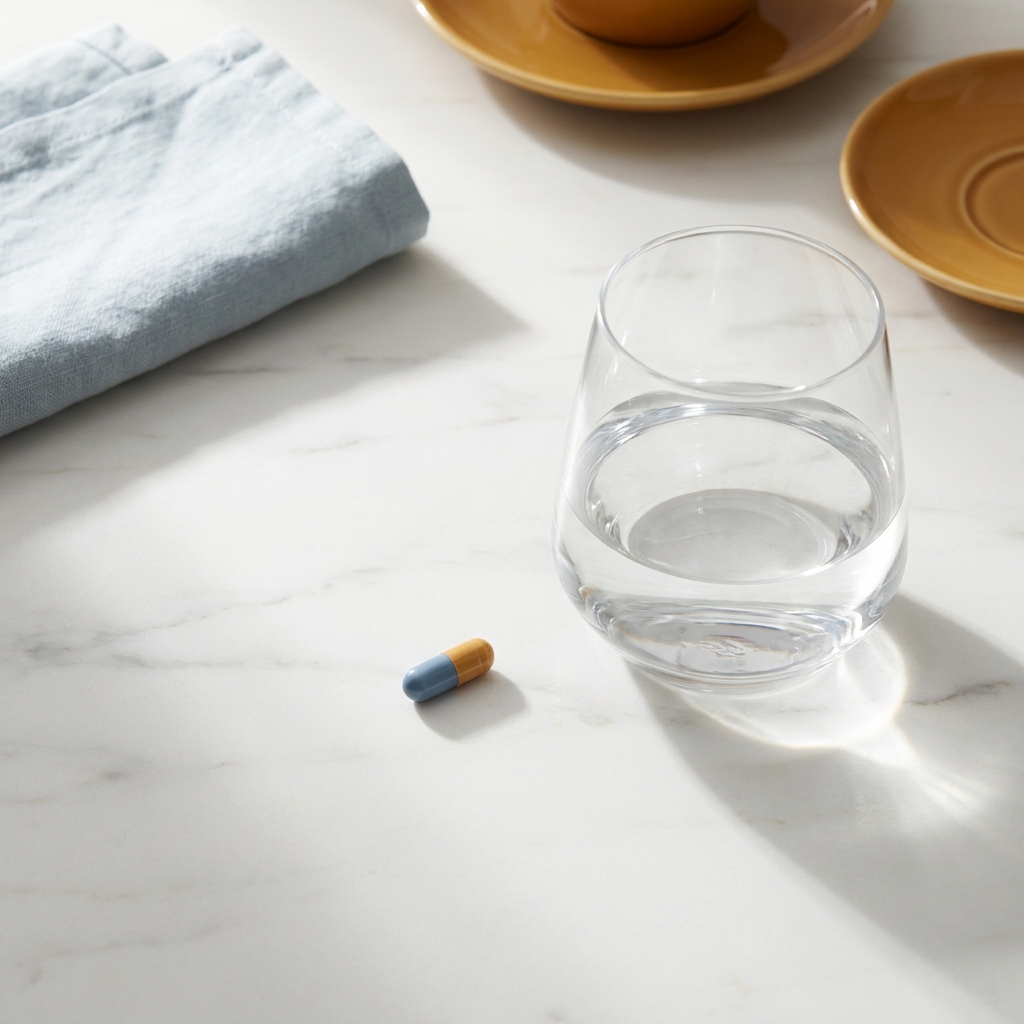
The experience is entirely different. Rather than twice-daily applications to dry hair followed by a multi-hour wait, oral minoxidil is a single daily capsule taken with water, no more disruptive than a daily vitamin.
There is also an absorption advantage. Topical minoxidil relies on variable scalp penetration and local enzymatic activation, factors that differ substantially from one man to the next. Oral delivery provides more predictable, systemic absorption, removing much of the guesswork from whether the medication is actually reaching the follicles.
The adherence payoff is dramatic. In a multicenter study of more than 1,400 patients, fewer than 2 percent of oral minoxidil users discontinued treatment, compared to the 86 percent discontinuation rate seen with topical formulations. Consistent use is what drives results, and oral delivery makes consistent use realistic.
The lifestyle transformation is complete. Oral minoxidil users can style their hair immediately, wash it on their own schedule, and go about their day with no visible sign they are treating hair loss at all.
Does Oral Minoxidil Actually Work? What the Clinical Evidence Shows
Convenience means nothing without efficacy. Fortunately, the clinical evidence for oral minoxidil is strong and growing.
In January 2025, JAMA Dermatology published the first international consensus statement on low-dose oral minoxidil, developed by 43 hair loss specialist dermatologists from 12 countries. This was a landmark moment that established oral minoxidil as a legitimate clinical standard rather than a fringe alternative.
The head-to-head data are equally compelling. A 2024 randomized clinical trial published in JAMA Dermatology (Penha et al., n=90 men) found that oral minoxidil 5 mg once daily was non-inferior to topical minoxidil 5 percent twice daily for male androgenetic alopecia. Notably, it was actually superior on the vertex at 24 weeks.
Breadth of evidence matters too. A 2025 meta-analysis in Frontiers in Pharmacology covering 2,933 patients across 27 studies found that 82 percent of oral minoxidil users experienced symptom improvement or stabilization.
Dosing is well established. The international consensus recommends 0.625 mg to 5 mg daily for adults, and the literature suggests men typically require 1.25 to 5 mg per day for maximal efficacy.
Honesty about side effects is important. The most common side effect of oral minoxidil is hypertrichosis, or unwanted body and facial hair growth, reported in roughly 49 percent of oral users in the 2024 RCT. However, it is dose-dependent, usually mild, and reversible upon dose reduction.
The direction of the field is clear. A 2025 PLOS One cross-sectional study using the NIH “All of Us” dataset found oral minoxidil is increasingly prescribed to younger men with androgenetic alopecia, signaling that the next generation is choosing oral from the start.
Oral vs. Topical Minoxidil: A Direct Comparison for Men Who Want Results
| Factor | Topical Minoxidil | Oral Minoxidil |
|---|---|---|
| Application | Twice daily to dry scalp | Once-daily capsule with water |
| Greasiness | Propylene glycol residue | Zero scalp contact, zero residue |
| Styling impact | Significant interference | None |
| Discontinuation rate | 86 to 95% within one year | Fewer than 2% in multicenter studies |
| Quit due to difficulty | 18.8% | 0% |
| Regulatory status | FDA-approved since 1988 | Off-label, backed by 2025 consensus |
The efficacy comparison settles the central question. The 2024 JAMA Dermatology RCT confirms that oral minoxidil is non-inferior to topical and superior on the vertex. Men are not trading effectiveness for convenience; they are gaining both.
This is the compliance multiplier at work. The best hair loss treatment is the one a man actually takes consistently. By structurally removing the greasy hair barrier, oral minoxidil makes consistent use dramatically more achievable.
The one requirement is a prescription, a requirement now easily met through telehealth platforms without any in-person visit, removing the final barrier to access.
Thryve Hair Lab: The Oral Hair Loss Capsule Built for Men Who Are Done With Greasy
Thryve Hair Lab designed its once-daily oral capsule for exactly the man described above: someone who has lived the topical minoxidil compliance trap and is ready for a treatment that works with his lifestyle rather than against it.
The formula is a meaningful clinical upgrade. Each capsule combines four active ingredients:
- Minoxidil (2.5 mg): Stimulates follicle regrowth through improved blood flow.
- Dutasteride (0.5 mg): Blocks both Type I and Type II DHT enzymes, offering more comprehensive protection than finasteride.
- Biotin (1 mg): Supports keratin production and hair strength.
- Vitamin D3 (600 IU): Nourishes and promotes follicle health.
The dutasteride advantage deserves attention. Most competitors rely on finasteride, which blocks only one DHT pathway. Thryve’s use of dutasteride targets both enzyme pathways, offering more complete protection against the follicle miniaturization that drives androgenetic alopecia. Learn more about why dutasteride is stronger than finasteride and how this distinction affects long-term results.
The zero-grease guarantee is built into the design. Because the treatment is entirely oral, there is no scalp application, no propylene glycol, no residue, and no styling compromise. A man takes his capsule and styles his hair however he chooses, immediately.
Access is refreshingly simple: a 2 to 3 minute online medical questionnaire, licensed provider review typically within one business day, and 2-day FedEx delivery. No clinic visit, no waiting room, no awkward conversations.
The credibility is real. Thryve’s formula was developed by a team with over 100 years of combined clinical experience in hair restoration, including board-certified hair surgical specialists and transplant surgeons, not general practitioners.
What Men Using Thryve Are Actually Experiencing
Clinical evidence becomes tangible in real-world outcomes. Thryve users report consistent, encouraging results:
- Chris L., age 39: Hairline visibly filling in within 3 months of consistent use.
- Jason M., age 34: Baby hairs returning at the hairline within 3 months.
- Marcus G., age 29: New growth at the temples, with specific praise for the discreet ordering and delivery process and no embarrassing pharmacy trips.
- R. Silver, age 44: Less scalp visible in photos after 4 months, following six years of thinning before finding a treatment he could actually stick with.
These results share a common thread: consistency. Oral delivery makes daily use achievable, and the men who see results are the ones who take their treatment every day, without a greasy scalp standing in the way.
Thryve’s broader outcome data reinforce the pattern. The company reports that 97 to 98 percent of men stop further hair loss, 90 percent see visible improvement in thickness and coverage within 3 to 6 months, and peak improvement typically arrives at 9 to 12 months of consistent use.
How to Get Started: From Greasy Scalp to Clean Treatment in 24 Hours
The path from frustration to a clean, effective treatment is straightforward.
- Complete the online questionnaire. It takes 2 to 3 minutes and covers health history and hair loss background. No in-person visit required.
- Get provider approval. A licensed provider reviews and approves the prescription, typically within one business day. If treatment is not approved, a full refund is issued.
- Receive discreet delivery. Capsules ship via 2-day FedEx in discreet, TSA-compliant foil-blister packaging with no indication of contents on the exterior.
- Take one capsule daily. No scalp prep, no waiting period, no styling compromise. That is the entire protocol.
The value proposition is clear as well. The 20-week subscription runs $67 per month with free shipping, compared to roughly $135 per month to purchase the same ingredients separately, representing claimed annual savings of $816.
Every subscription is backed by a 1-year satisfaction guarantee. If a man sees no visible results after consistent use, Thryve offers a full refund or account credit, removing the financial risk from the decision to switch.
Conclusion: Stop Managing Greasy Hair. Start Growing It Back.
Greasy hair from topical minoxidil is not a cosmetic inconvenience. It is the single most common reason men abandon treatment before results ever arrive, and it has quietly cost countless men months or years of potential regrowth.
Oral minoxidil does not reduce the greasiness problem; it eliminates it entirely by delivering the active ingredient through the bloodstream rather than the scalp.
The clinical validation is now overwhelming. The 2024 JAMA Dermatology RCT confirms efficacy parity and superiority on the vertex. The 2025 international consensus from 43 specialists across 12 countries confirms legitimacy. And the adherence data confirm that men who switch to oral actually complete their treatment.
Thryve Hair Lab represents the optimal expression of this approach: a doctor-formulated, 4-in-1 oral capsule combining minoxidil with dutasteride, biotin, and Vitamin D3, delivered to the door in 48 hours, with no clinic visit and no greasy aftermath.
The men who restore their hair are not the ones who perfected a topical application routine. They are the ones who switched to a treatment they could actually stick with. That switch starts today.
Ready for a Hair Loss Treatment That Leaves No Trace?
Start a free online consultation with Thryve Hair Lab today. No office visit. No greasy residue. Just one capsule a day and a treatment plan built to last.
The entry point is low-risk. The online questionnaire takes 2 to 3 minutes, provider review is typically completed within one business day, and a full refund is issued if treatment is not approved. Every subscription is backed by a 1-year satisfaction guarantee, so if a man does not see visible results after consistent use, he receives a full refund or account credit.
One biological reality is worth remembering: hair follicles that have been dormant for years are harder to reactivate than those recently affected. The earlier treatment begins, the greater the potential for meaningful regrowth.
Take the first step toward hair that grows back, without the grease holding progress back.