
Why Dutasteride Is Stronger Than Finasteride: The DHT Data Most Men Never See
Introduction: The Hair Loss Drug Comparison Most Men Get Wrong
Most men who start researching hair loss treatments run into the same wall. Finasteride appears everywhere, labeled the “gold standard,” the go-to first-line option recommended by nearly every telehealth brand on the internet. After enough articles repeat the same talking points, it starts to feel like the conversation is settled. But somewhere along the way, a quieter question surfaces: is there actually something stronger?
There is. Understanding why dutasteride is stronger than finasteride comes down to biochemistry and clinical data that most content conveniently skips over. Dutasteride is not a backup plan or a step-up option for men who fail on finasteride. It is, by nearly every measurable standard, the more potent and more effective treatment, and a substantial body of evidence proves it.
This article lays out the specifics that rarely make it into mainstream comparisons: dual enzyme inhibition, the real DHT suppression numbers, head-to-head clinical outcomes, and the truth about why dutasteride lacks U.S. FDA approval for hair loss despite being approved for it in other major markets. Finasteride works for many men. But for those who want the strongest evidence-backed option from day one, the data tells a clear story.
The Root Cause of Male Hair Loss: Why DHT Suppression Is the Target
Male pattern hair loss, clinically known as androgenetic alopecia (AGA), is driven by a hormone called dihydrotestosterone, or DHT. When DHT binds to receptors in genetically susceptible hair follicles, it triggers a process called miniaturization. The follicles shrink with each growth cycle, producing thinner and shorter hairs until they eventually stop producing hair altogether.
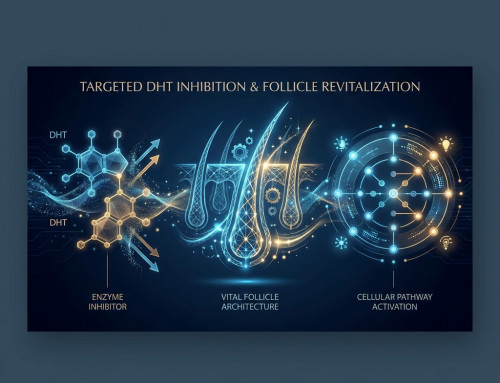
DHT does not appear on its own. It is created when an enzyme called 5-alpha reductase (5-AR) converts testosterone into DHT. This is the central pharmacological target for treating AGA: shut down the enzyme, reduce DHT, and protect the follicles.
Here is the critical detail most men never learn. There are two forms of this enzyme. Type I 5-alpha reductase is found primarily in sebaceous glands and scalp skin. Type II 5-alpha reductase is concentrated in hair follicles and the prostate. Both isoenzymes are present and active in the scalp, which means both contribute to the DHT that attacks hair follicles.
Think of it as two switches feeding the same problem. To meaningfully shut down DHT production at the scalp, both switches need to be turned off, not just one. Finasteride flips only a single switch. Dutasteride flips both.
How Finasteride Works, and Where It Falls Short
Finasteride is a selective inhibitor. It blocks Type II 5-alpha reductase and leaves Type I largely untouched. This is not a flaw in design so much as a limitation in scope, and it has earned legitimate results over decades of clinical use. At the standard 1 mg daily hair loss dose, finasteride reduces serum DHT by roughly 70 percent, which is enough to slow hair loss for a large number of men.
The problem is what it leaves behind. By ignoring Type I 5-alpha reductase, finasteride allows an entire DHT-production pathway to keep running in the scalp. The local numbers reveal the gap. Even at 5 mg per day, five times the standard hair loss dose, finasteride lowers scalp DHT by only about 41 percent. The serum reduction looks impressive on paper, but the effect at the actual site of hair loss is considerably weaker.
For many men, this partial suppression is enough to hold the line. It slows the loss without driving meaningful regrowth. This is not a failure of the drug; it is a ceiling. Once a man hits that ceiling, no amount of patience pushes him past it, because the underlying mechanism only addresses half the problem.
How Dutasteride Works: The Dual Inhibition Advantage
Dutasteride takes a fundamentally different approach. Rather than targeting a single isoenzyme, it inhibits both Type I and Type II 5-alpha reductase simultaneously. This is the foundational reason it outperforms finasteride, and the potency data makes the difference impossible to ignore.
According to GSK’s Phase III trial documentation on ClinicalTrials.gov (NCT01231607), dutasteride is approximately three times more potent than finasteride at inhibiting Type II 5-alpha reductase and more than one hundred times more potent at inhibiting Type I. A 2025 review in the Annals of Dermatology confirmed these same figures.
If finasteride closes one door that DHT can enter through, dutasteride closes both. The gap at Type I inhibition is not a rounding error. A potency difference of more than 100x is dramatic, and it translates directly into how completely DHT production is suppressed where it matters most: in the scalp.
The DHT Numbers: What the Data Actually Shows
The serum DHT comparison alone is striking. Dutasteride reduces circulating DHT by roughly 90 to 95 percent, with some studies reporting suppression as high as 98 to 99 percent. Finasteride sits at around 70 percent, a gap of 20 to 25 percentage points. A real-world multicentre study in South Korea documented dutasteride suppressing serum DHT by 98 percent versus 71 percent for finasteride.
The most compelling argument, however, is what happens at the scalp itself. A 2019 systematic review and meta-analysis in Clinical Interventions in Aging reported that 0.5 mg per day of dutasteride lowers scalp DHT by more than 51 percent, while 5 mg per day of finasteride lowers it by only about 41 percent.
A lower dose of dutasteride outperforms a five-times-higher dose of finasteride at the precise location where hair loss occurs. This matters because the follicle, not the bloodstream, is the true target. Serum DHT levels are a useful proxy, but scalp-level suppression determines whether follicles are protected and given the chance to recover. On that measure, dutasteride wins decisively.
What the Clinical Trials Show: Hair Count, Growth Rate, and Real-World Results
Biochemistry only matters if it produces results men can see in the mirror. The clinical trial data delivers on that front consistently.
In a landmark randomized controlled trial by Shanshanwal and Dhurat, published in the Indian Journal of Dermatology, Venereology and Leprology, 90 men were tracked over 24 weeks. The dutasteride group increased from 223 to 246 hairs per square centimeter. The finasteride group moved from 227 to only 231. The difference was statistically significant.
A larger Phase II RCT of 917 men reinforced this finding, with dutasteride 0.5 mg significantly outperforming finasteride 1 mg in hair count and hair growth at week 24 (P=.003, P=.004, and P=.002).
Real-world data tells the same story. The South Korean multicentre chart review of 600 patients found dutasteride-treated patients showed a 2.06x greater rate of improvement compared to finasteride (p=0.029), meaning men on dutasteride were roughly twice as likely to see meaningful improvement.
A 2024 systematic review by Almudimeegh and colleagues in Dermatology Reports analyzed nine studies and concluded that dutasteride 0.5 mg and 2.5 mg were significantly more effective than finasteride 1 mg at increasing hair counts. A 2025 network meta-analysis in the Journal of Cosmetic Dermatology ranked dutasteride 0.5 mg per day as the single most efficacious monotherapy for male AGA, above finasteride at any dose and above minoxidil. The studies also point to a speed advantage: greater and faster hair growth with dutasteride.
Even at Reduced Dosing, Dutasteride Outperforms Daily Finasteride
If there is a single study that captures dutasteride’s potency advantage, it is a 2025 RCT published in JAAD International. The design was deliberately lopsided in finasteride’s favor.
Researchers compared dutasteride 0.5 mg taken only three times per week against finasteride 1 mg taken every single day. The expectation might be that daily dosing would win on sheer frequency. It did not. Dutasteride taken just three times weekly increased hair density and thickness to a greater extent than daily finasteride. Adverse events were comparable across all groups.
Part of the explanation lies in pharmacology. Dutasteride has a half-life of roughly five weeks, compared to finasteride’s five to six hours. That extended half-life produces more consistent, sustained DHT suppression, which helps explain why even intermittent dosing maintained its edge.
Dutasteride Goes Deeper: The Molecular Evidence
Dutasteride’s advantage is not limited to hair counts and DHT percentages. It extends to the cellular level, where hair growth is actually orchestrated.
A 2022 gene expression study published via PMC examined how the two drugs affected hair growth factor expression in isolated human hair follicles. Dutasteride produced a linear dose-response effect on key growth-related genes including FGF7, IGF1, and WNT5a. Finasteride’s effect plateaued.
In plain terms, finasteride hits a biological ceiling in how much it can stimulate hair growth pathways. Dutasteride keeps driving results as the dose increases, working deeper at the root level and influencing the molecular signaling that tells follicles to grow.
There is also the matter of miniaturization reversal. In the Shanshanwal and Dhurat RCT, thin hair count per square centimeter, a marker of follicle miniaturization, decreased significantly more in the dutasteride group. The goal is not just to stop hair loss but to rehabilitate damaged follicles and bring them back toward producing healthy, terminal hair. Dutasteride demonstrates that capacity more strongly.
The FDA Approval Question: Regulatory Status vs. Efficacy Reality
The most common objection deserves a direct answer: if dutasteride is better, why is it not FDA-approved for hair loss in the United States?
The answer has nothing to do with safety or efficacy. In 2002, GSK halted its Phase III FDA approval trials for dutasteride in AGA for commercial reasons, choosing to focus resources on prostate health indications instead. The drug was not failing its trials. The decision was about corporate priorities, not clinical performance.
The absence of U.S. FDA approval for hair loss is therefore a regulatory and commercial artifact, not a verdict on whether the drug works. The international record makes this clear. Dutasteride is formally approved for androgenetic alopecia in South Korea (2009), Japan (2015), and Taiwan, all markets with rigorous regulatory standards. A 2026 review in Frontiers in Pharmacology confirms its approved status in Japan and South Korea.
Beyond formal approval, dermatologists around the world routinely prescribe dutasteride off-label for hair loss, backed by a robust and growing evidence base. FDA approval status reflects a company’s commercial decisions in the early 2000s. It says little about the drug’s clinical value today.
Side Effects: An Honest Comparison
Side effects are a legitimate concern, and any honest comparison must address them directly.
The overall safety profiles are broadly comparable. The 2024 Almudimeegh systematic review found no significant difference in adverse events between dutasteride and finasteride. The 2025 JAAD International RCT similarly reported comparable sexual adverse events across all groups. Thryve Hair Lab’s own clinical data aligns with this, with less than 0.3 percent of users reporting mild, temporary sexual side effects.
One real difference is worth noting. Because dutasteride’s half-life is roughly five weeks, any side effects that do occur take longer to resolve after stopping the medication compared to finasteride, which clears the body in hours. This is a genuine consideration, not a dealbreaker, but men deserve to know it upfront.
There is also a striking and underreported signal in the pharmacovigilance data. According to the UK MHRA Yellow Card system, there were 170 reports of suicidal ideation linked to finasteride versus only 5 for dutasteride 0.5 mg between 1994 and May 2025. There were 19 fatal suicide reports for finasteride versus zero for dutasteride.
This is observational data and does not prove causation. Reporting rates can be influenced by many factors. It is, however, a notable real-world signal, and on this particular measure the data favors dutasteride. The bottom line: the overall side effect profile is comparable, and the psychiatric safety signal does not work against dutasteride.
What Happens When Finasteride Stops Working
Many men start on finasteride, see some early stabilization, and then plateau. Progress stalls, and frustration sets in. This is one of the most common and disheartening experiences in hair loss treatment.
The data offers a clear path forward. In a study of 35 finasteride non-responders who switched to dutasteride, patients showed a 10.3 percent increase in hair density and an 18.9 percent increase in thickness after just six months.
This makes complete biological sense. Men who plateau on finasteride still have fully active Type I 5-alpha reductase driving DHT production in the scalp. Finasteride was never designed to touch that pathway. Dutasteride’s dual inhibition directly addresses the half of the problem finasteride leaves untouched.
For men who tried finasteride and felt let down, the takeaway is reassuring: the disappointment was likely a tool problem, not a sign that treatment cannot work. Dutasteride is not merely a step-up; it is a mechanistically more complete approach.
Why Dutasteride Is the Right Starting Point, Not a Last Resort
When the evidence is gathered into one place, a clear hierarchy emerges. The 2025 network meta-analysis ranks dutasteride 0.5 mg per day as the most efficacious monotherapy for male AGA, ahead of finasteride at any dose and ahead of minoxidil.
The supporting data reinforces that ranking: 98 percent versus 71 percent serum DHT suppression, a 2x real-world improvement rate, superior scalp-level DHT reduction even at lower doses, and faster visible results.
This raises a fair question about the industry default. If the evidence consistently shows dutasteride is more effective with a comparable side effect profile, what is the clinical rationale for routinely starting men on the weaker option? Finasteride works for many men, but dutasteride represents the more efficient path to results, particularly for men who want the strongest evidence-backed approach from the beginning.
This is exactly why Thryve Hair Lab built its 4-in-1 daily formula around dutasteride 0.5 mg rather than finasteride. The choice was deliberate, made by a medical team with more than 100 years of combined clinical experience in hair restoration. They selected the superior DHT blocker because the evidence supports it.
Conclusion: The Stronger Choice Is Backed by the Stronger Evidence
The case is straightforward. Dutasteride is stronger than finasteride because it blocks both DHT-producing enzymes instead of just one. It suppresses DHT far more completely: 98 percent versus 71 percent in serum and more than 51 percent versus roughly 41 percent at the scalp. It outperforms finasteride across every major clinical trial and meta-analysis and delivers roughly twice the real-world improvement rate.
The regulatory question resolves cleanly as well. The lack of U.S. FDA approval for hair loss is a commercial artifact from a 2002 business decision, not a reflection of the drug’s performance. Dutasteride is formally approved for AGA in South Korea and Japan and ranks as the top monotherapy in the most current evidence available.
On safety, the profiles are comparable, and the real-world pharmacovigilance data actually favors dutasteride on psychiatric signals. For men who want the most effective, evidence-backed approach to stopping hair loss and restoring growth, the path is clear: choose the right treatment from the beginning rather than working up to it after months of lost time.
Take the First Step Toward Stronger Hair Loss Treatment
Thryve Hair Lab’s 4-in-1 daily capsule was built around the science. It combines dutasteride 0.5 mg, the strongest evidence-backed DHT blocker, with minoxidil 2.5 mg to stimulate follicle regrowth, biotin to support hair strength, and vitamin D3 to nourish follicle health. One capsule, once a day, replacing a cabinet full of separate products.
Getting started is simple. A 2 to 3 minute online medical questionnaire is reviewed by a licensed provider, typically within one business day. No office visits, no complexity. Approved orders ship via 2-day FedEx in discreet, TSA-compliant packaging.
Plans start at $67 per month with free shipping, and every plan is backed by a 1-Year Satisfaction Guarantee. If treatment is not approved by the medical team, a full refund is issued, meaning there is zero risk in finding out whether this is the right fit.
Men who are ready to address hair loss with the most effective option available can complete the online consultation today and let a licensed provider determine the best path forward.