
Baby Hairs Growing Back After Treatment: What It Really Means
Introduction: Those Fine New Hairs Are Telling You Something Important
There is a moment that changes everything for a man on a hair loss treatment journey. He leans closer to the mirror, tilts his head under the light, and notices something unexpected: fine, short hairs appearing where his scalp was once bare or thinning. The question that immediately follows is both hopeful and uncertain. What does this actually mean?
For a man currently on a hair loss treatment who is seeing baby hairs emerge, this is one of the most encouraging signs his follicles can send. These fine strands are not random or meaningless. They represent a biological process that deserves a clear, science-backed explanation.
This article exists to provide exactly that. It will explain the clinical science behind what those hairs are, confirm whether they signal treatment success, and provide a concrete checklist to distinguish genuine regrowth from continued miniaturization. The phrase “baby hairs growing back after treatment” reflects a specific, high-intent question that deserves a specific, authoritative answer.
The tone here is results-focused and reassuring. This content is designed for men already in treatment who want confirmation, not a generic overview of hair loss basics. The following sections cover the biology of vellus-to-terminal hair conversion, the often-misunderstood dread shed phase, a practical regrowth confirmation checklist, timelines organized by treatment type, and how combination therapy accelerates results.
What Baby Hairs Actually Are: The Biology Behind the Fine Strands
Baby hairs, scientifically known as vellus hairs, are fine, short, and often colorless or lightly pigmented strands that lack a medulla. The medulla is the structural core found in mature terminal hairs. Understanding this distinction is fundamental to interpreting what those new hairs mean.
All hair growth, whether initial development or regrowth after treatment, begins as vellus hairs before maturing into full terminal hairs. This is a fundamental biological process, not a sign of weakness or incomplete results. Every thick, pigmented hair on a healthy scalp started its life as a fine strand.
Hair follicles operate on a cycle with three distinct phases: anagen (the growth phase, lasting 2 to 6 years), catagen (a brief regression phase), and telogen (the resting phase, approximately 3 months). In androgenetic alopecia, the progressive hair loss condition affecting millions of men, follicles become trapped in increasingly shorter anagen phases with each cycle.
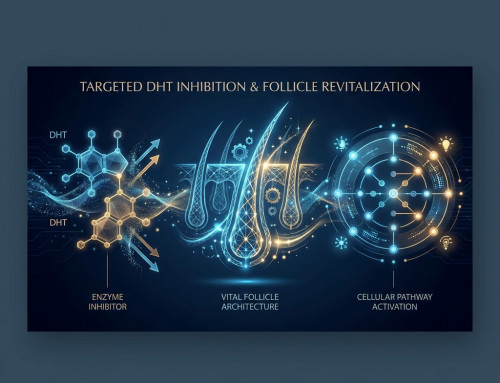
The culprit behind this miniaturization is DHT, or dihydrotestosterone. DHT binds to androgen receptors on genetically sensitive follicles, progressively shortening the anagen phase until only vellus hairs remain. This gradual shrinking of hair output is called miniaturization. Understanding the science behind hair loss helps clarify why this process unfolds the way it does and what can be done to reverse it.
Here is the critical distinction this entire article is built upon: baby hairs caused by miniaturization signal progressive loss, while baby hairs appearing during treatment signal follicle reactivation. The same fine hair carries two completely opposite meanings depending on context.
A 1999 study published in the Journal of the American Academy of Dermatology confirmed that finasteride increased the terminal-to-vellus hair ratio in treated patients, proving that miniaturized follicles can convert back to terminal hairs. More recently, a 2023 peer-reviewed study using a humanized mouse model of androgenetic alopecia demonstrated that both minoxidil and platelet-rich plasma (PRP) can promote vellus-to-terminal hair follicle reconversion in vivo.
The Dread Shed: Why Hair Loss Gets Worse Before It Gets Better
Before baby hairs appear, many men experience something that feels like the opposite of progress. This phenomenon is called the dread shed, and it causes more men to abandon effective treatment prematurely than almost any other factor.
The dread shed is an initial shedding phase that typically occurs in the first 1 to 3 months after starting minoxidil or other treatments. During this phase, existing hairs are pushed out of the telogen (resting) phase to make room for new anagen (growth) phase activity.
The mechanism is straightforward. Treatments like minoxidil accelerate the hair cycle, forcing resting follicles back into active growth. However, the old hair occupying that follicle must shed first before new growth can emerge. This creates the counterintuitive situation where effective treatment temporarily increases hair loss.
The dread shed is not a sign that treatment is failing. It is a sign that follicles are responding to the treatment stimulus.
The shedding phase typically peaks around weeks 4 to 8 and begins to resolve by months 2 to 3. After this period, the emergence of baby hairs becomes the first visible sign of regrowth. New hair begins growing as soon as the shedding phase ends, a pattern confirmed by the telogen effluvium mechanism underlying this temporary loss.
It is important to distinguish normal dread shed shedding from pathological shedding. Dread shed shedding is diffuse (spread across the scalp) and temporary. Concerning shedding is progressive, concentrated in specific areas, and accompanied by no new growth over extended periods.
For men who have moved past the 3-month mark and are seeing fine new hairs in previously thinning areas, the dread shed phase is complete. The regrowth phase has begun. This is exactly what success looks like.
How to Confirm Baby Hairs Are a Sign of Regrowth (Not Continued Miniaturization)
This section provides a practical, actionable checklist that addresses one of the most common questions men have during treatment: how to know whether those fine hairs represent progress or continued decline.
The Regrowth Confirmation Checklist
Tip shape: Regrowth baby hairs have tapered, pointed ends, similar to a pencil tip, because they are newly emerging from the follicle. Miniaturization hairs that have been present for a while often have blunt, broken ends from friction and breakage.
Darkening over time: True regrowth hairs gradually darken and thicken over 4 to 8 weeks as the follicle strengthens. If fine hairs remain pale and thin without change, miniaturization may be continuing.
Distribution pattern: Regrowth baby hairs appear across previously thinning areas (crown, temples, hairline) in a relatively uniform distribution. Miniaturization tends to produce sparse fine hairs while surrounding terminal hairs simultaneously become sparser.
Timeline alignment: Baby hairs appearing 12 to 16 weeks after starting minoxidil, or 6 to 12 months after starting finasteride or dutasteride, align with expected treatment response timelines. This timing is a strong positive indicator.
Scalp condition: Regrowth is more likely when the scalp is healthy and non-fibrotic. If the area has been bald for many years with shiny, tight skin, the follicles may be scarred rather than dormant.
Progression tracking: Photograph the same area in the same lighting every 4 weeks. Regrowth baby hairs will visibly thicken and lengthen over successive photos. Miniaturization will show the opposite trend in surrounding hairs.
Absence of concurrent worsening: If baby hairs are appearing while overall density in the area is stabilizing or improving, this confirms regrowth. If baby hairs appear while the broader area continues to thin, miniaturization may still be progressing.
Dormant vs. Dead Follicles: Why the Presence of Baby Hairs Matters More Than You Think
Understanding the difference between dormant and dead follicles is essential for every man evaluating his treatment progress.
The diagnostic significance of baby hairs cannot be overstated. If fine hairs are present, even very fine, barely visible vellus hairs, the follicle is still alive and reactivatable. The presence of any hair output, however small, confirms follicle viability.
Once a follicle is fully replaced with fibrotic tissue, no current medical therapy can restore it. Only surgical transplantation can address that area.
Baby hairs appearing during treatment signal that the window of opportunity is open. The goal of treatment is to strengthen these follicles before they cross into irreversible fibrosis.
A comprehensive 2025 review from Seoul National University covering DHT-driven follicle miniaturization and the biological mechanisms of hair regrowth reinforces the science of early intervention.
Seeing baby hairs is not just cosmetically encouraging. It is clinically meaningful evidence that follicles are still responding to treatment.
Treatment Timelines: When to Expect Baby Hairs and What Comes Next
Understanding when to expect baby hairs and how they evolve provides a realistic roadmap for men in treatment.
Months 1 to 3: The Adjustment Phase
Weeks 1 to 4: Treatment begins. DHT-blocking medications (dutasteride or finasteride) start reducing the hormonal signal driving miniaturization. Minoxidil begins improving blood flow and nutrient delivery to follicles.
Weeks 4 to 8: The dread shed may occur, with a temporary increase in shedding as follicles are pushed from telogen into anagen. This is normal and expected.
Weeks 8 to 12: Shedding typically subsides. Follicles begin transitioning back into active anagen phase. Some men begin to notice the very first baby hairs emerging, particularly with minoxidil.
According to FDA-cited research, 26% of men using even low-strength 2% minoxidil solution reported moderate to dense hair regrowth after just four months.
Months 3 to 6: The Baby Hair Emergence Phase
Weeks 12 to 16: Minoxidil users typically see new baby hairs by this window. These are fine, short, and may be barely visible, but they represent follicle reactivation.
Months 4 to 6: Baby hairs begin to darken and thicken as follicles strengthen and anagen phases extend. The vellus-to-terminal conversion process is underway.
Finasteride and dutasteride users may begin seeing early regrowth signals in this window, though the full effect of DHT blockade on follicle recovery takes longer to manifest visibly.
This is the phase to document with photos and resist the urge to judge results prematurely. The hairs visible at this stage are the foundation of what grows in months 9 to 12.
Months 6 to 12: Terminal Hair Conversion and Density Building
Months 6 to 9: Baby hairs continue maturing into progressively thicker, darker terminal hairs. Hair density in treated areas begins to visibly improve.
Months 9 to 12: This is the peak improvement window. The 2025 Seoul National University review confirms that full, stable hair growth typically requires 9 to 12 months of consistent treatment.
Long-term finasteride and dutasteride data show that approximately 90% of participants in placebo-controlled trials found the medication either prevented further hair loss or increased hair growth.
The men who see the best results at 12 months are those who stayed the course through the dread shed and the early baby hair phase without abandoning treatment.
Why Combination Therapy Accelerates Baby Hair Conversion
While monotherapy (single treatment) produces results, combination therapy addresses multiple mechanisms simultaneously. DHT blockade, follicle stimulation, blood flow improvement, and cellular regeneration work together to produce faster and fuller conversion from vellus to terminal hair.
A clinical study found that combined PRP, microneedling, and low-level laser therapy (LLLT) achieved a hair density increase of 81 ± 5 hairs/cm² at 12 weeks, significantly outperforming PRP alone.
A 2025 systematic review confirmed LLLT improves hair density and follicular responsiveness in AGA patients, with enhanced outcomes when used alongside minoxidil. There are currently 29 FDA-cleared LLLT devices for pattern baldness in the United States.
Dutasteride offers an advantage over finasteride in combination protocols. Dutasteride blocks both Type I and Type II 5-alpha reductase enzymes, reducing DHT more completely than finasteride, which only blocks Type II. More complete DHT blockade means less ongoing miniaturization pressure on recovering follicles.
Research published in Frontiers in Bioengineering in 2025 demonstrated that engineered exosomes (EX104) reversed follicle miniaturization in DHT-induced cells and showed comparable hair growth promotion to minoxidil. This illustrates the direction of next-generation combination approaches.
Men on combination therapy that includes a strong DHT blocker like dutasteride alongside a follicle stimulant like minoxidil are giving their baby hairs the best possible environment to mature into full terminal hairs. New breakthroughs in hair growth research continue to expand what is possible with these multi-mechanism approaches.
Real Men, Real Results: What Baby Hair Regrowth Looks Like in Practice
Connecting clinical mechanisms to real patient experiences provides the validation many men seek during their treatment journey.
Jason M., age 34, reported baby hairs returning at his hairline after 3 months of treatment. This timeline aligns precisely with the expected minoxidil response window of weeks 12 to 16.
Chris L., age 39, described his hairline filling in at 3 months, consistent with the early terminal hair conversion phase beginning after initial baby hair emergence.
R. Silver, age 44, noted less scalp showing in photos after 4 months, with a 6-year history of thinning. This demonstrates that even men with longer-standing hair loss can see meaningful regrowth when follicles are still viable.
These experiences are not anecdotal outliers. They reflect the documented clinical timeline of vellus-to-terminal conversion that peer-reviewed research confirms. Before and after results from men who have completed this journey offer a visual reference for what the full conversion process looks like over time.
The moment a man notices baby hairs returning is often the turning point from anxiety about hair loss to confidence in the treatment process. That psychological shift is itself part of the recovery journey.
Common Questions Men Have When They Notice Baby Hairs During Treatment
“Are these baby hairs permanent or will they fall out again?”
Baby hairs that emerge during treatment and continue to mature into terminal hairs are a sign of sustained follicle reactivation. However, continued treatment is essential to maintain the hormonal environment that supports their growth.
Stopping DHT-blocking treatment allows DHT levels to normalize, which can restart the miniaturization process. Consistency is the non-negotiable factor in long-term retention of regrowth.
“I see baby hairs but they’re not getting thicker. Should I be worried?”
Vellus-to-terminal conversion is a slow process. If baby hairs appeared recently (within the last 4 to 8 weeks), it is too early to judge their trajectory.
Tracking with monthly photos in consistent lighting is recommended. If hairs are not progressing after 3 to 4 months of consistent treatment, a consultation with a hair loss specialist is appropriate to evaluate whether treatment optimization is needed.
“I’m past 6 months and still only seeing baby hairs. Is my treatment failing?”
Not necessarily. Some follicles that have been miniaturized for longer periods take more time to complete the vellus-to-terminal conversion. The presence of baby hairs at 6 months still confirms follicle viability.
However, this is a signal to evaluate whether combination therapy or a stronger DHT blocker (such as dutasteride) could accelerate the conversion process.
Peak improvement in most studies occurs at 9 to 12 months. Men at 6 months are still within the expected treatment arc.
“How do I know if my follicles are dormant or permanently dead?”
The most reliable indicator of follicle viability is the presence of any hair output, even very fine vellus hairs. If any hair is visible or palpable in an area, the follicle is alive.
Areas that have been completely bald for many years with smooth, shiny, tight skin may have progressed to fibrosis. A clinical evaluation by a hair restoration specialist can assess this more accurately.
The baby hairs visible during treatment are evidence that follicles are still treatable. This is the window to act.
Conclusion: Baby Hairs Are a Signal That Treatment Is Working
Baby hairs growing back after treatment are not a cosmetic curiosity. They are a clinically meaningful signal of follicle reactivation and the first visible stage of vellus-to-terminal hair conversion.
The key distinctions covered here bear repeating: regrowth baby hairs have tapered tips, darken and thicken over 4 to 8 weeks, and align with expected treatment timelines. They are fundamentally different from miniaturization hairs.
For men who experienced a shedding phase before seeing these hairs, that was the treatment working, not failing.
The presence of baby hairs confirms that follicles are still viable and responding. This is the moment to stay consistent and, if appropriate, optimize the treatment protocol.
The men who see the best results at 12 months are those who understood what baby hairs meant, stayed the course, and gave their follicles the consistent, clinically backed support needed to fully convert.
Those fine hairs are the beginning of something real. The science supports the process. Stay the course.
Ready to Give Baby Hairs the Best Chance to Mature?
For men who have confirmed their baby hairs are a sign of regrowth and want to accelerate the vellus-to-terminal conversion process, combination therapy offers a clear path forward.
Thryve Hair Lab’s 4-in-1 daily capsule is designed to address multiple mechanisms simultaneously. The formula includes dutasteride for superior DHT blocking (targeting both Type I and Type II enzymes), minoxidil for follicle stimulation and blood flow, biotin for keratin support, and Vitamin D3 for follicle health.
Unlike treatments that only block Type II DHT, Thryve’s formula targets both enzyme types, reducing DHT more completely and giving reactivating follicles a stronger hormonal environment to mature in.
The process is straightforward: one daily capsule, no office visits, licensed provider review within 1 business day, 2-day FedEx delivery, and discreet packaging. A 1-year satisfaction guarantee reduces purchase risk and reinforces confidence.
Starting an online consultation requires completing a 2 to 3 minute questionnaire, after which a licensed provider delivers a personalized treatment plan.
Follicles are responding. Give them what they need to finish the job.