
Best DHT Blocker Supplement: OTC vs Prescription Ranked by Clinical Evidence
DHT blockade is a spectrum, not a switch. Where a product falls on that spectrum determines whether it actually works or simply drains a bank account while hair continues to disappear. That single distinction separates men who preserve their hair from men who spend years and thousands of dollars on interventions that were never strong enough to matter.
Hair loss carries a weight that goes far beyond aesthetics. Roughly 80 million Americans experience it, and the condition is skewing younger every year: 40% of hair loss patients are now aged 20 to 39, and the average onset in men arrives in the mid-twenties. For a man watching his hairline retreat at 26, the question is not academic. It is urgent.
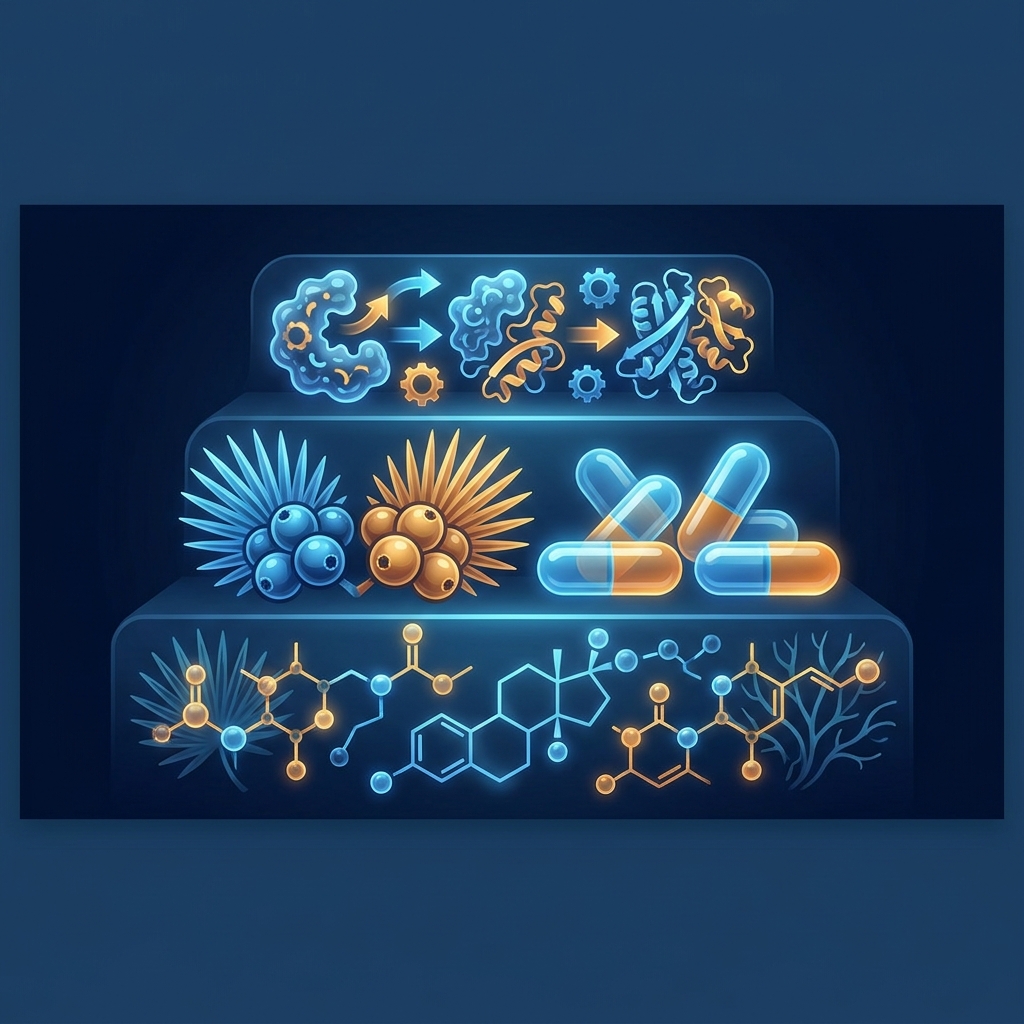
This is not a product roundup. It is a ranked, evidence-based comparison that quantifies exactly how much DHT each option actually blocks. By the end, the efficacy hierarchy will be clear: saw palmetto (an estimated 30 to 50% of finasteride’s 5-alpha reductase inhibition), finasteride (70 to 71% serum DHT reduction), and dutasteride (90 to 98% serum DHT suppression). Along the way, this article exposes the measurable performance gap between over-the-counter supplements and prescription-grade blockers, debunks two costly market myths, and helps men match the right tier of intervention to their stage of loss.
The stakes are defined by the numbers. Androgenetic alopecia (AGA) causes 95% of male hair loss. By age 35, approximately 40% of men experience significant loss. By age 50, that figure reaches 50%. Understanding what genuinely stops it is the first step toward keeping what remains.
Why DHT Is the Root Cause of Male Pattern Hair Loss
The mechanism is straightforward. Testosterone is converted into dihydrotestosterone (DHT) by an enzyme called 5-alpha reductase (5-AR). Roughly 5 to 10% of circulating testosterone undergoes this conversion. In genetically susceptible men, DHT binds to androgen receptors on scalp hair follicles and triggers progressive miniaturization: with each growth cycle, hairs emerge shorter, thinner, and lighter until the follicle eventually stops producing terminal hair altogether.
Two key isoenzymes are central to this process. Type 2 5-alpha reductase dominates in the scalp and is the primary target of finasteride. Type 1 is found in the skin and sebaceous glands and is additionally blocked by dutasteride. This distinction is the entire reason dutasteride suppresses DHT more completely than finasteride, and it becomes central later in this analysis.
Blocking DHT does not reverse existing miniaturization overnight. It halts the process and, over time, allows follicles to recover, which is why meaningful results take anywhere from three to twelve months. Patience is not optional; it is built into the biology.
The medical consensus is unambiguous. NIH StatPearls and a 2025 peer-reviewed review in Anais Brasileiros de Dermatologia both confirm AGA as a genetically predetermined, hormonally driven disorder, not a lifestyle problem or a nutritional deficiency. This sets the logical framework for everything that follows: if DHT is the cause, the only interventions that matter are those that measurably reduce DHT or block its receptor activity. The evidence for each option varies dramatically.
How to Read the Evidence: The Clinical Tier Framework Used in This Article
Not all evidence is equal, and most supplement marketing depends on readers not knowing the difference. In-vitro (petri dish) studies, animal studies, and human randomized controlled trials (RCTs) represent fundamentally different levels of proof. A compound that inhibits 5-AR in a lab does not automatically do so inside a living human scalp.
This article uses a three-tier evidence framework:
- Tier 1: Human RCT data with objective hair count measurements.
- Tier 2: Systematic reviews or prospective cohort studies in humans.
- Tier 3: In-vitro or animal data only.
The gold-standard reference point is the 2023 JAMA Dermatology systematic review led by Harvard Medical School researchers, which examined 30 studies. It found that 12 of 20 nutritional interventions had high-quality evidence suggesting objectively measured effectiveness, including pumpkin seed oil, Nutrafol, Viviscal, and zinc. Crucially, the authors also noted that small sample sizes and study heterogeneity limit definitive conclusions, and none of these options approach prescription-level DHT suppression.
The single most clinically meaningful metric for comparison is DHT suppression percentage, as it directly quantifies how much of the root cause is being addressed. The honest finding ahead is this: the evidence hierarchy strongly favors prescription options for men with moderate-to-significant AGA, while supplements may play a genuine but supportive role in early-stage or prevention-focused cases.
The DHT Blocker Efficacy Hierarchy: Ranked by Clinical Evidence
This section presents a side-by-side ranking of every major DHT blocker category, from weakest to strongest, quantified by clinical data. The hierarchy is a spectrum, running from OTC botanicals at the lower end to prescription dutasteride at the upper end, with each tier offering a measurably different level of DHT suppression.
Tier 4: DHT Blocker Shampoos (Except Ketoconazole 2%): Minimal Evidence
DHT-blocking shampoos are the weakest category, and the reason is physiological. A contact time of two to five minutes is simply insufficient for most botanical ingredients to penetrate the follicle and meaningfully suppress 5-AR activity.
There is one notable exception. Ketoconazole 2% shampoo has some RCT support as an adjunct, offering anti-inflammatory benefits and a possible mild DHT-blocking effect. Even so, it is not a standalone DHT blocker. No DHT-blocking shampoo has published RCT data showing meaningful serum or scalp DHT reduction. Shampoos marketed as “DHT blockers” are largely a marketing category, not a clinical one, and should never be relied upon as a primary intervention.
Estimated DHT reduction: negligible to unmeasured in human trials.
Tier 3: Natural Ingredients With Lab Evidence Only (EGCG, Reishi, Pygeum)
Green tea extract (EGCG), reishi mushroom, and pygeum africanum are commonly marketed as natural DHT blockers. Each shows 5-AR inhibition in in-vitro or animal studies. None has a single human RCT for hair loss.
The distinction matters enormously. Inhibiting 5-AR in a dish does not translate to meaningful scalp DHT reduction in a person, because absorption, bioavailability, and dosing all intervene. These ingredients frequently appear as supporting components in premium formulations, which is not inherently problematic, but they should never be the primary reason to purchase a product.
Evidence rating: Tier 3. Promising mechanistic data; insufficient human clinical evidence. Estimated DHT reduction in humans: unknown and unproven.
Tier 2: Saw Palmetto: The Most Studied Natural DHT Blocker
Saw palmetto is the most clinically supported natural DHT blocker and the only OTC botanical with multiple human RCTs specifically in androgenetic alopecia.
The 2023 VISPO trial (n=80, 16 weeks, published in Clinical, Cosmetic and Investigational Dermatology) found that oral standardized saw palmetto oil reduced hair fall by 29% and increased hair density by 5.17% versus placebo, alongside a marked reduction in serum DHT. Results were statistically significant, though modest. A 2020 systematic review (Evron et al.) analyzing five RCTs and two prospective cohort studies reported 60% improvement in overall hair quality, 27% improvement in total hair count, and increased density in 83.3% of patients.
More recent work is promising. A 2026 180-day clinical trial (Ablon, Journal of Cosmetic Dermatology) on a novel proprietary extract (Serevelle/ActiLipid4Hair) showed significant improvements in terminal hair count, vellus hair count, and overall density versus placebo, with no adverse events. Preclinical data indicated 75-fold greater 5-AR inhibition compared to standard saw palmetto extracts.
One critical quality caveat: saw palmetto must be standardized to 85 to 95% fatty acids to match clinical trial formulations. Non-standardized products may deliver inconsistent or negligible potency. Third-party testing (USP, NSF, ConsumerLab) is a key marker of quality.
Estimated DHT suppression: 30 to 50% of finasteride’s 5-AR inhibition strength. Best suited for: men with early-stage AGA, those preferring a supplement-first approach, or those using it as an adjunct to prescription treatment.
Tier 2: Pumpkin Seed Oil: The Best-Evidenced Natural Option for Hair Count
The landmark 2014 Korean RCT (Cho et al., Evidence-Based Complementary and Alternative Medicine, n=76) remains the most-cited natural DHT blocker study. Men taking 400 mg/day of pumpkin seed oil for 24 weeks saw a 40% increase in hair count, versus just 10% for placebo. Pumpkin seed oil was also among the interventions with supporting evidence in the 2023 JAMA Dermatology review.
The limitations deserve acknowledgment: a single center, 76 participants, and one study. Replication is needed before conclusions become definitive. The proposed mechanism involves phytosterols inhibiting 5-alpha reductase activity, though the exact pathway in humans is not fully characterized.
Dosing is non-negotiable. The trial used 400 mg/day; products with lower doses cannot claim equivalence to these results.
Estimated DHT reduction: not directly measured, though the hair count improvement suggests meaningful 5-AR inhibition. Best suited for: men seeking a natural option with the strongest single-study evidence, often combined with saw palmetto.
Tier 1: Finasteride (Oral, 1 mg): FDA-Approved, 70 to 71% DHT Reduction
Finasteride is the first prescription-grade option and the clinical benchmark against which every supplement is measured. FDA-approved for male AGA since 1997, it primarily inhibits Type 2 5-alpha reductase, reducing serum DHT by approximately 70 to 71% and scalp DHT by roughly 64%. NIH StatPearls confirms it as a competitive inhibitor of 5-AR that directly addresses the underlying pathophysiology of AGA.
Clinically, improvement appears as early as three months, with five-year studies showing sustained slowing of progression. Finasteride and minoxidil remain the only two FDA-approved drugs for male pattern hair loss.
Side effects deserve candid treatment. Sexual side effects such as erectile dysfunction and reduced libido occur in roughly 2 to 4% of men in clinical trials. Online forums and anecdotal amplification have shaped public perception far beyond what controlled data supports.
Topical finasteride offers a compelling middle ground. A Phase III RCT (Piraccini et al., published in JEADV) confirmed efficacy comparable to oral finasteride with markedly lower systemic exposure, reducing systemic absorption by up to 50 to 100 times while maintaining similar scalp DHT suppression. A September 2026 pharmacovigilance study reported that topical finasteride generated fewer post-finasteride syndrome-like adverse event signals than the oral form.
Estimated DHT reduction: 70 to 71% serum DHT (oral). Best suited for: men with moderate-to-significant AGA who want proven, FDA-approved efficacy.
Tier 1: Dutasteride (Oral, 0.5 mg): The Most Powerful DHT Blocker Available
Dutasteride is the most potent DHT blocker currently available, representing the clinical ceiling of DHT suppression. Its advantage is mechanistic: it inhibits both Type 1 and Type 2 5-alpha reductase isoenzymes, whereas finasteride primarily targets Type 2 alone. This dual inhibition is precisely why its DHT suppression is dramatically higher.
Dutasteride 0.5 mg suppresses serum DHT by 90 to 98%, compared to finasteride’s 70 to 71%. In a meta-analysis of 576 patients, dutasteride produced 28.57 more hairs per square centimeter than finasteride, a clinically meaningful and statistically significant difference. For a detailed breakdown of how these two options compare, see this dutasteride vs finasteride comparison.
Dutasteride is not FDA-approved specifically for AGA (it is approved for benign prostatic hyperplasia), but it is widely prescribed off-label by hair restoration specialists and is the active DHT blocker in Thryve Hair Lab’s 4-in-1 formula. Notably, the September 2026 pharmacovigilance study found that topical dutasteride showed a complete lack of adverse event signals. Its side effect profile is similar in type to finasteride, though its longer half-life (roughly five weeks versus approximately six hours for finasteride) means effects persist longer after discontinuation.
Estimated DHT reduction: 90 to 98% serum DHT suppression, the highest of any available option. Best suited for: men with moderate-to-significant AGA seeking maximum suppression, or those who have not achieved adequate results with finasteride.
The Efficacy Gap: What the Numbers Actually Mean for Hair
Laid side by side, the hierarchy tells a clear story: saw palmetto (an estimated 30 to 50% of finasteride’s 5-AR inhibition), then finasteride (70 to 71% serum DHT reduction), then dutasteride (90 to 98% serum DHT reduction).
In practical terms, a supplement that blocks 30 to 50% of 5-AR activity leaves the majority of the problem unaddressed in men with moderate-to-significant AGA. That does not make supplements useless. For men in the earliest stages of loss, or those using them as an adjunct to prescription treatment, the evidence for saw palmetto and pumpkin seed oil is real. It is simply proportionally limited.
The 28.57 hairs per square centimeter finding makes the dutasteride advantage tangible. That is not a marginal difference; it represents a visibly denser scalp over the same treatment window. The guiding principle is matching intervention intensity to loss severity. A man with slight recession at 25 has different clinical needs than a man with significant crown loss at 40. The best DHT blocker for a given man is the one that provides sufficient suppression to halt his specific rate of miniaturization.
Two Myths That Cost Men Their Hair (and Their Money)
Most supplement roundups avoid these two truths because they conflict with affiliate revenue. Both are addressed directly here: the Biotin Myth and the Transition Shed.
Myth #1: Biotin Will Fix DHT-Driven Hair Loss
Biotin supplements dominate the hair supplement market and rank among the best-selling products in the category. They are also largely irrelevant to androgenetic alopecia. For a deeper look at the evidence, this article on biotin hair loss effectiveness covers the research in full.
Biotin supports keratin infrastructure, the structural protein that forms the hair shaft. It has no mechanism of action on androgen receptor activity or 5-alpha reductase inhibition. DHT-driven hair loss will not respond to biotin unless a genuine biotin deficiency exists, and true deficiency is rare in men eating a normal diet. Deficiency-related loss also presents differently, as diffuse shedding rather than patterned miniaturization, and is typically identified through blood work.
This is why biotin appears in some formulas, including Thryve Hair Lab’s 4-in-1 capsule: as a supportive ingredient for hair shaft strength, a legitimate but strictly secondary role. If a man’s loss follows a patterned, receding, or thinning presentation consistent with AGA, biotin is not addressing the root cause. DHT suppression is.
Myth #2: The Transition Shed: Why Men Quit Right Before It Works
The transition shed is the single most common reason men abandon DHT blockers prematurely and one of the least-discussed topics in hair loss content.
The mechanism is as follows: when DHT levels drop, follicles that were locked in a prolonged, DHT-shortened growth phase are pushed into the resting and shedding phase simultaneously. This synchronized shedding typically occurs during weeks two to eight of treatment and can look alarming. It is not the treatment failing. It is evidence the treatment is working, as follicles reset to a healthier cycle.
The shed usually resolves within four to eight weeks, after which new, healthier terminal hairs begin to emerge. Most men see meaningful improvement at three to six months, with peak results at nine to twelve months. This timeline aligns with the research: the VISPO saw palmetto RCT measured results at 16 weeks, the Cho pumpkin seed oil trial ran 24 weeks, and finasteride’s FDA label notes improvement as early as three months with continued gains through five years.
The takeaway is straightforward. Men who quit at week four because of increased shedding never discover whether the treatment would have worked. Consistency through the transition shed is the single most important behavioral factor in treatment success. Understanding the full hair regrowth timeline helps set realistic expectations from the start.
How to Evaluate OTC DHT Blocker Supplement Quality: What the Label Does Not Tell You
Two saw palmetto supplements at the same milligram dose can deliver dramatically different results. The reason is standardization: only extracts standardized to 85 to 95% fatty acids match the formulations used in clinical trials. Non-standardized products may deliver inconsistent or negligible potency.
The dominant 2026 multi-ingredient strategy combines standardized saw palmetto, pumpkin seed oil (400 mg), stinging nettle, and EGCG to attack DHT through multiple mechanisms, with liquid softgels or lipid carriers preferred for absorption. This approach is reasonable, provided the doses are accurate and disclosed.
Third-party testing is non-negotiable. USP, NSF International, and ConsumerLab certification confirm that what appears on the label is actually in the capsule at the stated dose. Long-term safety is another consideration: most clinical studies on natural DHT blockers ran only 16 to 24 weeks, and safety data beyond two years is limited. Finasteride, by contrast, carries five-plus years of clinical trial data and decades of post-market surveillance.
Proprietary blends warrant caution. Supplements that list ingredients within a blend without individual doses make it impossible to verify whether clinical trial doses are being met.
A practical checklist for evaluating any OTC DHT blocker:
- Standardization percentage is listed.
- Individual ingredient doses are disclosed.
- The product is third-party tested.
- The evidence tier of each ingredient is understood.
- The manufacturer is transparent.
OTC vs. Prescription DHT Blockers: Matching Intervention to Stage of Loss
The following is a stage-matched framework, not a one-size-fits-all recommendation.
- Early-stage AGA (Norwood I–II, slight recession, minimal thinning): Standardized saw palmetto and pumpkin seed oil may provide meaningful benefit. The stakes of choosing a less potent option are lower at this stage.
- Moderate AGA (Norwood III–IV, visible thinning at crown or temples): The efficacy gap becomes clinically significant. Finasteride (oral or topical) is the evidence-supported standard of care. Supplements alone are unlikely to halt progression.
- Significant or rapidly progressing AGA (Norwood IV+ or aggressive early loss): Dutasteride’s 90 to 98% DHT suppression and its proven superiority over finasteride (28.57 more hairs per square centimeter) make it the clinically superior choice.
The Norwood scale provides a useful reference for identifying which stage applies and what level of intervention is appropriate. The instinct to try supplements first is understandable, but follicle miniaturization is progressive and partially irreversible. Early intervention with the most effective option preserves more follicles. Prescription and supplement approaches are not mutually exclusive; many men use a prescription DHT blocker as the primary intervention while adding supportive supplements. Prescription options also require medical oversight, which is both a safety feature and a quality assurance mechanism that OTC products lack.
Why Dutasteride Is the Clinical Standard for Maximum DHT Blockade
For men seeking maximum DHT suppression, dutasteride is the most evidence-supported option available. Its dual-enzyme mechanism, inhibiting both Type 1 and Type 2 5-alpha reductase, addresses DHT production across all tissue types rather than the Type 2-dominant blockade of finasteride.
Consider the 90 to 98% figure in context: for every 100 units of DHT that would otherwise reach hair follicles, dutasteride reduces that exposure to just 2 to 10 units. That is a fundamentally different level of protection than any OTC supplement can offer. The meta-analysis of 576 patients reinforces this with a clinically meaningful 28.57 additional hairs per square centimeter versus finasteride.
The off-label status is worth stating plainly: dutasteride is not FDA-approved specifically for AGA, but it is widely prescribed by hair restoration specialists and backed by a substantial evidence base for this use. This is precisely why it is the active DHT blocker in Thryve Hair Lab’s 4-in-1 formula, reflecting an evidence-supported clinical decision rather than a marketing one.
The Thryve Hair Lab 4-in-1 Formula: Clinical Evidence Behind Each Ingredient
Thryve Hair Lab’s formula is the practical application of the evidence hierarchy established throughout this article. Each ingredient earns its place:
- Dutasteride 0.5 mg: The most potent DHT blocker available, suppressing serum DHT by 90 to 98%, with meta-analysis superiority over finasteride of 28.57 hairs per square centimeter.
- Minoxidil 2.5 mg (oral): FDA-approved for hair loss. It stimulates follicle regrowth through improved blood flow and an extended growth phase, working synergistically with the DHT blocker by addressing a different mechanism entirely. Learn more about how minoxidil and dutasteride work together in a combined formula.
- Biotin 1 mg: Supports keratin production and hair shaft integrity. A supportive role, not a DHT-blocking one, consistent with this article’s honest assessment.
- Vitamin D3 600 IU: Supports follicle health. Vitamin D receptors are present in hair follicles, and deficiency has been associated with hair loss in some studies.
The clinical logic is coherent: dutasteride addresses the root cause, minoxidil stimulates regrowth through a complementary pathway, and biotin and D3 support the structural and nutritional environment for healthy hair. The formula was developed by a team with over 100 years of combined clinical experience in hair restoration, including board-certified hair surgical specialists and transplant surgeons. Reported outcomes reflect this rigor: 97 to 98% of men stop further hair loss, 90% see visible improvement in thickness and coverage within three to six months, and results peak at nine to twelve months.
Conclusion: The Honest Answer to “What Is the Best DHT Blocker Supplement?”
The evidence-based verdict is direct: the best DHT blocker is the one that provides sufficient DHT suppression to halt a man’s specific rate of follicle miniaturization, and that answer changes with stage of loss.
The hierarchy is clear. OTC supplements such as saw palmetto and pumpkin seed oil offer real but limited suppression, appropriate for early-stage AGA or adjunct use. Finasteride delivers 70 to 71% serum DHT reduction with FDA approval. Dutasteride delivers 90 to 98% suppression and proven superiority over finasteride.
Two trust-building truths bear repeating. Biotin does not block DHT and will not address AGA. The transition shed is a sign of progress, not failure; consistency through it is what separates men who see results from those who quit early. OTC supplements are accessible, prescription-free, and genuinely backed by evidence, but men with moderate-to-significant AGA who rely on them alone are likely leaving meaningful hair on the table.
Hair loss is progressive and partially irreversible. The follicles protected today are the ones kept tomorrow. The evidence strongly supports acting early with the most effective intervention appropriate to a man’s stage of loss.
Ready to Block DHT at the Clinical Level? Start With Thryve Hair Lab
For the man who understands the evidence hierarchy and wants to act on it, the next step is straightforward. Thryve Hair Lab combines dutasteride (90 to 98% DHT suppression) with oral minoxidil in a single daily capsule, formulated by hair restoration specialists with over 100 years of combined clinical experience.
Access is simple. There is no office visit. A two to three minute online questionnaire is reviewed by a licensed provider, typically within one business day, followed by discreet 2-day FedEx delivery. The 20-week subscription plan runs $67 per month with free shipping, with claimed savings of $816 per year compared to purchasing ingredients separately. A 1-year satisfaction guarantee backs the treatment: a full refund or account credit if there are no visible results after consistent use.
Take the 2-minute assessment and find out if Thryve Hair Lab is right for you. The science is clear, the process is simple, and the sooner DHT is blocked at the clinical level, the more hair there is to protect.