
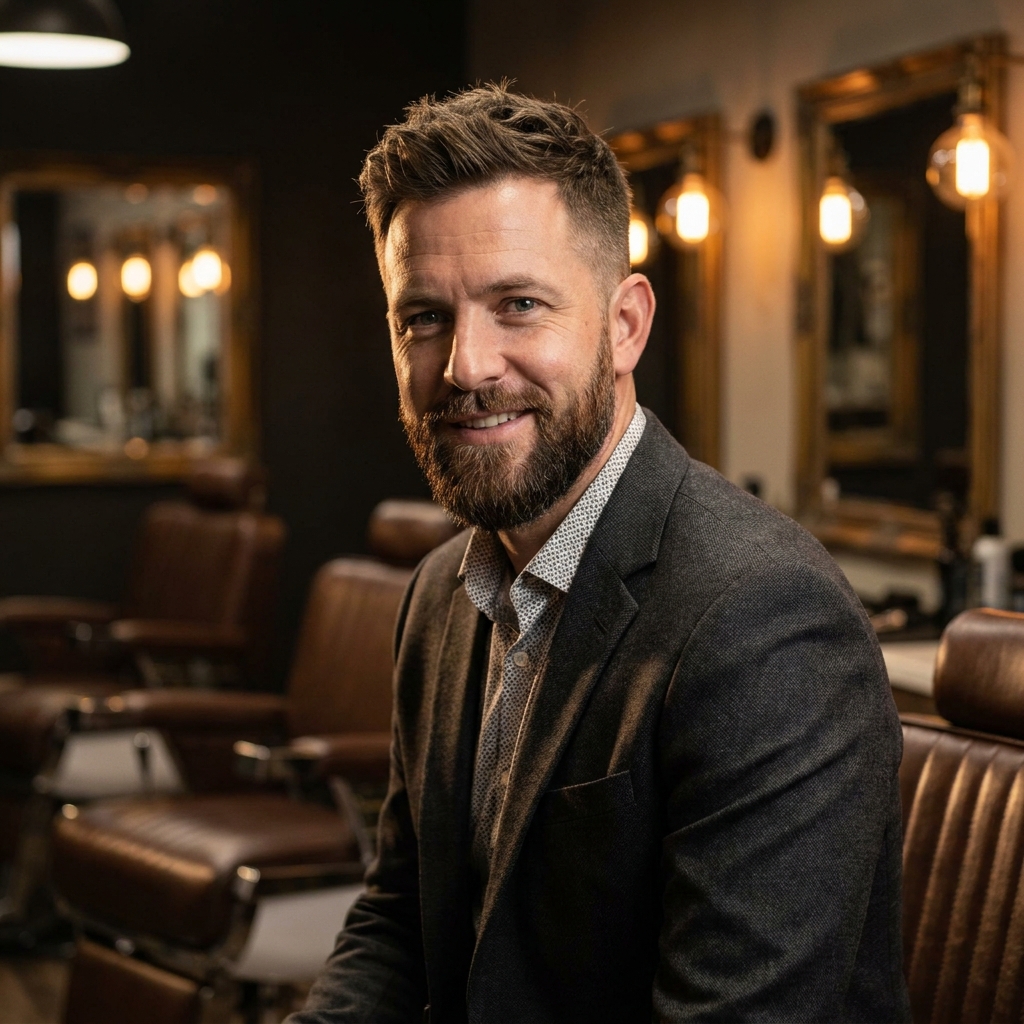
Thinning Hair Haircut Men: The Barber Script + Treatment Plan
Introduction: The Two-Part Problem Every Thinning-Hair Man Faces
Hair loss arrives earlier and touches more men than most realize. By age 35, two-thirds of American men experience some degree of noticeable hair loss, and by age 50, approximately 85% will have significantly thinning hair, according to the American Hair Loss Association. This is not a fringe concern. It is a near-universal experience.
It also carries weight beyond the mirror. In a multinational European study, over 70% of men reported hair as an important feature of their image, and 62% agreed that hair loss affects self-esteem, per PubMed. Those feelings are valid, but they are also addressable.
This guide is built around a simple two-part framework. Part one delivers the right haircut for a specific thinning pattern, an immediate confidence fix any man can act on this week. Part two introduces the treatment bridge, the long-term solution that stops the thinning for good. The right haircut makes thinning look deliberate and sharp. The right treatment stops it from getting worse. Both matter, and neither alone is enough.
Despite the prevalence of hair loss, fewer than 10% of affected men actively pursue treatment. This guide exists to close that gap by making both steps simple and actionable. A great thinning hair haircut is the starting point, not the finish line.
Why the Thinning Pattern Determines the Best Haircut
Male pattern baldness, known clinically as androgenetic alopecia, accounts for approximately 95% of male hair loss cases. It is driven by genetics and sensitivity to DHT (dihydrotestosterone), and it follows predictable patterns. Understanding that pattern is the foundation of choosing the right cut.
There are four primary thinning patterns that determine cut selection:
- Receding hairline: the temples and frontal scalp retreat
- Crown thinning: a sparse area develops at the top-back of the head
- Diffuse overall thinning: density drops across the entire scalp
- Combination or advanced thinning: multiple zones are affected simultaneously
The core principle behind every effective thinning-hair cut is contrast reduction. Short, textured cuts minimize the visual difference between sparse and dense areas, making thinning look intentional rather than accidental.
This is not exclusively a middle-age concern. Between 16% and 20% of men aged 18 to 29 already show moderate to extensive hair loss, meaning roughly one in five men notice thinning before 30. Early action on both cut and treatment matters more the sooner it begins.
Pattern-matching is essential because the wrong cut makes the problem more visible, not less. A style that flatters a receding hairline can expose a thinning crown. The sections below break down the best cuts by pattern, each paired with an exact barber script.
Pattern 1: Receding Hairline — Best Haircuts and Barber Scripts
A receding hairline draws attention to the temples and frontal scalp. The goal is to minimize the visual contrast between the hairline and the scalp behind it.
The top recommended cuts for this pattern are the textured crop with a low fade, the Caesar cut, the French crop, and the short quiff. The textured crop stands as the number one barber-recommended cut for thinning hair in 2026. Its short, choppy layers create the illusion of thickness, while a forward fringe covers the receding hairline directly.
The Caesar cut uses a forward-facing fringe as a strategic cover for the hairline, working especially well for men with moderate recession. Either cut pairs well with a low taper fade, the most requested fade style of 2026. A low taper keeps contrast gentle rather than harsh, which suits thinning hair far better than a high or skin fade.
For styling, blow-dry upward at the roots to create lift, and use lightweight matte-finish products such as texture powder or sea salt spray. Avoid heavy pomades, which flatten the hair and expose the scalp.
The Barber Script: What to Say for a Receding Hairline Cut
Bring this language directly to the appointment to remove the awkwardness of explaining thinning hair.
For the textured crop: “I have a receding hairline and I want to work with it, not against it. I’d like a textured crop: short on the sides with a low taper fade, and some choppy texture on top with a forward fringe to cover the hairline. Keep the top around [X] inches and use point-cutting or razor work to add texture, not thinning shears. I want it to look intentional and clean.”
For the Caesar cut: “I want a Caesar cut with a horizontal fringe across the front. My hairline is receding and I want the fringe to sit forward and cover it. Low fade on the sides, and keep the top uniform in length. No hard part. I want to keep as much density as possible.”
Telling the barber the thinning pattern upfront leads to a better result. A skilled professional will adjust technique accordingly, and transparency makes a meaningful difference. Above all, avoid requesting thinning shears on top, as they collapse fine strands and reduce the very density the cut is meant to preserve.
Pattern 2: Crown Thinning — Best Haircuts and Barber Scripts
Crown thinning creates a visible bald spot or sparse area at the top-back of the head. The goal is to minimize contrast and avoid any cut that exposes the crown.
The top recommended cuts are the textured crop, the crew cut, and the buzz cut. The crew cut works because uniform short length across the top reduces the contrast between the thinning crown and the denser hair surrounding it. When crown thinning becomes moderate to advanced, the buzz cut removes the contrast entirely. At a consistent short length, thinning simply reads as intentional.
A reliable approach any barber can execute is the 3-2-1 clipper guard rule: a #3 guard on top, #2 on the sides, and #1 at the fade line. This creates a safe, low-contrast look ideal for thinning hair.
Longer styles on top that fall flat over the crown should be avoided, as they create a comb-over effect. Length draws attention to sparse areas rather than away from them.
The Barber Script: What to Say for Crown Thinning
For the crew cut: “I have thinning at my crown and I want a crew cut that minimizes how visible it is. Keep the top short, around [X] inches, with a slight taper toward the crown so the length doesn’t separate and expose the scalp. Low to medium fade on the sides. No hard part. I want it to look clean and uniform.”
For the buzz cut: “I want a buzz cut that works with my crown thinning. Use a #3 guard on top and blend down to a #2 on the sides, with a #1 at the fade line. I want a low-contrast, clean look, nothing that makes the thinning at the crown stand out.”
Asking the barber to check the crown from above before finishing is advisable. That is the angle that reveals the most, and a skilled barber will adjust accordingly. Both the crew cut and buzz cut are also the easiest cuts to maintain at home between appointments, a practical benefit for men managing thinning hair.
Pattern 3: Diffuse Thinning — Best Haircuts and Barber Scripts
Diffuse thinning affects the entire scalp rather than a single zone. Overall density drops, making hair look limp, flat, and sparse across the board.
The top recommended cuts are the textured crop, the short quiff, and the buzz cut. The textured crop excels here because choppy layers and texture create the visual illusion of the volume and density that diffuse thinning removes. The short quiff offers a confidence-boosting alternative, using upward styling to create lift and the appearance of fullness. It works best for men with mild to moderate diffuse thinning.
The most effective styling approach is a three-step stack: apply sea salt spray to damp hair, blow-dry upward at the roots for lift, then finish with a small amount of texture powder worked through the ends.
Notably, diffuse thinning is often the pattern most responsive to medical treatment. For this group in particular, the treatment bridge discussed later in this guide deserves serious attention.
The Barber Script: What to Say for Diffuse Thinning
For the textured crop: “My hair is thinning overall, not just in one spot. I want a textured crop that creates the illusion of thickness. Short on the sides with a low taper fade, and on top I want choppy, disconnected texture using point-cutting, not thinning shears, which will make it look even thinner. I want the texture to create volume, not remove it.”
For the short quiff: “I have diffuse thinning across the whole top and I want a short quiff that gives me some lift and volume. Keep the sides short with a low fade, and leave enough length on top, around [X] inches, to style upward. Use point-cutting for texture. I’ll be blow-drying it up at the roots to get volume, so I need enough length to work with.”
For diffuse thinning, product choice after the cut matters as much as the cut itself. Asking the barber to recommend lightweight, volumizing products rather than heavy waxes or pomades is a worthwhile step.
Pattern 4: Advanced Thinning — The Shaved Head and Beard Strategy
When thinning becomes extensive, the most powerful move is to own it. The shaved head paired with a well-groomed beard is the number one thinning-hair styling combination of 2026.
The logic is strategic. Shaving the head eliminates the contrast between sparse and dense areas entirely, while a beard shifts visual focus downward from the scalp to the face, creating a strong, masculine aesthetic. A medium-length beard of one to three inches with clean lines and a defined neckline works best, acting as a visual anchor that balances a shaved head.
For men who keep a very short buzz rather than a full shave, blending the fade into the beard line produces a seamless, intentional look. Either way, scalp sunscreen becomes essential. The exposed scalp requires UV protection, and this has become an emerging grooming recommendation in 2026.
There is a psychological payoff as well. Men who take control of their appearance rather than trying to hide thinning consistently report higher confidence and greater social satisfaction.
The Barber Script: What to Say for the Shaved Head and Beard Combination
For the shaved head plus beard: “I want to go with a shaved head. Use a foil shaver or a #0 guard for a clean, uniform shave across the entire head. For the beard, I want to keep it at around [X] length, with clean lines on the cheeks, a defined neckline, and a fade that blends the beard into the shaved head for a seamless look. I want the overall effect to look intentional and sharp.”
For the short buzz plus beard: “I want a #1 or #2 buzz cut all over: uniform length, no fade, just clean and consistent. For the beard, keep it medium length with defined edges. I want the beard to be the focal point of my face, so make sure the lines are sharp and the neckline is clean.”
This combination is not a last resort. It is a deliberate, stylish choice that many men find more flattering and easier to maintain than fighting thinning with longer styles.
Haircuts to Avoid: What Makes Thinning Hair Look Worse
Knowing what to avoid is just as important as knowing what to request. Several common choices make thinning significantly more visible.
- Slick-backs: Pulling hair straight back exposes the scalp along the hairline and crown, one of the worst choices for any thinning pattern.
- Hard razor parts: Removing density from an already sparse area creates a stark, high-contrast line that draws the eye directly to thinning zones.
- Long, heavy styles: Length weighs fine hair down, causing strands to separate and expose the scalp. The longer the hair, the more thinning is revealed.
- Over-texturing with thinning shears: Thinning shears remove bulk from already fine strands, causing hair to collapse and look sparser. Point-cutting or razor work is the better alternative.
- High-contrast fades: A skin fade paired with thin hair on top creates a dramatic contrast that emphasizes sparse areas. A low taper fade is the safer choice.
- The comb-over: Sweeping longer hair over a bald spot is the most visible and least effective approach. It draws more attention to the thinning rather than concealing it.
- Clinging to length: The instinct to keep hair long to cover thinning is counterproductive. Shorter, textured cuts consistently look fuller and more intentional.
The Styling Stack: Products That Make Thinning Hair Look Thicker
The right cut creates the foundation, but the right products and technique complete the effect. Making thin hair look thicker requires three simultaneous approaches:
- Sea salt spray on damp hair. Apply before blow-drying to add texture and grip at the root level. It is lightweight and residue-free.
- Blow-dry upward at the roots. Direct the airflow upward and forward to create lift at the base. This is the single most effective technique for adding visual volume to thinning hair.
- Texture powder or matte clay finish. Work a small amount through the ends after blow-drying to define texture and add visual density without weighing hair down.
Heavy pomades, gel, and wet-look products should be avoided. These separate fine strands and make the scalp more visible. Notably, 2026 has seen men move away from over-styled looks toward practical, natural styles, a shift that benefits thinning-hair cuts prioritizing structure and low maintenance. Keeping the stack simple (one spray, one blow-dry technique, one finishing product) is the right approach. Consistency matters more than complexity.
The Treatment Bridge: Why the Right Haircut Is Only Half the Answer
The right haircut is an immediate confidence fix, but it does not stop the thinning. Without treatment, the loss continues and styling options narrow over time.
The medical reality is straightforward. Male pattern baldness is driven by DHT sensitivity. Without addressing the hormonal cause, hair follicles continue to miniaturize and eventually stop producing hair altogether. Treatment addresses the root cause; the haircut manages the symptom.
The rewards of treatment reach beyond appearance. Men who successfully treated hair loss reported 43% to 59% improvements in self-esteem and perception of personal attractiveness. Yet fewer than 10% of affected men actively pursue treatment, often because they do not know where to start or assume the process is complicated.
Starting early matters. The sooner intervention begins, the more hair can be preserved. The haircut buys time. The treatment stops the clock. Here is what the science says about what actually works.
What the Science Says: The 2026 Gold Standard for Hair Loss Treatment
Combination therapy is the 2026 evidence-based standard. Pairing minoxidil with a DHT blocker such as finasteride or dutasteride is the most effective non-surgical approach to androgenetic alopecia.
The clinical data is compelling. In comparative research, 94.1% of men on combination therapy showed improvement, versus 80.5% on finasteride alone and 59% on minoxidil alone. A real-world UK study of 502 men found that 92.4% achieved stable or improved hair density outcomes after 12 months on combined oral minoxidil-finasteride therapy, according to PMC. A 2025 meta-analysis of seven randomized controlled trials confirmed the combination produced clinically meaningful improvements in hair density (MD=9.22) and hair diameter (MD=2.26) over monotherapy, per PMC.
The mechanisms are complementary. Minoxidil stimulates follicle regrowth by improving blood flow to the scalp. DHT blockers prevent follicle shrinkage: finasteride blocks the Type II DHT enzyme, while dutasteride blocks both Type I and Type II, making it a more comprehensive option.
Expectations should be realistic. Results begin at three to six months, with peak improvement at nine to twelve months. Treatment is a long-term commitment, not a quick fix.
The pipeline continues to advance. Clascoterone 5% topical was submitted for FDA approval in spring 2026, showing 168% to 539% relative improvement in hair count in Phase 3 trials, and PP405 saw 31% of men achieve greater than 20% hair density increase in Phase 2 at eight weeks, per Healthline.
How Thryve Hair Lab Delivers the Treatment Plan
Thryve Hair Lab is built to serve as the convenient, medically credible bridge between the haircut fix and the long-term solution. Its flagship product is a once-daily oral capsule combining four active ingredients: minoxidil (2.5 mg), dutasteride (0.5 mg), biotin (1 mg), and vitamin D3 (600 IU). A single capsule replaces multiple separate treatments.
The dutasteride advantage is meaningful. By blocking both Type I and Type II DHT enzymes, it offers more comprehensive DHT control than finasteride-only alternatives, aligning with the combination-therapy evidence above.
The process is designed for simplicity. A 2 to 3 minute online medical questionnaire is reviewed by a licensed provider, typically within one business day, with no office visit required. Everything from consultation to prescription to discreet delivery happens online.
On cost, the 20-week plan runs $67 per month with free shipping, considerably more affordable than purchasing ingredients separately at an estimated $135 per month, with claimed annual savings of $816. Clinically, the company reports that 97% to 98% of men stop further hair loss, and 90% see visible improvement in thickness and coverage within three to six months. Only 0.3% of users report side effects, described as mild and temporary.
A one-year satisfaction guarantee offers a full refund or account credit if there are no visible results after consistent use, reducing purchase risk. The formula was developed by a team with over 100 years of combined clinical experience in hair restoration, including board-certified hair surgical specialists and transplant surgeons.
A Note on GLP-1 and Ozempic-Related Hair Thinning
In 2026, GLP-1 weight-loss drugs such as Ozempic and Wegovy have unintentionally increased demand for hair loss solutions. Rapid weight loss can trigger telogen effluvium, a form of significant hair shedding.
The mechanism differs from androgenetic alopecia, but the result (thinning hair) is the same, and the same haircut strategies apply. GLP-1-related thinning may be temporary in some cases, but it can persist or overlap with underlying androgenetic alopecia, so early treatment remains advisable. For the growing segment of men affected, the same dual-action approach of the right cut plus medical treatment is the recommended path.
Face Shape and Thinning Hair: Choosing the Right Cut for Your Features
Face shape matters differently for thinning hair. Thinning changes the visual proportions of the head, so the cut must account for both the face shape and the thinning pattern at once.
- Oval face: The most versatile shape. Almost all thinning-hair cuts work well, with the textured crop and crew cut being ideal.
- Round face: Avoid cuts that add width. A textured crop with a low fade and slight height on top elongates the face. Buzz cuts that emphasize roundness should be avoided.
- Square face: A strong jawline pairs well with a buzz cut or short textured crop. The angular shape provides natural definition that compensates for thinning on top.
- Oblong or rectangular face: Avoid adding height. A Caesar cut or French crop with a horizontal fringe balances the length of the face. Quiffs that add vertical height are not recommended.
For men with advanced thinning, the shaved head plus beard combination is the most face-shape-flexible option. The beard shape can be adjusted to complement any face regardless of scalp coverage.
Conclusion: Look Sharper This Week, Stop the Thinning for Good
The framework is clear. The right haircut is the immediate confidence fix, making thinning look deliberate, sharp, and intentional starting with the next barber appointment. But the haircut does not stop the thinning. Only medical treatment does, and the earlier it begins, the more hair can be preserved.
The action steps are straightforward: identify the thinning pattern, choose the matching cut from this guide, bring the barber script to the appointment, and start a clinically backed treatment plan.
The payoff is real. Men who treated hair loss reported 43% to 59% improvements in self-esteem and personal attractiveness. Thinning hair is not a sentence. It is a condition with proven solutions. The men who act early keep more options open. The men who wait narrow them.
Start Your Treatment Plan Today with Thryve Hair Lab
The haircut can happen this week. The long-term solution can start today.
Thryve Hair Lab makes it straightforward: a 2 to 3 minute online questionnaire, licensed provider review within one business day, and 2-day FedEx delivery. No office visit, no complexity.
The differentiators are built for results and peace of mind: a dutasteride-based formula for stronger DHT blocking, 4-in-1 convenience in a single daily capsule, pricing at $67 per month with free shipping, and a one-year satisfaction guarantee. That guarantee means there is no financial risk. If there are no visible results after consistent use, the plan comes with a full refund or account credit.
Get Started: Complete Your Free Consultation. Prefer to learn more first? Explore how the 4-in-1 formula works before committing.
The best time to start treatment is before the thinning advances. Every month of inaction is a month of continued follicle miniaturization that becomes harder to reverse.