How DHT Causes Male Pattern Baldness: The Molecular Truth
Introduction: Hair Loss Is Not a Cosmetic Accident — It Is a Biological Process Being Switched Off
The moment arrives differently for every man. Perhaps it was noticing more hair circling the drain after a shower. Maybe it was catching an unflattering angle in a photograph that revealed a thinning crown. Or watching a hairline retreat a little further each month.
Whatever the moment, the realization carries weight. And here is the truth most men are never told: hair loss is not a cosmetic accident. It is a biological process already underway inside the follicle, driven by precise molecular signals that are actively shutting down hair production.
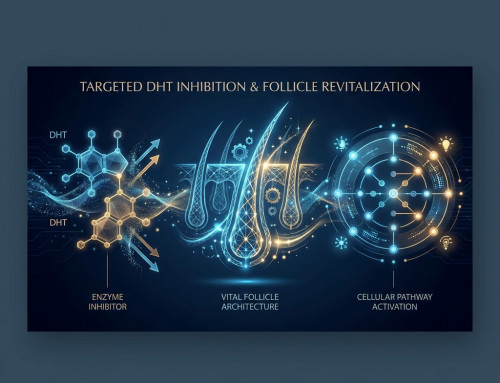
DHT, or dihydrotestosterone, does not simply “damage” hair follicles. It hijacks the follicle’s own internal signaling system, simultaneously shutting down growth signals and activating destruction signals. This dual attack is what makes male pattern baldness so relentless once it begins.
Most men have heard the surface explanation: “DHT shrinks your follicles.” But few have ever been told why or how this happens at the molecular level. This article addresses that gap.
The following sections deliver a clear, molecular explanation of exactly what DHT does inside a follicle, why some men are affected while others keep a full head of hair into old age, and what that understanding means for effective treatment.
The scale of this condition validates the experience of every man reading this. Approximately 95% of male hair loss is DHT-driven. An estimated 50 million men in the United States are affected. By age 35, two-thirds of men will have noticeable hair loss. This is not a rare condition or a sign of personal failure. It is biology.
What Is DHT and Where Does It Come From?
DHT (dihydrotestosterone) is a potent androgen derived from testosterone. It is not a foreign chemical or a toxin. It is a natural byproduct of normal male hormone metabolism that the body produces every day.
The conversion process is straightforward. The enzyme 5-alpha reductase converts testosterone into DHT. Approximately 10% of circulating testosterone undergoes this conversion. The result is a hormone that binds to androgen receptors two to three times more powerfully than testosterone itself.
DHT is not inherently harmful. It plays important roles in male development, including prostate function, body hair growth, and sexual development during puberty. The problem is site-specific sensitivity.
Here is the paradox that confuses many men: DHT stimulates hair growth on the beard, chest, and body, yet destroys hair on the scalp. The same hormone that gives a man a thick beard can simultaneously thin his hairline. This contradiction sets up a critical question that will be answered later: why do scalp follicles respond so differently?
Think of DHT as a key that fits certain locks far more tightly than testosterone does. Scalp follicles in vulnerable zones have more of those locks, which is why even small quantities of DHT can cause disproportionate damage in genetically sensitive individuals.
The Critical Distinction: It Is Not Blood DHT Levels, It Is Scalp DHT Activity
A widespread misconception drives much of the confusion around hair loss. Most men assume they need “high DHT levels” to go bald. The science says otherwise.
Roughly 80% of men with vertex or frontal thinning show higher 5-alpha reductase activity in scalp skin than unaffected men. The key driver of miniaturization is local DHT activity inside the follicle, not systemic blood levels.
This means genetically sensitive follicles can be destroyed by completely normal circulating DHT levels. Those follicles have a higher density of androgen receptors and more local 5-alpha reductase activity, making them vulnerable even when blood hormone levels are unremarkable.
Research published in PMC confirms this: “follicular miniaturization is caused by an inherited sensitivity of scalp hair follicles to normal levels of circulating androgens.”
This reframes the entire problem. The issue is not how much DHT a man produces. The issue is how his scalp follicles respond to it. Most competing content misses this critical nuance entirely.
With the location of the damage established, the next step is understanding exactly how it happens.
Inside the Follicle: The Molecular Cascade DHT Triggers
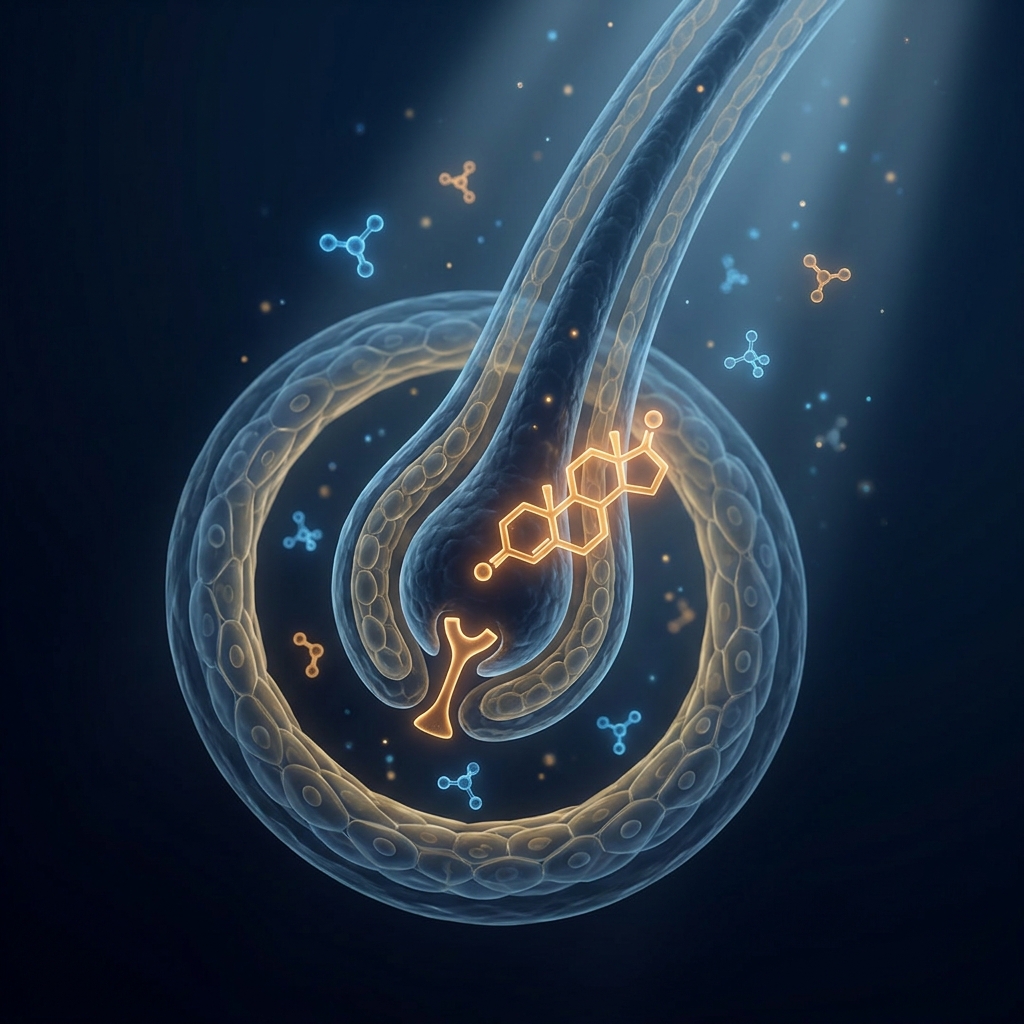
When DHT enters a genetically sensitive dermal papilla cell and binds to its androgen receptor, it does not simply “damage” the follicle. It activates a precise, multi-step biological program that leads to progressive miniaturization.
Step 1: DHT Activates the Androgen Receptor and Triggers TGF-Beta2
DHT binding to the androgen receptor (AR) in dermal papilla cells is the initiating event, functioning as the ignition switch for the entire cascade.
Once activated, the AR-DHT complex travels to the cell nucleus and upregulates the production of TGF-beta2 (transforming growth factor beta-2). This signaling protein suppresses the proliferation of epithelial cells in the hair follicle, essentially telling the cells responsible for building the hair shaft to stop dividing.
TGF-beta2 also activates the intrinsic caspase network, a series of enzymes that execute programmed cell death (apoptosis) within the follicle.
Research published in PubMed documents this mechanism: “DHT stimulates synthesis of TGF-beta2 in dermal papilla cells, which suppresses proliferation of epithelial cells and triggers the intrinsic caspase network, contributing to premature catagen entry.”
In plain terms, DHT orders the follicle to stop building hair and start dismantling itself.
Step 2: DHT Suppresses the Wnt/β-Catenin Pathway, Cutting Off the Growth Signal
The Wnt/β-catenin pathway is one of the body’s most important hair growth promoters. It signals follicle stem cells to activate, proliferate, and maintain the anagen (growth) phase.
In balding follicles, DHT suppresses Wnt/β-catenin signaling, effectively cutting the wire that tells the follicle to keep growing.
Research published in PMC confirms: “Both Wnt/β-catenin and TGF-β signaling pathways are involved in the pathologic process of AGA, with crosstalk between them representing one of the important mechanisms contributing to androgenetic alopecia.”
The crosstalk is critical to understand. TGF-beta2 (upregulated by DHT) and Wnt/β-catenin (suppressed by DHT) are in direct opposition. DHT tips the balance decisively toward destruction by amplifying one and silencing the other simultaneously.
This is the dual-attack mechanism. DHT does not attack from one direction. It suppresses growth signals while activating death signals at the same time.
Consider a factory where DHT simultaneously dismisses the workers building the product (Wnt/β-catenin suppression) and activates the demolition crew (TGF-beta2/caspase activation). The result is inevitable shutdown.
Step 3: Apoptosis, Premature Catagen, and the Shrinking Cycle
The downstream effects of TGF-beta2 upregulation and Wnt/β-catenin suppression force the follicle into premature catagen (the regression phase) long before it should be.
The three hair cycle phases work as follows: anagen (growth) lasts two to six years in healthy hair, catagen (transition) lasts approximately two weeks, and telogen (resting/shedding) lasts approximately three months. DHT aggressively shortens anagen and extends telogen.
The result is progressive miniaturization. Each successive hair cycle produces a thinner, shorter, lighter hair. The follicle shrinks with every cycle.
In pattern baldness, the ratio of full-thickness to miniaturized hairs drops below 4:1, compared to a healthy 7:1 ratio.
After enough cycles, the follicle produces only vellus (peach fuzz) hairs or stops producing visible hair entirely. The follicle itself often still exists, but in a dormant or severely miniaturized state.
This is why early intervention matters. Follicles exist on a spectrum from healthy to irreversibly scarred, and treatment is most effective before the point of no return.
Why Some Men Go Bald and Others Do Not: The Genetic Blueprint
The molecular cascade described above only fires in follicles that are genetically programmed to respond to DHT this way.
The androgen receptor (AR) gene on the X chromosome is the single most important gene in early-onset male pattern baldness. Because men inherit their X chromosome from their mother, the maternal side plays an outsized role in genetic risk.
However, this condition is polygenic. Multiple genes across multiple chromosomes contribute, not just the AR gene. The “blame your mother’s father” rule is an oversimplification.
Twin concordance data confirms the genetic basis. Identical twins have a 90% concordance rate for male pattern baldness versus only 30% in fraternal twins.
Family history contributes to 60 to 80% of male pattern baldness cases. Men with a father who experienced MPB are 2.5 times more likely to develop it.
The DHT paradox (scalp versus body hair) is explained by receptor density. Scalp follicles in DHT-sensitive zones have a higher density of androgen receptors, which is why the same DHT that destroys scalp hair simultaneously promotes beard and body hair growth. It is not about DHT quantity. It is about receptor density and follicle programming.
This also explains the “donor zone” phenomenon. Hair on the sides and back of the scalp has far fewer androgen receptors and is DHT-resistant. Transplanted hair from the back retains its growth properties even in a balding area.
What Accelerates DHT-Driven Hair Loss: The Lifestyle Amplifiers
Lifestyle factors do not cause male pattern baldness in the absence of genetic predisposition. However, they can significantly accelerate DHT-driven miniaturization in men who are already susceptible.
Chronic stress elevates cortisol, which can accelerate MPB progression by approximately 25% through the cortisol-androgen axis.
Smoking increases androgen receptor sensitivity and raises MPB risk by 23%, a rarely cited but clinically documented accelerant.
Poor diet and obesity can increase androgen conversion and local DHT activity. Metabolic dysfunction is associated with higher overall androgen turnover.
Sleep deprivation disrupts the hormonal environment that regulates the hair cycle.
While genetics cannot be changed, addressing these amplifiers gives men a degree of agency over the pace of their hair loss and complements medical treatment. Pairing lifestyle changes with evidence-based hair care practices can help slow the progression of DHT-driven miniaturization.
Hair Loss Is More Than Cosmetic: The Health Signals Worth Noting
Male pattern baldness may serve as a biomarker for broader health concerns.
Male pattern baldness is associated with a 17% higher risk of cardiovascular disease. Links to metabolic syndrome and insulin resistance have also been documented, conditions that share underlying hormonal and inflammatory pathways with AGA.
The psychological impact is real but should be framed honestly. A 2025 systematic review found that AGA has a meaningful effect on quality of life, particularly in younger men, though the impact is moderate rather than catastrophic.
Addressing hair loss is not vanity. It is taking health seriously, and treatment-seeking is a proactive, health-conscious decision.
The Window of Reversibility: Why Timing Is Everything
Follicles exist on a miniaturization spectrum from fully healthy to irreversibly scarred. Where a follicle sits on that spectrum determines how well it will respond to treatment.
In the early stages of miniaturization, follicles are still biologically active and responsive to DHT-blocking therapy. Regrowth is genuinely possible.
As miniaturization progresses, follicles become increasingly fibrotic and scarred. At the far end of the spectrum, they are permanently lost and no medical therapy can restore them.
The epidemiological urgency is clear. Twenty-five percent of men show signs of balding by age 30. One in four shows signs by age 25. The process often starts earlier than men realize.
Treatment does not cure the genetic sensitivity, but it can halt progression and, in many cases, reverse early miniaturization. This is only possible if started before follicles reach the irreversible end of the spectrum.
Transparency matters here. DHT blockers must be used long-term. Hair loss resumes within months of stopping, and regrown hair is typically lost within 12 months of discontinuation.
How DHT Blockers Work and Why Not All Are Equal
If DHT triggers the cascade, blocking DHT production at the source interrupts the entire process before TGF-beta2 is upregulated, before Wnt/β-catenin is suppressed, and before apoptosis is triggered.
5-alpha reductase inhibitors are the mechanistic solution. They block the enzyme that converts testosterone to DHT, reducing the amount of DHT available to bind to follicle androgen receptors.
There are two types of 5-alpha reductase. Type I is found primarily in the skin and scalp. Type II is found in the scalp and prostate.
Finasteride blocks only Type II 5-alpha reductase, reducing serum DHT by approximately 71%. It is effective but leaves Type I activity intact.
Dutasteride blocks both Type I and Type II 5-alpha reductase, reducing serum DHT by 90 to 94%, a significantly more complete blockade.
A 2025 network meta-analysis ranked dutasteride 0.5mg as the most effective medical therapy for male androgenetic alopecia, outperforming both finasteride and minoxidil across all dosages and routes.
By blocking both isoforms, dutasteride more completely interrupts DHT production at the scalp level, where local 5-alpha reductase activity is the primary driver of miniaturization.
The Dual-Enzyme Advantage: Why Dutasteride Addresses the Full Molecular Picture
Connecting dutasteride’s mechanism directly to the molecular cascade: the more completely DHT is suppressed at the scalp level, the less TGF-beta2 is produced, the less Wnt/β-catenin is suppressed, and the less apoptotic signaling is triggered.
Because Type I 5-alpha reductase is active in scalp skin, a drug that only blocks Type II leaves a significant pathway for local DHT production intact. Dutasteride closes both pathways.
This is the logical conclusion of the molecular science. Understanding the cascade makes the superiority of dual-enzyme blockade self-evident. For a deeper look at how this and other emerging approaches are reshaping treatment, the latest breakthroughs in hair growth research offer important context.
The safety profile is reassuring. Only 0.3% of men report side effects with dutasteride-based treatment, described as mild and temporary.
Thryve Hair Lab’s 4-in-1 Formula: Science-Backed, Doctor-Guided, Built for Long-Term Results
Thryve Hair Lab’s approach represents the practical embodiment of the science covered in this article. The doctor-formulated solution is designed around the molecular reality of DHT-driven hair loss.
The 4-in-1 daily capsule combines four active ingredients, each addressing a specific aspect of the mechanism:
- Dutasteride (0.5mg): Dual-enzyme DHT blockade, the most effective medical therapy per the 2025 meta-analysis
- Minoxidil (2.5mg): A vasodilator that improves blood flow to follicles and supports the anagen phase, complementing DHT blockade with a separate mechanism
- Biotin (1mg): Supports keratin production and hair shaft strength
- Vitamin D3 (600 IU): Nourishes follicle health and supports the cellular environment
The combination logic is clear. DHT blockade addresses the root cause. Minoxidil supports regrowth through a complementary pathway. The problem is addressed from two directions simultaneously.
The clinical team behind the formula includes specialists with over 100 years of combined clinical experience in hair restoration, including board-certified hair surgical specialists and transplant surgeons.
The efficacy data is compelling. Ninety-seven to 98% of men stop further hair loss. Ninety percent see visible improvement in thickness and coverage within three to six months.
The convenience factor removes barriers: a single daily capsule, no office visits, licensed provider review, two-day FedEx delivery, and discreet packaging.
A one-year satisfaction guarantee reduces perceived risk.
Conclusion: The Molecular Truth Points to One Clear Action
The molecular journey is now clear. DHT binds to genetically sensitive follicle receptors, triggers TGF-beta2, suppresses Wnt/β-catenin, activates caspase-mediated apoptosis, forces premature catagen, and drives progressive miniaturization toward eventual follicle loss.
The dual-attack insight is critical. DHT does not just damage hair. It simultaneously shuts off growth signals and activates destruction signals. Understanding this makes the case for treatment that addresses the mechanism at its root.
Follicles that are miniaturizing today are still treatable. But that window narrows with time. The science is clear that earlier intervention produces better outcomes.
This is a commitment, not a quick fix. But for men who are serious about their hair, the evidence strongly supports consistent, early action.
Understanding the biology means no longer being a passive observer of hair loss. The knowledge to act on it is now available.
Ready to Stop DHT at the Source? Start a Thryve Hair Lab Assessment Today
Starting the online assessment is the natural, logical next step after understanding the science.
The process is simple: a two to three minute online questionnaire, licensed provider review within one business day, and two-day FedEx delivery. The entire process from assessment to treatment in hand takes days, not weeks.
The one-year satisfaction guarantee means results within three to six months or a full refund.
Doctor-formulated, dual-enzyme DHT blockade, delivered to the door. The most effective medical approach to male pattern hair loss, simplified into one daily capsule.
Discreet packaging, no office visit required, cancel anytime. Every barrier has been removed.