
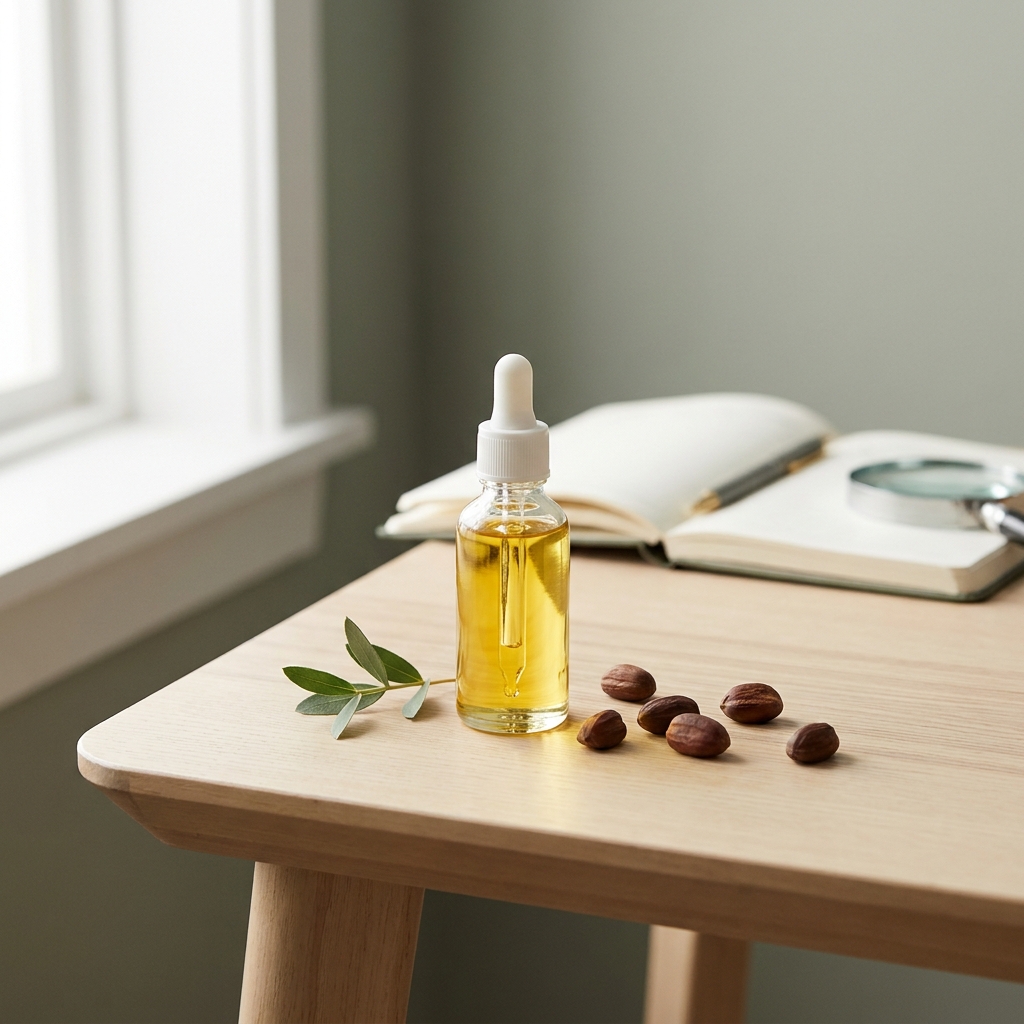
Jojoba Oil Hair Regrowth: What the Studies Actually Tested
Introduction: The Jojoba Oil Hair Regrowth Myth Starts With a Misreading of the Data
Search “jojoba oil hair regrowth” and a confident consensus appears: blogs, product pages, and forum threads repeat that jojoba oil has been “clinically shown” to stimulate follicles and thicken thinning hair.
The problem is that the claim does not survive a close reading of the research. Nearly every regrowth claim about jojoba traces back to two studies, and in both of them jojoba oil was the control or the carrier, not the treatment being tested.
The first is a 2014 mouse follicle study by Oh, Park, and Kim, published in Toxicological Research. The second is a 1998 randomized aromatherapy trial for alopecia areata, published in the Archives of Dermatology. Both are real, peer-reviewed papers, but neither shows what the internet claims it shows.
This article examines exactly where jojoba sat in each study design and why that placement changes the conclusion entirely. The appeal of the claim is understandable: watching a hairline recede or a crown thin is stressful, and a natural, low-risk fix sounds like a reasonable place to start. Still, men facing hair loss deserve accurate information, not recycled citations.
The second half of the article covers what jojoba is chemically proven to do, what it cannot do, and where real follicle-level evidence exists for men with androgenetic alopecia.
Where the “Jojoba Regrows Hair” Claim Actually Comes From
Independent reviews of the literature have reached a consistent conclusion: there are zero published human clinical trials testing jojoba oil alone for hair growth or regrowth. One analysis put it plainly, finding no published trial of jojoba oil alone for scalp health or hair growth.
Despite that gap, the claim persists because two papers get recycled across almost every source that promotes jojoba for regrowth. The pattern is predictable: a citation appears in one article, is copied into another, and eventually becomes “common knowledge” without anyone returning to the original paper to check what role jojoba actually played.
The Two Studies Behind Every Claim
The two studies are:
- The 2014 mouse follicle study (Oh, Park, and Kim, Toxicological Research)
- The 1998 alopecia areata aromatherapy trial (Hay, Jamieson, and Ormerod, Archives of Dermatology)
One is an animal study. The other is nearly three decades old and focused on an autoimmune condition. Neither was designed to test jojoba oil as an active regrowth treatment in humans with pattern hair loss. The sections below break down each one at the level of study design.
Study #1: The 2014 Mouse Follicle Study (Jojoba Was the Baseline, Not the Winner)
This study, conducted by Oh, Park, and Kim and published in Toxicological Research in 2014, used shaved C57BL/6 mice, a standard laboratory strain for hair cycle research.
What the Study Actually Tested
The purpose of the experiment was to evaluate 3% peppermint oil and its effect on hair follicle growth. The researchers compared four groups:
- Saline
- 3% minoxidil
- Jojoba oil (the vehicle control)
- 3% peppermint oil
After four weeks, the peppermint oil group produced roughly 740% more hair follicles than saline and 307% more than the jojoba group. Peppermint oil also outperformed 3% minoxidil on follicle count.
Where Jojoba Sat in the Design
Jojoba oil served as the control vehicle rather than an ingredient being measured for efficacy. Its job in the study was to provide a neutral comparison point so researchers could see whether peppermint oil did anything beyond what the base substance did on its own.
The most accurate summary is blunt: jojoba was the baseline that the active treatments were measured against, not the winner, a distinction dermatologist-reviewed analysis of the 2014 mouse study makes explicit when clarifying jojoba’s role as a control vehicle rather than an active treatment.
When an active ingredient dramatically outperforms its control, the finding is that the active ingredient works, not that the control does. In this study, jojoba was outperformed by a wide margin, the opposite of what regrowth claims suggest.
Why This Matters for Men Reading “Jojoba Regrows Hair”
Three points deserve emphasis:
- This is mouse data, not human data. Mouse follicle cycling studies do not automatically translate to androgenetic alopecia in men, which is driven by genetics and hormones.
- A substance cannot be both the inert comparison point and the proven treatment. Citing the control as the active agent misrepresents the study.
- This is the most-cited “animal evidence” for jojoba online, and it actually demonstrates jojoba’s limitations rather than its benefits.
Study #2: The 1998 Alopecia Areata Aromatherapy Trial (Jojoba Was the Carrier, Not the Cure)
The second paper is a randomized trial by Hay, Jamieson, and Ormerod, published in the Archives of Dermatology in 1998. It tested aromatherapy as a treatment for alopecia areata.
What the Study Actually Tested
The design was straightforward:
- Active group: Participants massaged a blend of essential oils (thyme, rosemary, lavender, and cedarwood) mixed into carrier oils (jojoba and grapeseed) into their scalp every day.
- Control group: Participants massaged only the carrier oils (jojoba and grapeseed) into their scalp, following the same daily ritual.
The researchers concluded that the essential oil treatment was significantly more effective than the carrier oil alone (P=.008), a result confirmed in the University of Aberdeen’s institutional record of the trial.
Where Jojoba Sat in the Design
Jojoba was part of the inert carrier-oil base in both arms of the trial. It was not an isolated variable.
That detail is decisive: because jojoba appeared in both the treatment and control groups, the study cannot attribute any of the reported benefit to it. The measurable difference came from the essential oils added on top of it.
Furthermore, the individual essential oils in the active blend were never tested separately. No single oil, jojoba included, earned its own independent result in this trial.
Why Alopecia Areata Isn’t Androgenetic Alopecia
This is the distinction most content on the topic never makes, and it is arguably the most important one.
- Alopecia areata is an autoimmune condition in which the immune system attacks hair follicles, typically causing patchy hair loss.
- Androgenetic alopecia, the condition behind most receding hairlines and crown thinning in men, is a genetic, hormone-driven process in which DHT gradually shrinks susceptible follicles.
Alopecia areata also remits spontaneously in a meaningful share of cases, which complicates any causal claim about a treatment. Different mechanisms require different evidence. Nothing in this trial supports using jojoba, or even this essential oil blend, for male pattern thinning.
The Human Evidence Gap: Why No Trial Has Tested Jojoba Alone
Strip away the two misread studies, and the remaining human evidence for jojoba as a regrowth treatment amounts to nothing. Independent reviews report no human trials testing jojoba oil alone for scalp health or hair growth.
That absence stands out because rigorous human trials do exist for other natural ingredients. A randomized, double-blind, placebo-controlled trial of pumpkin seed oil in men with androgenetic alopecia, for example, measured outcomes using phototrichography to track hair count and hair diameter. That is what genuine regrowth evidence looks like: the right population, the right condition, a placebo control, and objective measurement.
Even other telehealth companies that sell hair loss treatments have reached the same conclusion, stating that there is currently no clinical research in humans on jojoba oil’s effect on hair growth, and that it should not be relied on to stimulate follicles or reverse early balding.
What Jojoba Oil Is Chemically Proven to Do
None of this means jojoba is worthless. Its real benefits are simply different from regrowth, and understanding them helps men use it appropriately.
It’s Not Technically an Oil
Chemically, jojoba is a wax ester: a mixture of long-chain fatty acids and fatty alcohols joined by an ester bond, totaling 36 to 46 carbon atoms. That structure sets it apart from true plant oils such as coconut, argan, or olive oil, as detailed in reference material on jojoba ester composition.
According to a comprehensive 2021 review in Polymers, jojoba is the only unsaturated liquid wax readily extractable in large quantities from plant sources, making up roughly 52% of the total seed weight.
Its commercial rise has an unusual history. When the United States banned sperm whale oil (spermaceti wax) in 1974, jojoba emerged as a replacement because its structure is remarkably similar.
Sebum Mimicry and Scalp Conditioning
Jojoba’s structure closely resembles human sebum, the natural oil secreted by sebaceous glands to lubricate and protect skin and hair. When sebum production declines due to age, pollutants, or environmental stress, jojoba can help replicate that protective function.
In practical terms, jojoba can:
- Moisturize a tight, dry scalp
- Help balance excess sebum so follicles stay clear
- Support circulation when massaged in with the fingertips
This is scalp environment maintenance, not follicle stimulation.
Reduced Breakage and Hair Fiber Protection
Jojoba also coats and conditions the hair shaft, helping prevent brittleness and dullness. Less breakage means hair retains its length, which can make it look fuller.
The distinction matters: reducing breakage preserves existing hair. It does not create new hair from miniaturized or dormant follicles.
2024 Ex-Vivo Research: Anti-Inflammatory Potential in Skin Tissue
The most current and least-cited data point on jojoba comes from a 2024 ex-vivo human skin study by Tietel and colleagues in Frontiers in Pharmacology. Topical jojoba wax reduced inflammatory cytokines (IL-6, IL-8, and TNF-alpha) by about 30% and increased pro-collagen III and hyaluronic acid synthesis in human skin tissue.
The caveat is essential. This is skin tissue data, not scalp or follicle data. It suggests a plausible anti-inflammatory mechanism that may support scalp comfort, but it is not proof of regrowth.
What Jojoba Oil Cannot Do
No oil, jojoba included, reverses androgenetic alopecia. Pattern hair loss is a genetic and hormonal condition driven by DHT, not simply a shortage of moisture or an excess of inflammation.
Specifically:
- No study has confirmed that jojoba directly affects the anagen (growth) phase of the human hair cycle.
- Jojoba does not block DHT, the hormone responsible for shrinking follicles in pattern hair loss.
- Jojoba does not wake dormant follicles, the second mechanism required to meaningfully treat thinning.
The scale of the condition explains why low-risk, high-hype remedies are searched so often. Androgenetic alopecia is the most common cause of hair loss in men and affects up to 70% of men later in life, particularly those over 50.
Ranking the Options: Jojoba Oil vs. Rosemary Oil vs. FDA-Approved Treatments
Not all “natural” hair oils sit in the same evidence tier, and men deserve a clear hierarchy before choosing a strategy.
Jojoba Oil: Conditioning-Tier, Not Regrowth-Tier
Jojoba’s honest role covers scalp conditioning, sebum balance, breakage reduction, and possible anti-inflammatory support. These are useful, but they are not follicle-level effects. Jojoba is a reasonable complementary step for scalp comfort, not a standalone solution for visible thinning.
Rosemary Oil: The Natural Oil With Real Regrowth Data
Rosemary oil occupies a different tier. In a six-month randomized trial, rosemary oil matched the hair-count gains of 2% minoxidil in men with pattern hair loss. By contrast, jojoba, coconut, castor, and argan oils are characterized as conditioning the strand or supporting the scalp rather than growing new hair.
For men not yet ready for pharmaceutical treatment, rosemary oil is the more legitimate natural option. It is still not a substitute for DHT-blocking therapy in moderate-to-advanced thinning.
FDA-Approved Treatments: Where the Follicle-Level Evidence Actually Lives
Minoxidil and DHT-blocking agents remain the treatments with robust, repeated human clinical trial evidence specifically in androgenetic alopecia. Topical minoxidil and oral finasteride are FDA-approved for male pattern hair loss, while oral minoxidil and dutasteride are widely prescribed by hair loss specialists off-label, supported by a growing body of clinical data.
These therapies target the two drivers of pattern hair loss directly:
- Poor follicular blood flow and shortened growth cycles, addressed by minoxidil
- DHT-driven follicle shrinkage, addressed by finasteride or dutasteride
No essential or carrier oil has been shown to do both. For men whose thinning has moved beyond what conditioning can address, this is the evidence tier worth pursuing.
When Thinning Has Moved Past What Oils Can Fix
Early-stage thinning and receding hairlines respond best when treatment begins early. Follicles that are still producing hair, even thinner hair, are far easier to preserve than follicles that have fully miniaturized.
Androgenetic alopecia is progressive. It does not pause while a man experiments with lower-evidence remedies, and months spent relying on conditioning oils alone can mean losing hair that might have been kept.
Once hairline recession, crown thinning, or diffuse shedding becomes noticeable, a doctor-guided, clinically backed approach is the responsible next step.
Thryve Hair Lab: A Doctor-Formulated, Clinically Backed Next Step
For men who need more than scalp conditioning, Thryve Hair Lab offers a single, once-daily oral capsule that combines four ingredients:
| Ingredient | Dose | Role |
|---|---|---|
| Minoxidil | 2.5 mg | Stimulates follicle regrowth through improved blood flow |
| Dutasteride | 0.5 mg | Blocks Type I and Type II DHT enzymes |
| Biotin | 1 mg | Supports keratin production |
| Vitamin D3 | 600 IU | Supports follicle health |
Dutasteride is central to the formula. Where finasteride blocks only the Type II enzyme that converts testosterone to DHT, dutasteride blocks both Type I and Type II. That addresses the hormonal driver of androgenetic alopecia directly, something no oil can do.
For a research-minded reader, credibility matters. The formula was developed by a team of hair restoration specialists and transplant surgeons with more than 100 years of combined clinical experience. Every prescription is reviewed by a licensed provider, typically within about one business day, and no office visit is required.
The practical details are designed around privacy and simplicity:
- Discreet packaging and 2-day FedEx shipping
- TSA-compliant foil-blister packs for travel
- Subscription plans that can be modified or canceled at any time
- A 1-year satisfaction guarantee
Hair restoration takes patience. Most users report visible improvement in thickness and coverage within 3 to 6 months, with peak results typically around 9 to 12 months. These are expected timelines rather than guarantees, and individual results vary.
This is not a reason to dismiss jojoba oil’s genuine benefits for scalp care. It is the logical next step once hair loss has progressed past what conditioning oils were ever designed to treat.
Conclusion: Separate the Study From the Story
Both landmark “jojoba hair regrowth” studies used jojoba as a control or a carrier. In the 2014 mouse study, it was the baseline that peppermint oil outperformed. In the 1998 aromatherapy trial, it was part of the inert base in both groups, tested on an autoimmune condition unrelated to male pattern baldness.
Jojoba oil is genuinely useful for sebum mimicry, scalp conditioning, and breakage reduction, and 2024 research suggests it may calm inflammatory markers in skin tissue. It cannot reverse androgenetic alopecia, block DHT, or stimulate dormant follicles.
Conditioning oils are a reasonable part of a hair care routine. Men experiencing real thinning, however, need treatments with follicle-level, human clinical evidence behind them.
Ready for an Evidence-Based Plan Instead of Guesswork?
Men who are noticing a receding hairline, thinning crown, or increased shedding can find out whether they qualify for Thryve Hair Lab’s doctor-formulated 4-in-1 treatment by completing a short online questionnaire.
- 2 to 3 minutes to complete the medical questionnaire
- Licensed provider review in about one business day
- No in-person visit required
- Cancel-anytime subscription with discreet delivery
Hair loss responds best to early, informed action. With a treatment grounded in real clinical evidence and guided by experienced specialists, restoring both hair and confidence becomes a clear, achievable plan.