
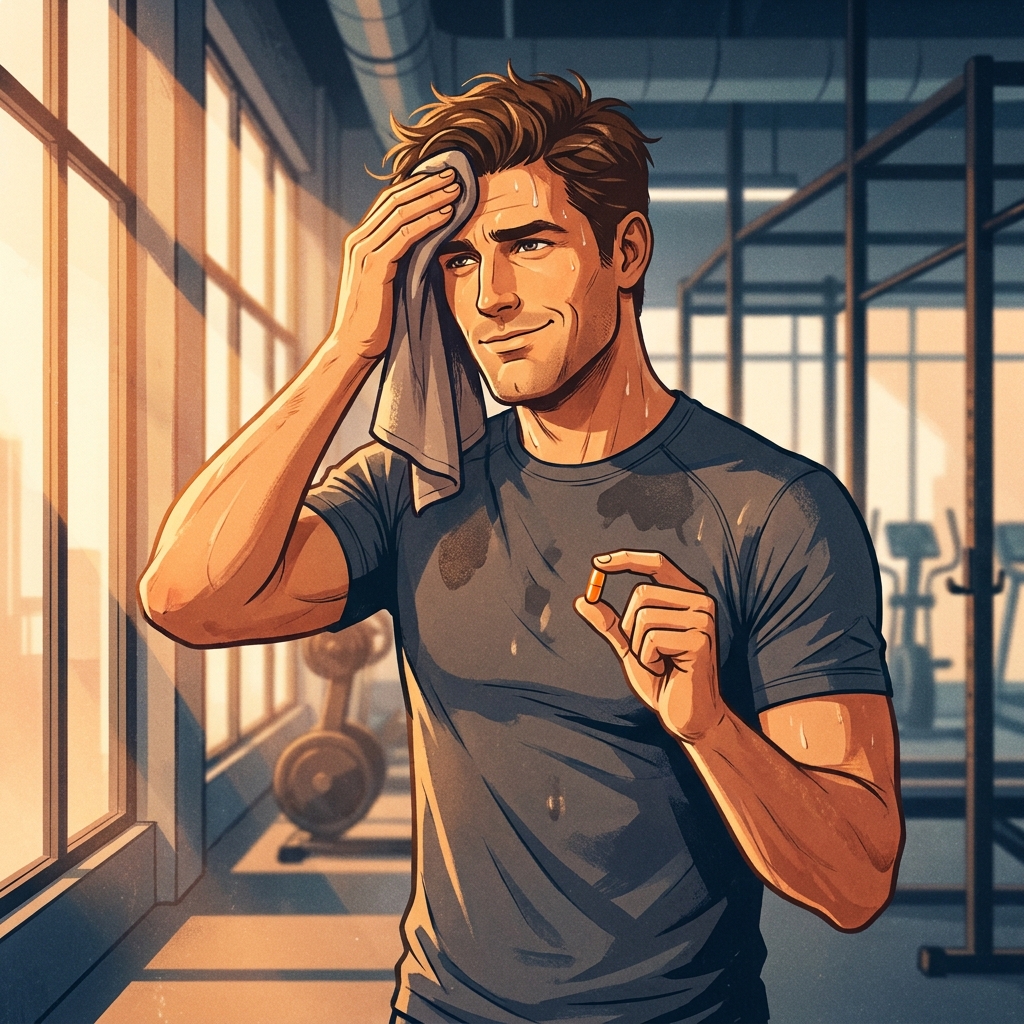
Hair Loss Treatment for Men Who Sweat a Lot: Why Topical Minoxidil Fails Active Men and What Actually Works
If a man trains hard, works outdoors, competes in endurance sports, or simply lives in a hot climate, he has likely been handed the same advice everyone else gets when hair loss begins: apply topical minoxidil twice a day and wait. For most of the population, that recommendation makes sense. But for men who sweat heavily and consistently, it quietly sets them up to fail.
This is not another article telling active men to “wait 30 minutes before the gym.” That advice misunderstands the actual problem. The reality is more uncomfortable: for men who sweat throughout the day, topical minoxidil does not just work a little less. It can be washed away before it ever does its job, delivering close to zero benefit while creating the illusion that treatment is underway.
The good news is that the science offers a clear, clinically supported solution. This is a data-driven breakdown of why topical minoxidil functionally fails sweaty men, what the evidence actually says works, and how active men can pursue a treatment that keeps working no matter how hard they train.
Why Sweating and Topical Minoxidil Are a Fundamentally Bad Combination
Topical minoxidil only works if it stays on the scalp long enough to be absorbed. According to published guidance, roughly 75 percent of topical minoxidil is absorbed within the first four hours of contact, and the ideal window is a full eight hours of uninterrupted scalp exposure. Anything that shortens that window reduces the dose the follicles actually receive.
For active men, the failure happens on two fronts. First, sweat physically dilutes and washes the solution off the scalp before it can penetrate the stratum corneum, the outer skin barrier the drug must cross. Second, exercise triggers cutaneous vasodilation, which can modestly increase how much of the remaining product enters the bloodstream systemically rather than staying local. The result is a treatment that becomes unpredictable in both effectiveness and dosing.
The problem often begins before application even starts. Oil, sweat, and leftover styling product sitting on the scalp form a barrier that blocks minoxidil from reaching the follicles. Active men, who sweat more and wash more, are more likely to have compromised scalp conditions that undermine absorption from the outset.
Formulation offers only a marginal reprieve. Foam versions dry in roughly two to four minutes, compared to twenty to thirty minutes for propylene glycol solutions. That faster drying time helps a little before light activity, but the advantage largely disappears during vigorous, sweat-heavy training. The uncomfortable conclusion is simple: for men who sweat heavily across the day, not just during a single workout, there is no reliable application window that guarantees adequate absorption.
The “Wait 30 Minutes” Advice Is Not Enough: Here’s the Math
The most common piece of advice online is to wait 30 minutes after applying minoxidil before exercising. This advice confuses two entirely different things: drying time and absorption time.
When minoxidil dries in 30 minutes, it means the product is no longer visibly wet. It does not mean the active ingredient has been absorbed. Absorption requires hours, not minutes.
Consider a realistic morning. A man applies topical minoxidil at 7:00 AM, waits the recommended 30 minutes, heads to the gym at 7:30 AM, and sweats heavily for an hour. He has disrupted absorption at the 30-minute mark, far short of the four-hour minimum threshold needed for even 75 percent uptake. The follicles received a fraction of the intended dose.
Now extend that to men who cannot control their sweat exposure at all: construction workers, landscapers, cyclists, distance runners, and anyone living in a hot, humid climate. For them, continuous daytime sweating makes every daylight application window unreliable. The issue is not timing. For these men, the problem is the delivery mechanism itself.
The Adherence Crisis: How Sweating Turns Missed Doses Into a Pattern
Even when absorption is not the issue, consistency becomes one. A 2025 analysis found that oral minoxidil users missed an average of just 0.15 treatment days per year, compared to 1.2 missed days for topical users. More striking still, zero percent of oral users discontinued treatment due to difficulty of use, versus 18.8 percent of topical users.
That gap is not about discipline. It is about friction. Timing applications around workouts, waiting for the scalp to dry, avoiding sweat, and washing after exercise creates a routine full of failure points. Every friction point is an opportunity to skip a dose, and active men encounter more of them than anyone.
Missed doses matter more than most men realize. Hair loss treatment depends on the consistent, sustained delivery of the active ingredient. Inconsistent use does not simply slow progress; it can allow DHT-driven follicle miniaturization to keep advancing while the man believes he is treating it. This is a structural problem with the topical format, not a willpower problem, and it is precisely the wrong fit for an active lifestyle.
What the Clinical Evidence Says About Oral Minoxidil for Active Men
Oral minoxidil solves the sweat problem by removing the scalp from the equation entirely. As a systemic vasodilator, it reaches hair follicles through the bloodstream, so sweating, showering, and application timing become irrelevant.
The efficacy data is compelling. A 2024 randomized clinical trial published in JAMA Dermatology compared oral minoxidil 5 mg daily against topical minoxidil 5 percent over 24 weeks in 90 men. Oral minoxidil was as effective overall and statistically superior on the vertex (crown), with a 24 percent improvement (p=0.04). A September 2025 RCT then found that 2.5 mg per day matched 5 mg in efficacy while producing fewer side effects, supporting the low-dose protocol used in modern formulations.
For active men, the clinical implication is decisive: efficacy is completely unaffected by sweating, exercise intensity, scalp hygiene, or application timing, because the medication is delivered from the inside out.
Oral minoxidil is FDA-approved for hypertension and prescribed off-label for hair loss, so it requires a prescription. Telehealth access is the practical path forward. On safety, the most common side effect is hypertrichosis (unwanted body or facial hair) at roughly 15 percent incidence, but a review in the Journal of Clinical Medicine notes it led to treatment withdrawal in only 0.5 percent of patients. Cardiovascular effects at low doses are uncommon: lightheadedness at 1.7 percent, fluid retention at 1.3 percent, and tachycardia at 0.9 percent.
Oral Minoxidil vs. Topical Minoxidil: A Direct Comparison for Active Men
| Factor | Topical Minoxidil | Oral Minoxidil |
|---|---|---|
| Delivery mechanism | Applied to scalp; requires absorption | Systemic via bloodstream |
| Sweat resistance | Poor; washed away by sweat | Complete; unaffected by sweat |
| Absorption reliability | Requires 4 to 8 hours of contact | Consistent, not scalp-dependent |
| Adherence (missed days/year) | 1.2 | 0.15 |
| Efficacy evidence | Effective when used correctly | Equal overall, superior on vertex |
| Common side effects | Scalp irritation, dermatitis | Hypertrichosis (~15%) |
| Prescription required | No (OTC) | Yes |
For the general population, topical minoxidil remains a reasonable option, and it holds the advantage of being available over the counter. But for men who sweat heavily and consistently, the data points firmly toward oral minoxidil as the clinically superior choice. The one genuine hurdle, the prescription requirement, is easily resolved through telehealth. This is not about dismissing topical treatment; it is about matching the right delivery format to the right man.
The Gold Standard: Combining Oral Minoxidil With a DHT Blocker
Minoxidil, in any form, addresses blood flow and follicle stimulation. What it does not do is block DHT, the hormone that drives male pattern baldness in the first place. To stop the underlying cause, a second ingredient is required.
That is why the 2026 gold standard for non-surgical treatment pairs oral minoxidil with a 5-alpha reductase inhibitor, either finasteride or dutasteride. The results speak clearly. A real-world UK study of 502 men published in Cureus found that 92.4 percent achieved stable or improved outcomes over 12 months on the combination, with 57.4 percent showing marked improvement.
A 2025 network meta-analysis in Frontiers in Medicine reinforced this, identifying finasteride plus minoxidil combinations as producing among the highest hair density gains of any FDA-approved approach. On its own, finasteride reduces DHT by 65 to 70 percent, stabilizes hair loss in roughly 83 percent of men, and promotes regrowth in about 66 percent.
Dutasteride goes further. While finasteride blocks only the Type II DHT enzyme, dutasteride blocks both Type I and Type II, delivering more comprehensive DHT suppression. For men with aggressive hair loss patterns, that broader coverage matters, which is why it is the DHT blocker used in Thryve Hair Lab’s formulation.
One important safety note belongs here. In October 2025, the FDA issued updated warnings on finasteride regarding potential links to depression and mood changes, and European regulators added suicidal ideation as a potential risk in 2025. These findings are reasons every man should discuss his options with a licensed provider before starting treatment, rather than reasons to avoid effective care.
Other Sweat-Proof Treatment Options Worth Knowing
Oral minoxidil paired with a DHT blocker is the primary recommendation for active men. A complete picture, however, includes several other sweat-resistant options that can serve as adjuncts or alternatives. These are supplementary tools, not replacements for the core approach.
Low-Level Laser Therapy (LLLT): A Sweat-Proof Device Option
LLLT works through photobiomodulation, using light energy to stimulate follicle activity with no topical application at all. Because nothing sits on the scalp, sweat has no effect on it whatsoever.
A 2026 prospective 12-month trial in Dermatologic Therapy found hair density rose from 99.2 to 124.2 hairs per square centimeter with a helmet-type device used three times a week, and over 85 percent of patients expressed satisfaction. A 2024 RCT found LLLT results statistically comparable to 5 percent topical minoxidil for hair density improvement.
Practically, LLLT requires consistent use, typically 20 to 30 minutes three times weekly, and carries an upfront device cost. It is best used as an adjunct to oral treatment rather than a standalone solution, and it is ideal for active men who want to maximize results without adding anything topical to their routine.
PRP Therapy: Effective but Requires Post-Treatment Sweat Avoidance
Platelet-Rich Plasma therapy is an in-office treatment that uses the patient’s own growth factors to stimulate dormant follicles, showing 70 to 80 percent efficacy in clinical research. The catch for active men is significant: patients must avoid heavy sweating for 24 to 48 hours after each session, because sweat can introduce bacteria to the treated scalp and reduce effectiveness.
Once that recovery window passes, daily sweating no longer affects the result. PRP therefore works well as a periodic boost for men who can plan around the short recovery period, but it is not a practical daily solution.
The Nighttime Application Workaround (And Why It Is Still a Compromise)
For men determined to stay with topical minoxidil, the most practical workaround is nighttime application. Applied post-shower to a clean, dry scalp before bed, minoxidil gets the full eight-hour ideal absorption window during sleep, when sweating is typically minimal.
The limitations are real. It only works for men who do not experience night sweats, who can maintain a consistent bedtime routine, and whose partners are not sensitive to the product’s residue. Even with perfect nighttime application, topical users still miss far more doses than oral users: 1.2 versus 0.15 days per year. Nighttime application is a useful optimization for occasional sweaters. It is not a reliable answer for men facing chronic, unavoidable daily sweat.
Scalp Health for Active Men: What Sweat Does to Your Follicles
There is a related concern active men should not ignore. Excessive sweat sitting on the scalp without proper hygiene can clog follicles, trigger folliculitis (scalp inflammation), and cause chronic irritation that indirectly worsens hair loss.
To be clear, sweating itself does not directly cause hair loss or follicle miniaturization. The primary driver of male pattern baldness is genetic DHT sensitivity. Intense workouts may coincide with temporary testosterone and DHT spikes that could modestly accelerate progression in genetically predisposed men, but that effect is small compared to baseline DHT levels.
The practical guidance is straightforward. Active men should wash the scalp after workouts to clear sweat, salt, and sebum, using a gentle, sulfate-free shampoo that cleans without stripping. Sweat should not be left to sit on the scalp for hours. A clean, healthy scalp maximizes the effectiveness of any hair loss treatment and supports overall follicle health regardless of which approach a man chooses.
How Thryve’s 4-in-1 Oral Capsule Solves the Sweat Problem Completely
For active men, Thryve Hair Lab’s oral 4-in-1 capsule offers a definitive solution: a single daily pill that delivers all four active ingredients systemically, with zero dependence on scalp contact time or sweat-free windows.
The formula combines:
- Minoxidil 2.5 mg to stimulate follicle regrowth through improved blood flow
- Dutasteride 0.5 mg to block both Type I and Type II DHT enzymes, offering more comprehensive suppression than finasteride
- Biotin 1 mg to support keratin production and hair strength
- Vitamin D3 600 IU to nourish and promote follicle health
The dutasteride advantage is central. By covering both DHT enzyme types rather than just Type II, it provides more complete hormonal suppression for men with aggressive loss patterns. Because everything is delivered in one capsule, there are no application timing concerns, no waiting for the scalp to dry, and no product to sweat off. It fits seamlessly into even the most demanding training or work schedule.
The efficacy benchmarks are strong: 97 to 98 percent of men stop further hair loss, 90 percent see visible improvement in thickness and coverage within three to six months, and peak results arrive at nine to twelve months. Fewer than 0.3 percent of users report mild, temporary sexual side effects, consistent with low-dose oral minoxidil data. A one-year satisfaction guarantee reduces the risk of committing, and TSA-compliant foil-blister packaging is a genuine convenience for men who travel for sport, work, or competition.
The Thryve Treatment Process: Simple, Private, and Built for Busy Men
The path to treatment is designed for men who value their time. It starts with a 2 to 3 minute online medical questionnaire. A licensed provider reviews the responses, typically within one business day, and once approved, the prescription ships via 2-day FedEx. No in-person office visit is required at any stage.
Packaging and delivery are discreet, respecting the privacy many men prefer. Pricing starts at $67 per month on the 20-week plan with free shipping, representing significant savings compared to buying the four ingredients separately (a claimed $816 per year). If the medical team does not approve treatment, a full refund is issued, so there is no financial risk at entry.
Behind the formulation is a team with over 100 years of combined clinical experience in hair restoration, including board-certified hair surgical specialists and transplant surgeons. As Dr. Glenn M. Charles put it: “After 30 years in this field, I’ve never seen a simpler, more effective option than Thryve Hair Lab’s 4-in-1 formula.”
Conclusion: Stop Letting Sweat Undermine Hair Loss Treatment
The core argument is straightforward and backed by the evidence. Topical minoxidil is not merely less effective for active men. For those who sweat heavily and consistently, it functionally fails them, washing away before the four-hour minimum absorption threshold is ever reached.
Oral minoxidil changes the equation entirely. It delivers clinically equivalent or superior efficacy, dramatically better adherence (0.15 versus 1.2 missed days per year), and zero dependence on a sweat-free application window. Paired with a DHT blocker, particularly dutasteride for its dual-enzyme coverage, it forms the most effective non-surgical approach available in 2026.
Male pattern baldness is driven by genetics and DHT, not by sweating. But choosing the wrong delivery mechanism for treatment is a controllable variable, and it is one active men should not leave to chance. The right treatment, delivered the right way, keeps working regardless of how hard a man trains, how hot his climate runs, or how physical his job is.
Ready to Start a Treatment That Works With Your Lifestyle, Not Against It?
Active men deserve a treatment built for the way they actually live. Thryve Hair Lab’s 2 to 3 minute online consultation is the first step toward one daily capsule with no topical mess, no timing concerns, and no sweat-related failures: just consistent, clinically backed treatment delivered to the door.
The one-year satisfaction guarantee means there is little to lose and a full head of hair to protect. The clinical truth is also worth acting on: hair follicles that miniaturize over time become progressively harder to restore, which means early action produces better outcomes.
For men ready to stop letting sweat sabotage their results, the next step is clear.
Start Your Free Consultation and get a personalized treatment plan built for an active life.