
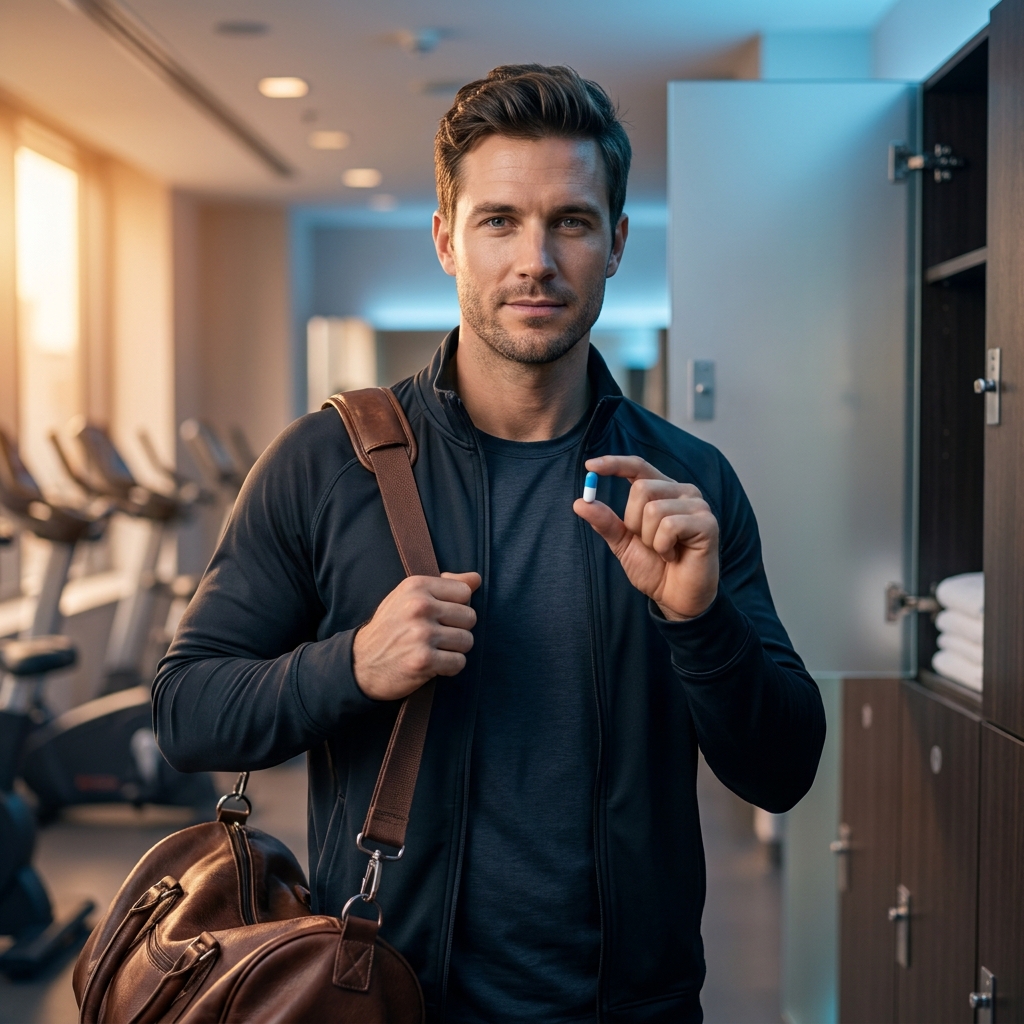
Hair Loss Treatment for Active Lifestyle Men: Why the Gym Kills Topical Treatments
Introduction: The Treatment That Works Until You Start Sweating
Picture the routine of a committed lifter. He wakes up, applies his topical minoxidil to his scalp, and heads straight to the gym. Forty-five minutes into a hard session, sweat is pouring down his forehead. What he does not realize is that his treatment, applied barely an hour earlier, is running off his scalp with that sweat before his skin ever had the chance to absorb it. He repeats this cycle every single day, convinced he is treating his hair loss when in reality he is washing it down the drain.
This is the quiet frustration facing millions of active men. Hair loss treatments were largely designed without the workout-driven lifestyle in mind, and the most widely prescribed format, topical minoxidil, is structurally incompatible with how these men actually train and live.
Hair loss treatment for active lifestyle men is a genuine, underserved problem. This is not a matter of personal preference or convenience; it is a clinical adherence issue with measurable consequences. Consider the scale: approximately 85% of men will experience some form of hair loss in their lifetime, and by age 35, roughly 40 to 65% notice thinning. A large share of gym-going men are already affected or soon will be.
This article explains why the gym kills topical treatments, what the adherence data actually says, and why an oral capsule is not merely more convenient. For the active man, it is the only format structurally compatible with his life.
Why Active Men Face a Unique Hair Loss Challenge
Active men are not simply inconvenienced by hair loss. They may be at heightened biological risk because of the very training habits that define their lifestyle.
The connection runs through DHT (dihydrotestosterone), the primary hormonal driver of male pattern baldness in genetically susceptible men. Resistance training and high-intensity interval workouts can temporarily raise testosterone levels, which in turn increases DHT conversion through the enzyme 5-alpha reductase. For a man with the genetic predisposition to androgenetic alopecia, that elevated DHT accelerates the miniaturization of hair follicles.
The type of exercise matters. Aerobic cardio has been shown to lower DHT levels, whereas anaerobic training such as weight lifting and HIIT can raise DHT in the blood, potentially accelerating hair loss in predisposed men.
There is also an emotional dimension. In a multinational European study, over 70% of men reported hair as an important feature of their image, and 62% agreed that hair loss affects self-esteem. Men who already invest heavily in their physical appearance through disciplined training tend to feel this impact more acutely. Their bodies are a project they control; hair loss can feel like the one variable they cannot.
The result is a compounding disadvantage that most hair loss content ignores entirely. Active men are simultaneously at higher DHT-driven risk and find the most common treatment format the hardest to use consistently.
How Topical Minoxidil Actually Works and Why Sweat Breaks It
Topical minoxidil works by being applied directly to the scalp and absorbed through the skin, where it stimulates follicle regrowth via improved blood flow. Absorption is the critical step. If the product does not penetrate the skin, it does nothing.
That is where sweat becomes the enemy. Clinical guidance requires users to wait at least two to four hours after application before vigorous exercise or heavy sweating, because perspiration can wash the product away before it is absorbed, reducing efficacy.
A common misconception is that foam formulations solve this problem. Foam does dry faster than liquid, but it is still subject to sweat runoff during intense exercise. Faster drying does not mean sweat resistance.
There is also the irritation problem. Sweat can increase scalp discomfort after applying topical minoxidil, leading many active men to skip application entirely on training days, which directly undermines adherence. Heavy sweating can also carry topical product to the face, neck, or forehead, causing unwanted hair growth in those areas.
For a man who trains daily, the two-to-four-hour pre-workout window and the post-workout irritation risk create a scheduling conflict with no clean solution inside the topical format.
The Sweat Timing Problem: A Day in the Life of a Topical User
Consider how this plays out in a real routine. A morning workout before the office demands application hours earlier or an inconvenient gap. An evening gym session after work collides with the second daily application. Weekend outdoor runs, cycling in humid conditions, or a game of pickup basketball all introduce sweat that interferes with absorption.
The math is unforgiving. Twice-daily topical application requires two separate two-to-four-hour windows free from any significant sweating. For a man who trains five or six days a week, that is structurally unachievable without compromising either his treatment or his training.
Outdoor activity compounds the problem. Swimming, cycling, and running in humid environments introduce sweat runoff, rain, and humidity that interfere with absorption in ways an indoor session alone does not fully capture.
Beyond the physical conflict is the psychological burden. The constant mental calculation of when the product was applied, whether it is safe to train, and whether it sweated off adds cognitive friction that erodes adherence over months. Treatment fatigue is a real clinical outcome.
If a man has struggled with topical timing, he is not failing at his treatment. The treatment format is failing him.
The Data Does Not Lie: How Active Lifestyles Sabotage Topical Adherence
Peer-reviewed research confirms what active men already experience intuitively.
A cross-sectional study published in the Journal of Drugs in Dermatology in 2025 found that oral minoxidil patients missed a mean of just 0.15 treatment days per month, compared to 1.2 days for topical users. That is roughly an eightfold difference in missed doses.
The discontinuation gap is even more striking. Zero oral minoxidil patients stopped treatment because it was too difficult to use, versus 18.8% of topical users. Nearly one in five topical users quit because the format itself was too hard to maintain.
Clinically, missed doses are not trivial. Hair loss treatment requires consistent, uninterrupted use to hold results. Every missed day is a gap in protection that allows DHT-driven follicle miniaturization to continue. Adherence to topical regimens is documented as “suboptimal” across the clinical literature. This is a recognized problem, not an individual failure.
Connecting the data to the active lifestyle reveals an important point. That 1.2 missed days per month is a population average across all topical users. For men who train five or six days a week, the real-world missed dose rate is almost certainly higher, making the adherence gap even more pronounced.
Does Working Out Make Hair Loss Worse? What the Research Shows
Active men frequently ask whether training itself accelerates their hair loss. The honest answer requires nuance.
Exercise does not cause hair loss. However, the type of exercise matters for men with a genetic susceptibility to androgenetic alopecia. HIIT and weight training can raise DHT levels in the blood, and in genetically predisposed men, elevated DHT accelerates the follicle miniaturization that defines male pattern baldness.
The key variable is genetic sensitivity. Men without the predisposition are unlikely to see any training-related acceleration in their hairline. For those who do carry the genetic risk, the sustained DHT elevation associated with regular anaerobic training creates a more aggressive biological environment.
By contrast, moderate aerobic exercise has been associated with lower DHT levels and may be neutral or mildly protective. This is not a reason to abandon weight training; rather, it is context for understanding the hormonal environment active men operate within.
Because active men may face elevated DHT exposure from training, effective DHT-blocking treatment becomes even more important, and consistent adherence to that treatment becomes the single most critical variable.
Oral vs. Topical: The Clinical Case for Active Men
Oral minoxidil is not a compromise or a merely acceptable alternative. For active men, it is the format that removes every structural barrier the topical version creates.
Start with efficacy. A 2025 meta-analysis in the International Journal of Dermatology found that oral minoxidil performs comparably to topical minoxidil in hair density outcomes, with studies suggesting better patient adherence than the topical form. Active men do not sacrifice results by switching formats.
The combination advantage is equally significant. A 2026 network meta-analysis confirmed that combination therapy pairing minoxidil with a DHT blocker demonstrates over a 90% success rate in stabilizing or reversing hair loss, making it the most powerful non-surgical protocol available. Real-world evidence supports this: a 2025 UK retrospective study of 502 men on combined oral minoxidil-finasteride therapy found 92.4% achieved stable or improved hair outcomes over 12 months (Cureus).
There is also a styling benefit. A 2025 clinical study found that oral minoxidil patients reported greater ease of styling their hair on treatment, a direct quality-of-life advantage for men who shower and style after every workout.
The core reframe is this: oral treatment wins for active men not simply because it is easier, but because ease of use directly drives adherence, and adherence directly drives outcomes. For the active man, convenience is not a comfort feature; it is the mechanism of efficacy.
What to Look for in an Oral Hair Loss Treatment
An informed consumer evaluating oral hair loss treatments should look for several specific components.
- Minoxidil. This stimulates follicle regrowth through improved blood flow. Low-dose oral minoxidil at 2.5 mg has been shown in clinical studies to be effective with a favorable safety profile.
- A DHT blocker. Dutasteride blocks both Type I and Type II 5-alpha reductase enzymes, making it more comprehensive than finasteride, which targets only Type II. For active men with elevated DHT from training, that broader coverage is particularly relevant.
- Supporting nutrients. Biotin supports keratin production and hair structural integrity. Vitamin D3 has been linked to follicle health and is commonly deficient in men who train intensively indoors.
- Once-daily dosing. A single capsule taken at the same time each day, whether with morning coffee, a pre-workout, or a post-gym meal, integrates into existing habits without creating new scheduling conflicts.
- Prescription oversight. Legitimate oral hair loss treatments require licensed provider review. This is a quality signal that protects the patient and ensures the treatment fits their health profile.
- Travel-friendly packaging. TSA-compliant packaging matters for men who travel for competitions, races, or work. Treatment continuity should never be disrupted by a trip.
How Thryve Hair Lab’s 4-in-1 Capsule Is Built for the Active Man
Thryve Hair Lab addresses every structural problem outlined above. Its flagship product is not a generic supplement; it is a doctor-formulated, once-daily oral capsule purpose-built for the way active men live.
The formula combines four active ingredients in a single capsule:
| Ingredient | Dose | Function |
|---|---|---|
| Minoxidil | 2.5 mg | Stimulates follicle regrowth via improved blood flow |
| Dutasteride | 0.5 mg | Blocks Type I and Type II DHT enzymes to prevent follicle shrinkage |
| Biotin | 1 mg | Supports keratin production and hair strength |
| Vitamin D3 | 600 IU | Nourishes and promotes follicle health |
The dutasteride advantage deserves emphasis. By blocking both Type I and Type II DHT enzymes, it provides more comprehensive protection than finasteride, which is especially relevant for men whose training may elevate DHT.
Connecting that formula to the adherence data clarifies the practical benefit. One capsule, once daily, means no scalp application, no absorption windows, and no sweat interference. The 0.15 missed days per month adherence rate becomes genuinely achievable because there is no format friction to overcome.
The process is equally frictionless. A 2-to-3-minute online medical questionnaire, licensed provider review typically within one business day, and 2-day FedEx delivery mean no gym sessions are sacrificed for clinic appointments. The treatment is formulated by a team with over 100 years of combined clinical experience in hair restoration, including board-certified hair transplant surgeons. This is prescription-grade care, not a wellness product.
The efficacy claims align with the broader research. Thryve reports that 97 to 98% of men stop further hair loss and 90% see visible improvement in thickness and coverage within three to six months, consistent with the 90%-plus success rates documented for combination therapy in the clinical literature. A one-year satisfaction guarantee removes the risk of trying a new format, offering a full refund or account credit if there are no visible results after consistent use.
Real Results: What Active Men Can Expect on Oral Treatment
Realistic expectations build trust and reduce the anxiety of starting something new.
The timeline is well established. Results begin at three to six months, with peak improvement arriving at nine to twelve months, consistent with the clinical literature on combination oral therapy.
Some men experience temporary increased shedding in the first four to eight weeks as follicles transition into a new growth cycle. This is a normal part of the process, not a sign the treatment is failing.
Customer experiences reflect these timelines. Chris L., age 39, saw his hairline filling in at three months. Jason M., age 34, reported baby hairs returning at the hairline within the same window. Marcus G., age 29, noted new growth at his temples and praised the discreet process.
The single most important variable is consistency. The oral format removes the barriers, but the daily commitment remains the patient’s responsibility. Taken every day, the capsule delivers the adherence advantage the data promises.
On safety, honesty matters. Fewer than 0.3% of users report mild, temporary sexual side effects, a legitimate concern worth addressing directly rather than avoiding.
Conclusion: Stop Letting the Gym Undo Your Treatment
Active men are not failing at hair loss treatment. The topical format is failing them by creating structural incompatibilities with how they actually live.
The eightfold difference in missed treatment days between oral and topical users is a measurable outcome gap, not a comfort preference. Convenience, for the active man, is a clinical advantage.
Consider the dual reality. Elevated DHT from anaerobic training increases the biological need for consistent treatment, while the sweat-timing constraints of the topical format make consistent treatment hardest to achieve. Oral treatment resolves both sides of that equation at once.
For men with active lifestyles, an oral combination capsule containing both a DHT blocker and minoxidil is not just the most convenient option; it is the most clinically rational one. The men who see the best results are those who remove every barrier between themselves and consistent treatment. For the active man, switching to oral is the single most impactful step available today.
Take the First Step Toward Treatment That Works With Your Lifestyle
For a man who now understands why his current approach may be falling short, the next step is straightforward.
Thryve Hair Lab’s online consultation begins with a 2-to-3-minute medical questionnaire, followed by licensed provider review typically within one business day and 2-day FedEx delivery. The entire process fits neatly between gym sessions, with no office visit required.
Every remaining barrier has been removed: discreet packaging, the freedom to cancel anytime, and a one-year satisfaction guarantee that stands behind the results. Plans start at $67 per month with free shipping, and the 4-in-1 capsule replaces multiple separate products, saving up to $816 per year compared to buying ingredients individually.
Start the consultation today and get a treatment plan built for how active men actually live.