
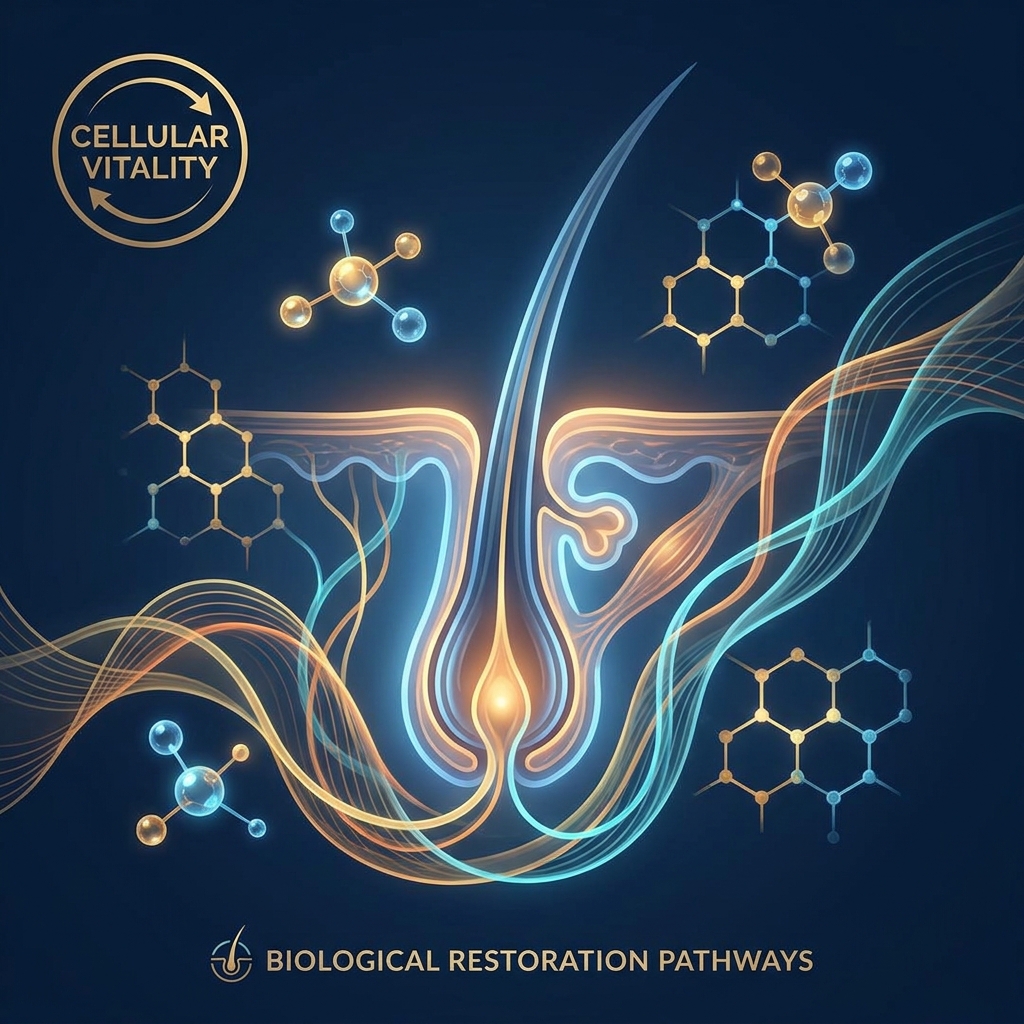
Hair Follicle Restoration Treatment: The Biology That Determines Success
Introduction: The Biology Behind Hair Loss Is More Actionable Than You Think
Approximately 85% of men experience noticeable hair loss by age 50, and roughly 16% of men aged 18 to 29 already show early signs of male pattern baldness. These numbers establish a clear reality: hair loss is not an outlier condition but a biological process that affects the vast majority of men at some point in their lives.
Most men approach hair loss as an aesthetic problem, something to conceal or accept. However, hair loss is fundamentally a biological process with specific, identifiable checkpoints. Each of those checkpoints can be targeted with the right compounds and interventions.
This article explains not just what causes follicle miniaturization, but precisely how specific ingredients intervene at each biological stage to restore function. The distinction between dormant and dead follicles serves as the foundational concept. Many follicles in thinning areas are not gone; they are stalled. This distinction determines whether restoration is possible.
The science is clear, the mechanisms are well documented, and the tools to address follicle health have never been more accessible. A coordinated, multi-compound approach that addresses multiple biological pathways simultaneously changes how any treatment should be evaluated.
How Hair Follicles Actually Work: The Growth Cycle You Need to Understand
Hair follicles operate on a three-phase cycle that determines visible hair production. The anagen phase represents active growth, lasting two to seven years. The catagen phase is a brief transition period of approximately two weeks. The telogen phase is the resting and shedding period, lasting around three months. Healthy hair requires follicles to re-enter anagen reliably after each cycle.
The hair follicle is one of the most metabolically active structures in the human body. This high metabolic demand makes follicles uniquely sensitive to hormonal signals, nutritional status, and vascular supply. Any disruption to these inputs can trigger premature entry into the resting phase.
At the base of each follicle sits the dermal papilla, a cluster of specialized cells that orchestrates growth signals. The dermal papilla communicates with stem cells and determines whether a follicle enters or exits anagen. Follicle stem cells reside in the bulge region of the outer root sheath and serve as the reservoir for follicle regeneration, remaining present even in miniaturized follicles.
In androgenetic alopecia, the anagen phase shortens progressively over successive cycles. Each cycle produces finer, shorter hairs until the follicle generates only vellus hair or stops producing hair entirely. This is miniaturization in action, not sudden loss. At the molecular level, Wnt signaling promotes follicle proliferation while TGF-β signaling induces miniaturization. Hair loss is fundamentally a signaling imbalance, not simply a structural failure.
The Root Cause: How DHT Hijacks the Follicle
DHT, or dihydrotestosterone, is the primary driver of androgenetic alopecia. Testosterone converts to DHT through the enzyme 5-alpha reductase, which exists in two isoforms: Type I and Type II. Both contribute to DHT production in the scalp.
The mechanism is well established. DHT binds to androgen receptors in dermal papilla cells, triggering a cascade that shortens the anagen phase, reduces follicle size, and progressively miniaturizes the hair shaft over successive cycles. This process is gradual and cumulative. Each growth cycle produces a slightly thinner, shorter hair until the follicle produces only fine, colorless vellus hair or stops producing hair entirely.
The concept of a “point of no return” is critical. Follicle miniaturization exists on a spectrum from reversible to irreversible. Early-stage miniaturized follicles can often be reactivated. Permanently atrophied follicles cannot. This makes the timing of intervention the single most critical factor in restoration success.
Recent research confirms that hair loss is influenced by many genes affecting follicle growth, survival, and hormone response. However, genetic predisposition does not mean inevitable, untreatable loss. Understanding DHT’s mechanism explains why blocking it is necessary, but not sufficient. Restoration requires addressing multiple biological deficits simultaneously. The science behind hair loss confirms that a multi-pathway approach is essential for meaningful results.
Dormant vs. Dead: Why the Distinction Changes Everything
A follicle that has stopped producing visible hair is not necessarily dead. In many balding areas, follicle stem cells remain dormant: present but not activated. These dormant follicles have lost the signaling environment they need to re-enter anagen, including insufficient blood flow, reduced growth factor availability, disrupted VDR signaling, and ongoing DHT suppression.
Scientific validation continues to mount. In March 2026, a US and Japan research team grew fully functional hair follicles in a lab for the first time. These follicles cycle through natural growth phases, confirming that follicle biology is reactivatable under the right conditions. Companies like Pelage Pharmaceuticals are targeting dormant hair follicle stem cells via a UCLA-discovered metabolic switch called PP405, with Phase 3 trials launching in 2026. This further validates the reactivation model.
The practical implication is significant. The window during which dormant follicles can be reactivated is finite. The longer miniaturization progresses without intervention, the more follicles cross from dormant to permanently atrophied. Effective hair follicle restoration treatment must address the biological environment that keeps follicles dormant, not just stimulate surface-level growth.
The Two Biological Pathways That Determine Restoration Success
Restoration requires addressing two distinct but complementary biological pathways. The first is vascular supply, the follicle’s lifeline. The second is follicle cycling regulation, the follicle’s internal clock.
Most treatments address only one pathway, which explains why single-ingredient approaches produce limited results. Understanding both pathways is essential for evaluating any treatment protocol.
The first pathway involves VEGF-driven perifollicular vascularization, ensuring the follicle receives the blood flow and nutrients it needs to sustain anagen. The second pathway involves VDR-mediated follicle cycling, regulating the cellular signals that determine whether a follicle stays in telogen or re-enters anagen.
These pathways operate independently at the molecular level and can be targeted simultaneously without interference. Simultaneous targeting creates a compounding restoration effect. Minoxidil operates primarily on the vascular pathway. Vitamin D3 operates primarily on the cycling pathway. This makes them biologically complementary rather than redundant.
Pathway One: Minoxidil and the VEGF Vascularization Mechanism
Minoxidil’s primary mechanism involves upregulating VEGF (vascular endothelial growth factor) in dermal papilla cells in a dose-dependent manner. This increases perifollicular vascularization and blood flow to the follicle.
The molecular pathway is well characterized. Minoxidil inhibits HIF-prolyl hydroxylase, stabilizing HIF-1 (hypoxia-inducible factor), which in turn drives VEGF secretion. This is a peer-reviewed mechanism, not a hypothesis.
Vascularization matters because the anagen phase is metabolically demanding. Without adequate blood supply, the dermal papilla cannot sustain the growth signals needed to keep follicles in active production. Minoxidil also activates potassium channels in dermal papilla cells, promotes survival of dermal papilla cells via ERK and Akt pathway activation to prevent apoptosis, and activates the β-catenin pathway. These mechanisms support anagen prolongation beyond simple vasodilation.
Clinical evidence supports these mechanisms. 62% of men experienced hair regrowth in affected areas after one year of using 5% minoxidil. A 2025 network meta-analysis found finasteride combined with minoxidil is the most effective regimen for male androgenetic alopecia. Search interest in minoxidil was over six times higher in 2025 than in 2016, reflecting growing recognition of its evidence base.
Minoxidil addresses the vascular environment of the follicle. However, it does not regulate the follicle’s internal cycling machinery. That requires a different biological intervention.
Pathway Two: Vitamin D3 and VDR-Mediated Follicle Cycling
The Vitamin D Receptor (VDR) is the key molecular actor in follicle cycling. VDR is expressed in the outer root sheath, hair matrix, and dermal papilla: the core structures that regulate follicle cycling.
When active Vitamin D3 (1,25-(OH)2D3) binds to VDR, it regulates keratinocyte proliferation, hair follicle stem cell maintenance, and the transition from telogen back to anagen. When VDR activity is insufficient, follicles stall in the resting phase, unable to receive the signal to re-enter anagen. This state resembles hair loss but is actually a cycling failure.
The deficiency data is striking. A 2024 Frontiers in Nutrition meta-analysis found Vitamin D deficiency in 47.38% of male androgenetic alopecia patients, 51.94% of alopecia areata patients, and 53.51% of telogen effluvium patients. This makes Vitamin D one of the most prevalent nutritional co-factors in hair loss.
In vivo evidence confirms that active Vitamin D3 prolongs the anagen phase and enhances the proliferation and migration of dermal papilla cells and outer root sheath keratinocytes in a VDR-dependent manner. However, clinical data from February 2026 indicates that correcting Vitamin D deficiency alone may not restore hair growth if VDR function within the follicle is impaired. This reinforces that supplementation must be part of a broader protocol, not a standalone fix.
The Synergy Effect: Why These Pathways Work Better Together
Minoxidil and Vitamin D3 operate on different biological pathways: vascular supply versus follicle cycling. They address different failure points simultaneously without overlap or redundancy.
The compounding logic is straightforward. A follicle that receives improved blood flow through minoxidil but still lacks the cycling signal to re-enter anagen due to VDR deficiency will not restore. Conversely, a follicle with corrected VDR signaling but insufficient vascular support cannot sustain anagen. Both conditions must be met.
Clinical evidence supports this synergy. The combination of Vitamin D with minoxidil has demonstrated enhanced efficacy in female pattern hair loss and chemotherapy-induced alopecia, suggesting the multi-pathway mechanism produces outcomes neither ingredient achieves alone.
Consider the follicle as a dormant engine. Minoxidil restores the fuel supply through blood flow and nutrients. Vitamin D3 provides the cycling signal. Both are required to restore function. This synergy principle explains why dermatologists increasingly recommend multi-modal approaches to hair restoration in 2026.
Even with restored blood flow and corrected cycling signals, ongoing DHT activity will continue to miniaturize follicles. Blocking DHT is the third biological checkpoint that must be addressed.
Blocking DHT at the Source: Why Dutasteride Outperforms Standard Options
DHT blocking is the third essential component of a complete restoration protocol. Without it, the follicle environment may improve but DHT continues to drive miniaturization.
Two 5-alpha reductase isoforms exist. Type I is found in sebaceous glands and skin. Type II is found primarily in hair follicles and the prostate. Both contribute to DHT production in the scalp.
Finasteride blocks only Type II 5-alpha reductase, leaving Type I activity intact. This means DHT production continues through an unblocked pathway. Dutasteride blocks both Type I and Type II 5-alpha reductase, providing more comprehensive DHT suppression at the follicle level. This dual-isoform blockade translates to more complete DHT reduction in scalp tissue, a meaningful biological advantage for men with moderate to advanced miniaturization.
Regarding side effects, less than 0.3% of men using the Thryve Hair Lab formula report side effects, described as mild and temporary. Dutasteride addresses the hormonal driver. Minoxidil addresses the vascular environment. Vitamin D3 addresses the cycling signal. Three distinct checkpoints require three distinct interventions.
The Role of Biotin: Supporting the Infrastructure of Hair Production
Biotin is not a primary restoration agent but a structural support ingredient. It ensures the follicle has the raw materials needed for keratin production.
Biotin (Vitamin B7) is a cofactor for carboxylase enzymes involved in fatty acid synthesis and amino acid metabolism. Both are essential for keratin, the protein that constitutes the hair shaft. Biotin deficiency, while less common than Vitamin D deficiency, can impair hair shaft quality and contribute to brittleness and breakage, undermining the visible results of follicle restoration.
As follicles reactivate and re-enter anagen, they need adequate keratin infrastructure to produce strong, visible hair. Biotin supports the quality of regrowth, not just its occurrence. With all four biological checkpoints addressed, the question becomes how these ingredients work as a coordinated system rather than a collection of separate supplements.
A Coordinated Biological Intervention: How the 4-in-1 Protocol Addresses Each Checkpoint
The Thryve Hair Lab 4-in-1 formula functions as a coordinated biological intervention. Each component targets a specific, identified failure point in the hair loss cascade.
The checkpoint-to-ingredient mapping is clear: DHT suppression through dutasteride; vascular restoration through minoxidil and VEGF upregulation; follicle cycling reactivation through Vitamin D3 and VDR activation; keratin infrastructure through biotin.
The oral delivery format matters biologically. Systemic absorption ensures that all four compounds reach the dermal papilla and follicle structures via the bloodstream, which is the same route through which DHT and nutritional deficiencies affect follicle function.
The formula was developed by specialists with over 100 years of combined clinical experience in hair restoration, including board-certified hair surgical specialists and transplant surgeons. The efficacy data supports this approach: 97 to 98% of men stop further hair loss, and 90% see visible improvement in thickness and coverage within three to six months. Results begin at three to six months with peak improvement at nine to twelve months.
The biological window during which dormant follicles can be reactivated is finite. The 4-in-1 protocol is most effective when initiated before follicles cross from dormant to permanently atrophied.
What the Research Says About Timing: The Early Intervention Window
The demographic reality has shifted dramatically. According to the ISHRS 2025 Practice Census, 95% of first-time hair restoration surgery patients in 2024 were between ages 20 and 35. This reflects growing awareness of the dormant versus dead distinction.
The biological basis for early action is clear. Follicle miniaturization is a progressive, reversible-to-irreversible spectrum. Early-stage miniaturized follicles retain stem cell populations and vascular connections that can be reactivated. Late-stage atrophied follicles do not.
High stress increases the odds of sudden hair shedding (telogen effluvium) by approximately 1.5 times. Stress-triggered shedding can accelerate the miniaturization timeline, narrowing the restoration window. Vitamin D deficiency affects nearly half of male androgenetic alopecia patients, and the hair follicle’s metabolic demands during anagen make it particularly vulnerable to nutritional gaps.
Men who act during the dormant phase, before follicles permanently atrophy, have a significantly higher probability of visible restoration. Men who wait until advanced thinning may require surgical intervention rather than medical restoration. The science is clear: earlier intervention produces better outcomes. Reviewing new breakthroughs in hair growth research further reinforces why acting within this window is so critical.
What to Realistically Expect from a Hair Follicle Restoration Treatment
Follicle reactivation is not instantaneous. Dormant follicles must re-enter anagen, produce a new hair shaft, and grow that shaft to visible length. This process takes months, not weeks.
The clinical timeline is consistent: results typically begin at three to six months, with peak improvement occurring at nine to twelve months of consistent use. This aligns with the biological reality of the anagen cycle.
Real-world outcomes from Thryve users describe hairline filling in at three months, baby hairs returning at the hairline, and new growth at the temples. These outcomes are consistent with follicle reactivation, not just hair thickening. Before and after results from Thryve Hair Lab users illustrate these timelines in practice.
Consistency matters biologically. The anagen phase must be sustained over multiple cycles to produce lasting results. Interrupting treatment allows DHT suppression to lapse and vascular support to diminish, potentially reversing progress.
Some men experience increased shedding in the first four to eight weeks of minoxidil use. This occurs as follicles are pushed from telogen into anagen simultaneously and is a known biological response, not a sign of failure. The Thryve Hair Lab 1-year satisfaction guarantee aligns with the biological timeline, giving men the full restoration window before evaluating outcomes.
Conclusion: The Biology Is on Your Side If You Act Within the Window
Hair follicle miniaturization is a multi-checkpoint process driven by DHT, vascular insufficiency, disrupted follicle cycling, and nutritional deficits. Each checkpoint can be targeted with the right compounds.
The dormant versus dead distinction is the most actionable insight. For men in the early-to-moderate stages of hair loss, the follicles are likely still present and reactivatable. The biology supports restoration, not just maintenance.
Minoxidil’s VEGF-driven vascularization and Vitamin D3’s VDR-mediated cycling regulation operate on different pathways, creating a compounding restoration effect that neither ingredient achieves alone. Dutasteride’s dual-isoform DHT blockade addresses the root hormonal driver simultaneously.
Understanding the biology is not academic. It explains why a coordinated, multi-compound protocol produces superior outcomes compared to single-ingredient approaches. The timing of that intervention determines the ceiling of what is achievable.
The science of hair follicle restoration has never been more advanced, and the tools to act on that science have never been more accessible. The question is not whether restoration is biologically possible. The question is whether action happens within the window when it is.
Take the First Step Toward Follicle Restoration
If the biology in this article describes what is happening to a patient’s hair, there is a clinically backed protocol designed to address each of those biological checkpoints in a single daily capsule.
The process is straightforward: a two to three minute online questionnaire, licensed provider review within one business day, and two-day FedEx delivery. No office visits, no complexity, no waiting rooms.
Thryve Hair Lab’s 4-in-1 formula was developed by specialists with over 100 years of combined clinical experience in hair restoration, including board-certified hair surgical specialists and transplant surgeons.
The 1-year satisfaction guarantee means the full biological timeline is available to evaluate results with no financial risk. At $67 per month, the 4-in-1 formula delivers all four clinically active compounds in a single prescription, compared to approximately $135 per month when purchasing ingredients separately.
Start the online consultation today and take the first step toward restoring the follicle environment the hair needs to grow.