
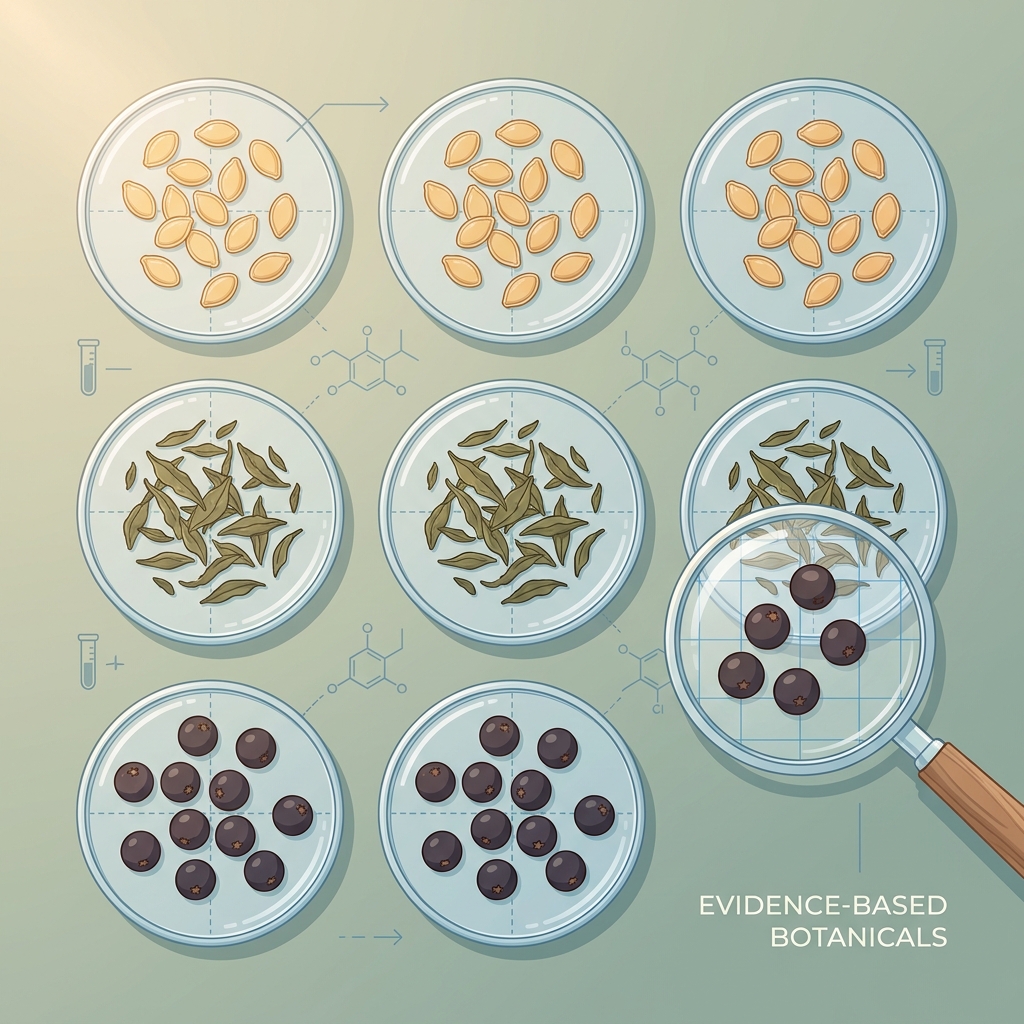
DHT Blocker Foods: The Real Evidence Behind the Hype (2026)
Introduction: The DHT Blocker Food Hype vs. the Real Science
Search for “DHT blocker foods” and the same list appears again and again: pumpkin seeds, green tea, soy, onions, saw palmetto, and tomatoes rich in lycopene. The formats vary, but the claims are nearly identical, each presented with the same unearned confidence.
The problem is that these lists rarely distinguish between a human clinical trial, a study on rat liver tissue, and an experiment in a petri dish. A compound that inhibits an enzyme in a lab dish is placed on the same footing as one tested in real men with real hair loss. For someone trying to protect his hairline, that difference matters a great deal.
This article sorts every commonly cited food into one of three evidence tiers: human randomized controlled trials, animal or lab-only data, and theoretical claims. It then measures each against the pharmaceutical benchmarks of finasteride (about 70% inhibition of 5-alpha reductase) and dutasteride (about 98%), and delivers a clear verdict.
It is written for men who want a credible answer before trying a diet-first approach, and for those who have already tried it and are wondering what comes next. The stance here is balanced and evidence-based: diet can play a legitimate supporting role, but it cannot reverse genetic androgenetic alopecia on its own.
What DHT Actually Does to Hair Follicles
Dihydrotestosterone (DHT) is a derivative of testosterone, formed when the enzyme 5-alpha reductase converts testosterone into this more potent androgen. DHT binds to androgen receptors with roughly five times the affinity of testosterone, making it the primary hormonal driver of androgenetic alopecia (AGA), commonly known as male pattern baldness.
AGA is the most common form of hair loss, affecting about 85% of men and 40% of women at some point in life. Roughly 30% of Caucasian men show signs by age 30, rising to about 50% by age 50.
The mechanism is gradual. In genetically sensitive follicles, DHT binds to receptors and progressively shrinks the follicle, a process called miniaturization. The growth phase of each hair cycle shortens, and the hairs produced become thinner and weaker until some follicles stop producing visible hair altogether.
Genetics play a central role in this process. A large genome-wide association study of more than 70,000 men identified 71 genetic loci explaining 38% of male pattern baldness risk. This is the structural ceiling every diet-based strategy faces: food does not change the inherited sensitivity of a follicle to DHT.
How Every “DHT Blocker” Food Claim Was Evaluated
Each food in this article is placed into one of three evidence tiers:
- Tier 1: Human randomized controlled trials. The compound was tested in people, against a placebo or comparator, with hair outcomes measured.
- Tier 2: Animal or in-vitro (lab) studies only. The compound shows biochemical activity against 5-alpha reductase or DHT effects, but only in cells, tissue samples, or animals.
- Tier 3: Theoretical or extrapolated claims. No direct hair-loss data exists; the claim is borrowed from unrelated research or general nutrition.
This distinction matters because a compound inhibiting an enzyme in a test tube, or in a rat’s prostate, does not guarantee the same effect in a human scalp at the amounts a person would realistically eat.
There is a second distinction that most lists ignore: whole food versus concentrated extract. A standardized 400 mg pumpkin seed oil capsule is a very different intervention from a handful of pumpkin seeds. In practice, most of the “foods” on these lists were tested as isolated, concentrated supplements, not as dietary habits.
Tier 1: The Only Food-Derived Compound With Real Human Evidence
Pumpkin seed oil is the single strongest entry on any legitimate DHT blocker list.
In a 2014 randomized, double-blind, placebo-controlled trial, 76 men with mild-to-moderate AGA took either 400 mg of pumpkin seed oil per day or a placebo for 24 weeks. Participants had not used finasteride, minoxidil, or other hormonal hair treatments for three months beforehand. The pumpkin seed oil group showed meaningfully greater hair counts and higher self-reported satisfaction than the placebo group.
Two caveats deserve attention:
- It was a capsule, not a snack. Participants took a concentrated oil capsule. Eating pumpkin seeds has never been tested this way, and there is no evidence that dietary seeds deliver the same effect.
- DHT was not measured. The researchers did not confirm a drop in DHT among participants. The 5-alpha reductase mechanism is plausible, but it remains unproven as the cause of the observed benefit.
The fair conclusion: pumpkin seed oil represents the best evidence available, not proof that food blocks DHT. Even so, it stands well above anything else on a typical list.
Saw Palmetto: Real But Clearly Secondary Efficacy
Saw palmetto is the most extensively studied natural DHT blocker overall. Clinical data suggest it inhibits roughly 30 to 40% of 5-alpha reductase activity, compared with about 70% for finasteride and about 98% for dutasteride.
The 2012 Rossi et al. trial put a number on the gap. Saw palmetto at 320 mg per day increased hair density in 60% of AGA patients over 24 months, compared with 83% in a finasteride group. That is a real benefit, but a clearly smaller one.
The evidence is also mixed. A 2017 meta-analysis in the Journal of the American Academy of Dermatology concluded there was insufficient evidence overall to support saw palmetto as a hair loss treatment, despite individual positive studies. Even the “best” natural option has inconsistent data behind it.
It is also worth noting that saw palmetto is a supplement extract, not a conventional food. Men looking for a purely dietary fix will not find it here.
Tier 2: Promising in the Lab, Unproven in Humans
The compounds in this tier show genuine biochemical activity against 5-alpha reductase or DHT-related processes. None has a human hair-growth trial confirming real-world benefit.
Reishi Mushroom: The Strongest Lab Result, Zero Human Hair Data
A 2005 screening of edible and medicinal mushrooms found that Ganoderma lucidum (reishi) showed the strongest 5-alpha reductase inhibition of the species tested, roughly 70 to 80% in rat liver and prostate tissue. That figure sits in the same range reported for finasteride, which is why it sounds dramatic in listicles.
The critical caveat is that this was never measured in human scalp tissue or linked to hair regrowth in people. A rat prostate study is a long way from a human hairline.
There is also an often-omitted safety point: reishi may have a blood-thinning effect, which is relevant for men taking anticoagulants or preparing for surgery.
Green Tea (EGCG): Anti-Androgenic in Cell Cultures, Unconfirmed in People
Epigallocatechin gallate (EGCG), the main catechin in green tea, has shown anti-androgenic and follicle-protective behavior in lab and cell-culture settings. However, no study has definitively proven that drinking green tea reduces DHT or stimulates hair growth in humans.
Brewed tea is generally safe as a beverage. Concentrated green tea extract supplements are a different matter and have been associated with liver-injury concerns in some populations.
Soy Isoflavones (Genistein): A Small Human Signal, Not a Hair Outcome
Soy isoflavones such as genistein inhibit 5-alpha reductase in laboratory research. One small human study found that men consuming soy protein or soy milk products showed a slight DHT decrease compared with men using a dairy-based protein isolate.
A modest shift in a hormone level in a small study is not the same as a demonstrated hair-retention or regrowth outcome. Direct applicability to AGA remains unconfirmed.
Rice Bran Extract: An Emerging Lab Finding Worth Watching
Research on Thai rice bran extract (the Tubtim Chumphae variety) found it suppressed SRD5A gene expression, the genes behind 5-alpha reductase, to a degree comparable with finasteride in lab models. Alpha-tocopherol, a form of vitamin E, was identified as a key bioactive compound.
This is an early, molecular-level finding with no human trial data. It is included here to show where research is heading, not as an actionable recommendation.
Tier 3: Theoretical Claims With Little to No Direct Evidence
This tier covers the claims repeated most often across listicles. They are extrapolated from unrelated conditions, weakly supported, or simply general nutrition advice relabeled as “DHT blocking.”
Zinc: A Deficiency Story, Not a DHT-Blocking Story
The claim that zinc is a “potent inhibitor of 5-alpha reductase” traces back largely to a single 1988 study in the British Journal of Dermatology. Zinc deficiency is genuinely linked to accelerated hair loss, but modern human research connecting dietary zinc to lower DHT or AGA reversal remains sparse.
An important distinction is often lost: much of the zinc and hair loss evidence centers on alopecia areata, an autoimmune condition, not pattern baldness. Correcting a deficiency is valuable. Treating zinc as a DHT blocker is not supported.
Lycopene (Tomatoes, Watermelon): Cellular Protection, Not DHT Reduction
A systematic review concluded that lycopene may blunt some DHT-induced cellular effects. It does not, however, appear to meaningfully lower DHT levels. That is a mechanism of cellular protection, not hormonal suppression, and it has not been tied to hair outcomes in men with AGA.
Onions, Turmeric, Coconut Oil, and Other Listicle Staples
These items appear on nearly every list despite minimal to no direct human DHT research. The pattern is consistent: the claims trace back to general antioxidant or anti-inflammatory properties, or to isolated animal data, rather than a demonstrated anti-DHT effect.
Many lists also pad their numbers with eggs, biotin-rich foods, walnuts, and berries. These foods have no direct DHT mechanism data. They are reasonable “good for hair” nutrition choices, but labeling them DHT blockers misleads readers about what they can actually do.
The Efficacy Gap: Food vs. Pharmaceutical DHT Blockers
When the options are lined up side by side, the gap is clear:
| Option | Approximate 5-AR Inhibition | Evidence Level |
|---|---|---|
| Saw palmetto (320 mg/day) | ~30-40% | Human trials, mixed overall |
| Finasteride | ~70% (Type II enzyme) | Decades of large human trials |
| Dutasteride | ~98% (Type I and Type II enzymes) | Large human trials |
| Pumpkin seed oil capsule | Not measured | One human RCT |
| Dietary foods (seeds, tea, soy, onions) | Not established in humans | Lab, animal, or theoretical |
The same Rossi et al. data reinforces the point: only 60% of men improved with saw palmetto, compared with 83% on finasteride, over 24 months.
No food, and no “anti-DHT diet,” has been shown in human trials to lower DHT enough to change the course of pattern hair loss. For men with active, progressing genetic hair loss, closing a 40 to 60 percentage-point efficacy gap through diet alone is not realistic.
By contrast, FDA-approved treatments such as topical minoxidil and finasteride, along with dutasteride (widely prescribed by hair specialists), show substantially larger and more consistent effects across years of large clinical trials than any dietary intervention.
What Diet Can Realistically Do for Your Hair
Diet’s clearest and most defensible role is correcting genuine nutrient deficiencies. Low iron, zinc, vitamin D, biotin, or protein can all contribute to shedding and weaker hair. Addressing them can make a real difference for someone who is actually deficient.
Most people can meet these needs through a balanced diet, and according to Harvard Health, supplementing beyond actual need has not been shown to add benefit.
The most medically credible approach is the one recommended by registered dietitians at Cleveland Clinic: an eating pattern resembling the Mediterranean diet, built around lean proteins, whole grains, fruits, vegetables, and omega-3-rich fish. The emphasis is on overall nutritional adequacy, not DHT suppression.
It is also worth noting how often DHT-and-diet fears spread without rigorous testing. Creatine, a common worry among men who lift, was tested in a 12-week randomized controlled trial in 2025. The study found no significant adverse change in DHT or hair-follicle health markers.
Diet works best as a foundation: supporting follicle health and ruling out deficiency. It is not a standalone treatment for genetic hair loss.
Why “Food-First” Isn’t Enough for Genetic Hair Loss
Androgenetic alopecia is progressive and genetically driven. Diet cannot change how sensitive a follicle is to DHT, and none of the foods on popular lists has been shown to reduce DHT in the scalp enough to halt miniaturization.
The verdict is straightforward: diet is a legitimate complementary strategy for general hair health or mild concerns, but it cannot reverse genetic AGA on its own.
Timing also matters. Because AGA progresses, months spent on unproven food-only strategies are months in which follicles continue to shrink. Follicles that have been miniaturized for longer are harder to recover. For men who have already tried the food-first route without results, or who want an approach proven at the human-trial level, medical treatment is the logical next step.
When It’s Time to Move Beyond Diet: Medical-Grade DHT Blocking
The strongest strategy is not choosing between good nutrition and medical treatment. It is combining a solid nutritional foundation with a clinically backed, doctor-guided plan.
Thryve Hair Lab’s doctor-formulated 4-in-1 daily capsule is designed to address the efficacy gap directly:
- Dutasteride (0.5 mg): Blocks both Type I and Type II 5-alpha reductase enzymes, going beyond finasteride’s single-pathway action.
- Minoxidil (2.5 mg): Supports follicle regrowth by improving blood flow to the scalp.
- Biotin (1 mg): Supports keratin production and hair strength.
- Vitamin D3 (600 IU): Supports overall follicle health.
Every prescription is reviewed by a licensed medical provider, with no office visit required. The formula was developed by a team that includes board-certified hair surgical specialists and hair transplant surgeons with decades of clinical experience in hair restoration.
Treatment plans are personalized through a medical review, delivery is discreet, and a 1-year satisfaction guarantee reduces the risk for men who have already spent time on the natural route. The point is not to abandon good nutrition. It is to pair it with a treatment that has human-trial-level efficacy against DHT.
Frequently Asked Questions
Can food really reduce DHT levels naturally?
Some foods and food-derived compounds show DHT-lowering activity in lab or animal studies. Only pumpkin seed oil, taken as a concentrated 400 mg capsule, has human clinical trial evidence tied to actual hair outcomes, and even that trial did not confirm a DHT reduction as the cause.
What is the strongest natural DHT blocker?
By human trial evidence, pumpkin seed oil capsules. By raw lab inhibition percentage, reishi mushroom extract. Neither comes close to dutasteride’s roughly 98% inhibition, and reishi has no human hair data at all.
Is it safe to combine DHT-blocking foods with finasteride or dutasteride?
Normal dietary amounts of these foods are generally low-risk. Concentrated supplements are different: saw palmetto, reishi, and green tea extract can carry interaction or side-effect risks, including reishi’s potential blood-thinning effect and liver concerns linked to green tea extract. Any supplement stack should be discussed with a licensed provider before it is combined with prescription treatment.
How long does it take to see results from diet changes vs. medical treatment?
The pumpkin seed oil trial ran 24 weeks to show a measurable difference, and the saw palmetto and finasteride comparison ran 24 months. With medical treatment, results typically begin around 3 to 6 months, with peak improvement around 9 to 12 months. Either way, consistency and patience are essential.
Conclusion: An Honest Verdict on DHT Blocker Foods
The evidence sorts cleanly into tiers. One food-derived compound, pumpkin seed oil taken as a capsule, has real human evidence. Several others, including reishi, green tea, soy, and rice bran, show laboratory promise without human confirmation. Many of the most popular claims, such as zinc, lycopene, and onions, are theoretical or borrowed from unrelated research.
The efficacy gap is substantial. Even the best-performing natural option inhibits 5-alpha reductase at roughly a third to a half the rate of finasteride, and far less than dutasteride.
Diet remains a worthwhile complementary strategy, especially for correcting deficiencies and supporting overall follicle health. It is not a substitute for medical treatment in genetic androgenetic alopecia. Men who understand this distinction early can make an informed decision, rather than losing months or years to food-only strategies while their hair loss continues.
Ready to Move Beyond Guesswork? Get a Doctor-Guided Treatment Plan
For men who have tried the diet-first approach without the results they hoped for, the next step is an evidence-based one. Thryve Hair Lab keeps the process simple:
- Complete a 2 to 3 minute online questionnaire.
- Get reviewed by a licensed medical provider, typically within one business day.
- Receive a custom-compounded 4-in-1 capsule, shipped discreetly by 2-day FedEx.
The dutasteride-based formula targets both Type I and Type II DHT enzymes, combined with minoxidil, biotin, and vitamin D3 in one daily capsule. Subscription plans start at $67 per month with free shipping, no contracts, and a 1-year satisfaction guarantee.
Hair loss responds best when it is addressed early. With a proven, doctor-guided plan in place, men can stop guessing and start protecting the hair they have, with confidence.